Results by title
20 books match the query 'Service learning'
Awakening Democracy through Public Work
Pedagogies of EmpowermentHarry C. Boyte
Vanderbilt University Press, 2018
Awakening Democracy through Public Work begins with the story of Public Achievement, a youth civic education and empowerment initiative with roots in the civil rights movement. It describes Public Achievement's first home in St. Bernard's, a low-income Catholic elementary school in St. Paul, Minnesota, and how the program spread across the country and then abroad, giving birth to the larger concept of public work.
In Public Achievement, young people practice "citizen politics" as they tackle issues ranging from bullying, racism, and sexual harassment to playground improvements, curriculum changes, and better school lunches. They develop everyday political skills for working across differences and making constructive change. Such citizen politics, more like jazz than a set piece of music, involves the interplay and negotiation of diverse interests and views, sometimes contentious, sometimes harmonious. Public Achievement highlights young people's roles as co-creators—builders of schools, communities, and democratic society. They are not citizens in waiting, but active citizens who do public work.
Awakening Democracy through Public Work also describes how public work can find expression in many kinds of work, from education and health to business and government. It is relevant across the sweep of society. People have experimented with the idea of public work in hundreds of settings in thirty countries, from Northern Ireland and Poland to Ghana and Japan. In Burundi it birthed a national initiative to rework relations between villagers and police. In South Africa it helped people in poor communities to see themselves as problem solvers rather than simply consumers of government services.
In the US, at Denison University, public work is being integrated into dorm life. At Maxfield School in St. Paul, it is transforming special education. In rural Missouri, it led to the "emPowerU" initiative of the Heartland Foundation, encouraging thousands of young people to stay in the region. In Eau Claire, Wisconsin, it generated "Clear Vision," a program providing government support for citizen-led community improvements. Public work has expanded into the idea of "citizen professionals" working with other citizens, not on them or for them. It has also generated the idea of "civic science," in which scientists see themselves as citizens and science as a resource for civic empowerment.
Awakening Democracy through Public Work shows that we can free the productive powers of people to work across lines and differences to build a better society and create grounded hope for the future.
Civic Engagement in Global Contexts
International Education, Community Partnerships, and Higher EducationJim Bowman
Utah State University Press, 2021
Civic Engagement in Global Contexts provides examples and evidence of the critical self-reflection and iteration with community partners that make these projects important and valuable. Throughout its thirteen chapters, this collection provides practical pedagogical and administrative approaches for writing studies faculty engaging with global learning projects, as well as nuanced insight into how to navigate contact zones from the planning stages of projects to the hard work of self-reflection and change.
Partnerships and projects across national borders compel the field of rhetoric and composition to think through the ethics of writing studies program design and teaching practices. Doing this difficult work can disrupt presumptive notions of ownership that faculty and administrators hold concerning the fields involved in these projects and can even lead to decentering rhetoric/composition and other assumptions held by US-based institutions of higher education. Civic Engagement in GlobalContexts will be useful to instructors, advisors, and project managers of students in faculty-led project learning in overseas settings, international service learning through foreign study programs, and foreign study itself and to faculty members introducing civic engagement and community-based learning projects with foreign students in overseas institutions.
Contributors: Olga Aksakalova, James Austin, Maria de Lourdes Caudillo Zambrano, Rebecca Charry Roje, Patricia M. Dyer, Tara E. Friedman, Bruce Horner, Kathryn Johnson Gindlesparger, Adela C. Licona, Ian Mauer, Joyce Meier, Susan V. Meyers, Sadia Mir, Stephen T. Russell
Community Engagement Abroad
Perspectives and Practices on Service, Engagement, and Learning OverseasPat Crawford
Michigan State University Press, 2020
Creating Citizens
Liberal Arts, Civic Engagement, and the Land-Grant TraditionEdited by Brigitta R. Brunner
University of Alabama Press, 2016
Creating Citizens is a collection of essays about Community and Civic Engagement (CCE) learning at land-grant universities.
In Creating Citizens, professors and administrators at Auburn University’s College of Liberal Arts recount valuable, first-hand experiences teaching Community and Civic Engagement (CCE). They demonstrate that, contrary to many expectations, CCE instruction both complements the mission of liberal arts curricula and powerfully advances the fundamental mission of American land-grand institutions.
The nine essays in Creating Citizens offer structures for incorporating CCE initiatives into university programs, instructional methods and techniques, and numerous case studies and examples undertaken at Auburn University but applicable at any university. Many contributors describe their own rewarding experiences with CCE and emphasize the ways outreach efforts reinvigorate their teaching or research.
Creating Citizens recounts the foundation of land-grant institutions by the Morrill Act of 1862. Their mission is to instruct in agriculture, military science, and mechanics, but these goals augmented rather than replaced an education in the classics, or liberal arts. Land-grant institutions, therefore, have a special calling to provide a broad spectrum of society with an education that not only enriched the personal lives of their students, but the communities they are a part of. Creating Citizens demonstrates the important opportunities CCE instruction represents to any university but are especially close to the heart of the mission of land-grant colleges.
In open societies, the role and mission of public institutions of higher learning that are supported by public subsidies are perennial subjects of interest and debate. Creating Citizens provides valuable insights of interest to educators, education administrators, students, and policy makers involved in the field of higher education.
Going Public
Civic and Community EngagementHiram E. Fitzgerald
Michigan State University Press, 2013
The terms “civic engagement” and “community engagement” have various definitions, but they are united by the sense that individuals who are civically engaged not only are concerned about the quality of life in their communities but also take action to improve conditions for the common good. In the United States, to be civically engaged means to actively participate in a civil democratic society. Going Public examines programs related to civic engagement and the ways in which faculty and students participate in communities in order to improve them. Engagement scholarship is a scholarship of action, a scholarship of practice that takes place both in and with the community. Within the framework of this new scholarship, the mission of the academy does not begin and end with intellectual discovery and fact-finding. Rather, the academy joins forces with the community, and together they use their knowledge and resources to address pressing social, civic, economic, and moral problems. Each chapter in this book tells a unique story of community engagement and the scholarship of practice in a diverse range of settings, documenting successes and failures, the unintended consequences, and the questions yet to be answered.
Handbook of Engaged Scholarship
Contemporary Landscapes, Future Directions: Volume 1: Institutional ChangeHiram E. Fitzgerald
Michigan State University Press, 2010
In the preface to the Handbook of Engaged Scholarship, Hiram Fitzgerald observes that the Kellogg Commission's challenge to higher education to engage with communities was a significant catalyst for action. At Michigan State University, the response was the development of "engaged scholarship," a distinctive, scholarly approach to campus-community partnerships.
Engaged scholars recognize that community based scholarship is founded on an underpinning of mutual respect and recognition that community knowledge is valid and that sustainability is an integral part of the partnership agenda.
In this two-volume collection, contributors capture the rich diversity of institutions and partnerships that characterize the contemporary landscape and the future of engaged scholarship. Volume One addresses such issues as the application of engaged scholarship across types of colleges and universities and the current state of the movement. Volume Two contains essays on such topics as current typologies, measuring effectiveness and accreditation, community-campus partnership development, national organizational models, and the future landscape.
Handbook of Engaged Scholarship
Contemporary Landscapes, Future Directions: Volume 2: Community-Campus PartnershipsHiram E. Fitzgerald
Michigan State University Press, 2010
In the preface to the Handbook of Engaged Scholarship, Hiram Fitzgerald observes that the Kellogg Commission's challenge to higher education to engage with communities was a significant catalyst for action. At Michigan State University, the response was the development of "engaged scholarship," a distinctive, scholarly approach to campus-community partnerships.
Engaged scholars recognize that community based scholarship is founded on an underpinning of mutual respect and recognition that community knowledge is valid and that sustainability is an integral part of the partnership agenda.
In this two-volume collection, contributors capture the rich diversity of institutions and partnerships that characterize the contemporary landscape and the future of engaged scholarship. Volume One addresses such issues as the application of engaged scholarship across types of colleges and universities and the current state of the movement. Volume Two contains essays on such topics as current typologies, measuring effectiveness and accreditation, community-campus partnership development, national organizational models, and the future landscape.
Knowledge for Social Change
Bacon, Dewey, and the Revolutionary Transformation of Research Universities in the Twenty-First CenturyLee Benson, Ira Harkavy, Matthew Hartley
Temple University Press, 2017
Employing history, social theory, and a detailed contemporary case study, Knowledge for Social Change argues for fundamentally reshaping research universities to function as democratic, civic, and community-engaged institutions dedicated to advancing learning and knowledge for social change. The authors focus on significant contributions to learning made by Francis Bacon, Benjamin Franklin, Seth Low, Jane Addams, William Rainey Harper, and John Dewey—as well as their own work at Penn’s Netter Center for Community Partnerships—to help create and sustain democratically-engaged colleges and universities for the public good.
Knowledge for Social Change highlights university-assisted community schools to effect a thoroughgoing change of research universities that will contribute to more democratic schools, communities, and societies. The authors also call on democratic-minded academics to create and sustain a global movement dedicated to advancing learning for the “relief of man’s estate”—an iconic phrase by Francis Bacon that emphasized the continued betterment of the human condition—and to realize Dewey’s vision of an organic “Great Community” composed of participatory, democratic, collaborative, and interdependent societies.
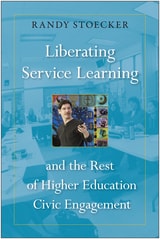
Liberating Service Learning and the Rest of Higher Education Civic Engagement
Randy Stoecker
Temple University Press, 2016
Randy Stoecker has been “practicing” forms of community-engaged scholarship, including service learning, for thirty years now, and he readily admits, “Practice does not make perfect.” In his highly personal critique, Liberating Service Learning and the Rest of Higher Education Civic Engagement, the author worries about the contradictions, unrealized potential, and unrecognized urgency of the causes as well as the risks and rewards of this work.
Here, Stoecker questions the prioritization and theoretical/philosophical underpinnings of the core concepts of service learning: 1. learning, 2. service, 3. community, and 4. change. By “liberating” service learning, he suggests reversing the prioritization of the concepts, starting with change, then community, then service, and then learning. In doing so, he clarifies the benefits and purpose of this work, arguing that it will create greater pedagogical and community impact.
Liberating Service Learning and the Rest of Higher Education Civic Engagement challenges—and hopefully will change—our thinking about higher education community engagement.

Library Service And Learning
Empowering Students, InspiringTheresa McDevitt
American Library Association, 2018
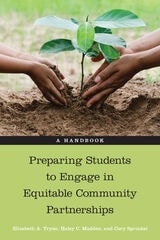
Preparing Students to Engage in Equitable Community Partnerships
A HandbookElizabeth A. Tryon
Temple University Press, 2023
Preparing Students to Engage in Equitable Community Partnerships provides a wealth of valuable resources and activities to help impart ideas of identity, privilege, oppression, bias, and power dynamics to best support students and community in these relationships. Believing that authenticity only comes about in an atmosphere of mutual respect and self-awareness, the authors argue for cultural and intellectual humility.
Each chapter looks at topics and issues through different lenses, complete with underlying theories, and relates those discussions to concrete classroom activities, facilitation strategies, and scholarly frames. In addition, the authors include contributions from a diverse group of practitioners at community colleges, private colleges, historically Black colleges and universities, and minority-serving institutions.
Preparing Students to Engage in Equitable Community Partnerships is a much-needed, comprehensive resource for community-engaged professionals as they prepare students for building relationships when entering a community for learning or research purposes.
Putting the Invisible Hand to Work
Concepts and Models for Service Learning in EconomicsKimMarie McGoldrick and Andrea L. Ziegert, Editors
University of Michigan Press, 2002
The two parts of this volume provide a theoretical basis for service learning and offer lessons gleaned from applying it in the classroom. The theoretical chapters outline the learning theory and models of service learning as they can be applied in economics. Service learning is introduced here as a technique that teaches students to "do economics." Also included are specific models of service learning and an overview of assessment issues. The applications chapters detail various examples of using service to enhance learning. These range from using a single service experience in a class to courses that use service experiences as the focus and context for learning economics. Course topics cover environmental and natural resources, statistics, econometrics and research methods, principles and economic issues, labor, the economics of gender, forensic economics, and development economics. Each application provides details regarding the institutional environment in which it was implemented, type of course, enrollment, and process through which student learning was enhanced. Handouts and abbreviated syllabi are included.
Economics educators have a stake in improving their students' long-term economic literacy. Service learning offers significant benefits beyond those offered by pedagogies traditionally found in economics classrooms and should be considered as a teaching strategy by economics professors everywhere.
Kim Marie McGoldrick is Associate Professor of Economics, University of Richmond. Andrea L. Ziegert is Associate Professor of Economics, Denison University.
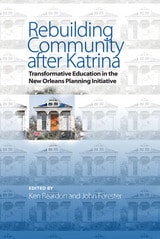
Rebuilding Community after Katrina
Transformative Education in the New Orleans Planning InitiativeKen Reardon
Temple University Press, 2015
Rebuilding Community after Katrina chronicles the innovative and ambitious partnership between Cornell University’s City and Regional Planning department and ACORN Housing, an affiliate of what was the nation’s largest low-income community organization. These unlikely allies came together to begin to rebuild devastated neighborhoods in New Orleans after Hurricane Katrina.
The editors and contributors to this volume allow participants’ voices to show how this partnership integrated careful, technical analysis with aggressive community outreach and organizing. With essays by activists, organizers, community members, and academics on the ground, Rebuilding Community after Katrina presents insights on the challenges involved in changing the way politicians and analysts imagined the future of New Orleans’ Ninth Ward.
What emerges from this complex drama are lessons about community planning, organizational relationships, and team building across multi-cultural lines. The accounts presented in Rebuilding Community after Katrina raise important and sensitive questions about the appropriate roles of outsiders in community-based planning processes.
Regional Perspectives on Learning by Doing
Stories from Engaged Universities around the WorldLorlene Hoyt
Michigan State University Press, 2017

Service Learning
Edited by Joan Schine
University of Chicago Press, 1997
Although a small number of schools and colleges have incorporated service learning in their curricula for many years, only in the last decade has it become the object of extensive study for researchers, scholars, and practitioners, as well as for policymakers and the general public. The Yearbook includes a historical overview, discussion of the roles of state and federal government in establishing and supporting service learning, and descriptions of existing programs at the school and college level. A theoretical framework for service learning is delineated, existing research is described, and additional areas for research and evaluation are suggested.
Service Learning in Interpreter Education
Strategies for Extending Student Involvement in the Deaf CommunitySherry Shaw
Gallaudet University Press, 2013
Institutions of higher learning around the nation have embraced the concept of student civic engagement as part of their curricula, a movement that has spurred administrators in various fields to initiate programs as part of their disciplines. In response, sign language interpreting educators are attempting to devise service-learning programs aimed at Deaf communities. Except for a smattering of journal articles, however, they have had no primary guide for fashioning these programs. Sherry Shaw remedies this in her new book Service Learning in Interpreter Education: Strategies for Extending Student Involvement in the Deaf Community.
Shaw begins by outlining how to extend student involvement beyond the field experience of an internship or practicum and suggests how to overcome student resistance to a course that seems atypical. She introduces the educational strategy behind service-learning, explaining it as a tool for re-centering the Deaf community in interpreter education. She then provides the framework for a service-learning course syllabus, including establishing Deaf community partnerships and how to conduct student assessments.
Service Learning in Interpreter Education concludes with first-person accounts from students and community members who recount their personal and professional experiences with service learning. With this thorough guide, interpreter education programs can develop stand-alone courses or modules within existing coursework.
Service-Learning as a New Paradigm in Higher Education of China
Carol Ma Hok-ka
Michigan State University Press, 2018
The Landscape of Rural Service Learning, and What It Teaches Us All
Randy Stoecker
Michigan State University Press, 2016
The Unheard Voices
Community Organizations and Service LearningRandy Stoecker
Temple University Press, 2009
Service learning has become an institutionalized practice in higher education. Students are sent out to disadvantaged communities to paint, tutor, feed, and help organize communities. But while the students gain from their experiences, the contributors to The Unheard Voices ask, "Does the community?"
This volume explores the impact of service learning on a community, and considers the unequal relationship between the community and the academy. Using eye-opening interviews with community-organization staff members, The Unheard Voices challenges assumptions about the effectiveness of service learning. Chapters offer strong critiques of service learning practices from the lack of adequate training and supervision, to problems of communication and issues of diversity. The book's conclusion offers ways to improve service learning so that future endeavors can be better at meeting the needs of the communities and the students who work in them.
Working en comunidad
Service-Learning and Community Engagement with U.S. Latinas/os/esEdited by Elena Foulis, Stacey Alex, and Glenn Martínez
University of Arizona Press, 2024
The volume tackles three major themes: ethical approaches to working with Latina/o/e communities within language courses and beyond; preparing Latina/o/e students for working with their own communities in different environments; and ensuring equitable practices and building relationships that are mutually beneficial for students and community members. The editors forward two central arguments: (1) Equitable community engagement in higher education is a reflective and reciprocal process that develops empathy and personal and professional growth in students; and (2) service-learning is most transformative when it explicitly guides students and the community to build cultural humility and recognize Latina/o/e experiences and agency as foundational to the learning process.
Many of the contributors and editors are Latina/o/e-identified scholars, practitioners, and researchers, who lend a rich body of experience and a personal dedication to this work. They present distinct approaches and geographies, as well as range of institutions, to offer a wide scope of engaged work that builds on the concept of comunidad to advance a critical new conceptual framework of equitable education and racial justice.
Contributors
Stacey Alex
Elena Foulis
Christina García
Catherine Komisaruk
Kelly Lowther Pereira
Glenn Martínez
María Luisa Parra-Velasco