Results by title
8 books match the query 'Sex discrimination in higher education'

Conquering Heroines
How Women Fought Sex Bias at Michigan and Paved the Way for Title IXSara Fitzgerald
University of Michigan Press, 2020
Galvanized by their shared experiences with sex discrimination, the Ann Arbor women organized a group called FOCUS on Equal Employment for Women, led by activist Jean Ledwith King. Working with Bernice Sandler of the Women’s Equity Action League, they developed a strategy to unleash the power of another powerful institution—the federal government—to demand change at U-M and, they hoped, across the world of higher education. Prompted by a complaint filed by FOCUS, the U.S. Department of Health, Education, and Welfare soon documented egregious examples of discrimination in Michigan’s practices toward women and threatened to withhold millions of dollars in contracts unless the school adopted remedies. Among the hundreds of similar complaints filed against U.S. colleges in 1970–1971, the one brought by the Michigan women achieved the breakthrough that provided the historic template for settlements with other institutions.
Drawing on oral histories from archives as well as new interviews with living participants, Conquering Heroines chronicles this pivotal period in the histories of the University of Michigan and the women’s movement. An incredible story of grassroots activism and courageous women, the book highlights the kind of relentless effort that has helped make inclusivity an ongoing goal at U-M.

Do Babies Matter?
Gender and Family in the Ivory TowerMason, Mary Ann
Rutgers University Press, 2013
Do Babies Matter? is the first comprehensive examination of the relationship between family formation and the academic careers of men and women. The book begins with graduate students and postdoctoral fellows, moves on to early and mid-career years, and ends with retirement. Individual chapters examine graduate school, how recent PhD recipients get into the academic game, the tenure process, and life after tenure. The authors explore the family sacrifices women often have to make to get ahead in academia and consider how gender and family interact to affect promotion to full professor, salaries, and retirement. Concrete strategies are suggested for transforming the university into a family-friendly environment at every career stage.
The book draws on over a decade of research using unprecedented data resources, including the Survey of Doctorate Recipients, a nationally representative panel survey of PhDs in America, and multiple surveys of faculty and graduate students at the ten-campus University of California system..
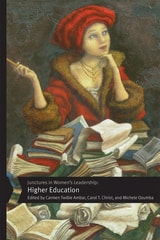
Junctures in Women's Leadership
Higher EducationCarmen Twillie Ambar
Rutgers University Press, 2020
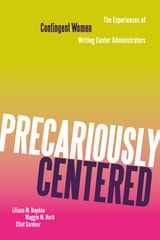
Precariously Centered
The Experiences of Contingent Women Writing Center AdministratorsLiliana M. Naydan
Utah State University Press, 2026
Precariously Centered confronts the troubling intersection of gender and contingency in administrative writing center work—an intersection that has haunted writing centers for decades. Featuring findings from a groundbreaking qualitative study of a diverse group of contingent women writing center administrators, Liliana M. Naydan, Maggie M. Herb, and Clint Gardner demonstrate that gender and its intersections have personal, professional, disciplinary, and pedagogical consequences in writing centers.
This report on interview-based qualitative research documents the experiences of sixteen writing center administrators—how their working lives are often complicated by the intersection of gender, contingency, and other identities. The authors address precarity, identity-based discrimination, extensive and invisible emotional labor, limited resources, lack of institutional support, and barriers to promotion. The words of these administrators come into conversation with scholarship on identity, feminist theory, and the current labor crisis in higher education and reveal challenges ranging from a dearth of resources to discrimination. Their words also reveal dire disciplinary and pedagogical consequences for our institutions and higher education.
Amid increasingly distressing labor conditions in the early twenty-first century, Precariously Centered addresses how writing center professionals—and all academics—can better address contingency, the corporatization of higher education, and the patriarchy. It emphasizes the value of discourse about working conditions, intersectional solidarity, and organizing for labor justice.
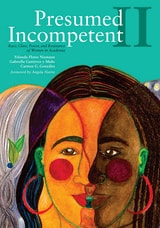
Presumed Incompetent II
Race, Class, Power, and Resistance of Women in AcademiaYolanda Flores Niemann
Utah State University Press, 2020
The courageous and inspiring personal narratives and empirical studies in Presumed Incompetent II: Race, Class, Power, and Resistance of Women in Academia name formidable obstacles and systemic biases that all women faculty—from diverse intersectional and transnational identities and from tenure track, terminal contract, and administrative positions—encounter in their higher education careers. They provide practical, specific, and insightful guidance to fight back, prevail, and thrive in challenging work environments. This new volume comes at a crucial historical moment as the United States grapples with a resurgence of white supremacy and misogyny at the forefront of our social and political dialogues that continue to permeate the academic world.
Contributors: Marcia Allen Owens, Sarah Amira de la Garza, Sahar Aziz, Jacquelyn Bridgeman, Jamiella Brooks, Lolita Buckner Inniss, Kim Case, Donna Castaneda, Julia Chang, Meredith Clark, Meera Deo, Penelope Espinoza, Yvette Flores, Lynn Fujiwara, Jennifer Gomez, Angela Harris, Dorothy Hines, Rachelle Joplin, Jessica Lavariega Monforti, Cynthia Lee, Yessenia Manzo, Melissa Michelson, Susie E. Nam, Yolanda Flores Niemann, Jodi O’Brien, Amelia Ortega, Laura Padilla, Grace Park, Stacey Patton, Desdamona Rios, Melissa Michal Slocum, Nellie Tran, Rachel Tudor, Pamela Tywman Hoff, Adrien Wing, Jemimah Li Young
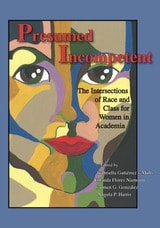
Presumed Incompetent
The Intersections of Race and Class for Women in Academiaedited by Gabriella Gutiérrez y Muhs, Yolanda Flores Niemann, Carmen G. González, and Angela P. Harris
Utah State University Press, 2012
Presumed Incompetent is a pathbreaking account of the intersecting roles of race, gender, and class in the working lives of women faculty of color. Through personal narratives and qualitative empirical studies, more than 40 authors expose the daunting challenges faced by academic women of color as they navigate the often hostile terrain of higher education, including hiring, promotion, tenure, and relations with students, colleagues, and administrators. The narratives are filled with wit, wisdom, and concrete recommendations, and provide a window into the struggles of professional women in a racially stratified but increasingly multicultural America.
Response to Reform
Composition and the Professionalization of TeachingMargaret J. Marshall
Southern Illinois University Press, 2003
Response to Reform: Composition and the Professionalization of Teaching critiques the politics of labor and gender biases inherent in the composition workplace that prevent literacy teachers from attaining professional status and respect. Scrutinizing the relationship between scholarship and teaching, Margaret J. Marshall calls for a reconceptualization of what it means to prepare for and enter the field of composition instruction.
Interrogating the approach the education system takes to certify teachers without actually “professionalizing” their careers, Marshall contends that these programs rely on outdated rhetorics of labor that only widen the gap between teaching and other professional jobs. Such attempts to re-educate literacy teachers exploit and marginalize their work, and thus prevent them from claiming the status of academic professionals. In providing an overview of the history of and language used to literacy instruction, she also points out that while women are overrepresented in composition instruction, they are underrepresented in tenure track and administrative positions.
To correct and combat these inequities, Marshall advocates an alternate alignment of power structures and rhetorical choices. In a wide-ranging survey that sheds new light on the composition workplace as well as higher education at large, Response to Reform: Composition and the Professionalization of Teaching boldly asks us to do away with the reductive language we inherit from the past that characterize teaching and professionalization, as well as our customary responses to public criticism of education. The result is a new articulation of composition as a meritorious profession.

Writing with Fire
The Cowboy Suit Tragedy and the Course of a LifeBarbara Young Welke
University of Chicago Press, 2026
A cultural and legal history intertwined with a deeply emotional meditation on the course of life, memory, and the documents that define us.
During the 1940s and 1950s, an untold number of American children suffered devastating injuries when the fur-like fabric on the chaps of their Gene Autry–branded cowboy playsuits exploded into flame. Barbara Young Welke was researching this history when her teenage daughter unexpectedly died.
The shock of Welke’s loss transformed her understanding of the children and their families. Her experience also led her to question the norms of scholarship and of writing. Historians are trained to separate the personal from the intellectual, to be suspicious of emotion. These and other norms are embedded in and reinforced by the calling card of academics, the curriculum vitae. Welke wondered how that cold document—with its literal meaning, “the course of life”—had become a form that excludes so much of what gives life meaning. What impact did that have on what we know, how we know it, and how we understand ourselves? Similarly, Welke wondered, what might we see if we looked at the history of the cowboy suit tragedy as more than a matter of lawsuits brought by grieving families? Here, Welke traces the making, marketing, and selling of the cowboy suits; the lengths the defendants went to avoid and limit liability; and the meaning of the injuries, deaths, and legal settlements in the course of these children’s and families’ lives.
Writing with Fire interweaves the histories of the cowboy suit tragedy and the curriculum vitae. Grounded in archival and legal research, oral histories, and letters Welke wrote her daughter following her death, Welke offers an inimitable examination of trauma, law, autobiography, and identity. The result is revelatory and unforgettable: a provocative historical reflection on life and death, depression and war, markets and families, law, power, and precarity in modern America.