Results by title
17 books match the query 'Sexism'

American Infanticide
Sexism, Science, and the Politics of SympathyClara S. Lewis
Rutgers University Press, 2025
Emboldened by fear, the sorority sisters investigated. In the driveway next to the kitchen door, they found Emile’s newborn baby girl dead inside a garbage bag. Emile’s crime seemed senseless and left her family and friends with an aching question: what happened?
American Infanticide situates Emile's tragic act in a long intellectual, social, and legal history, uncovering disturbing missing chapters in our national history that undercut myths that have shaped public reactions to so-called monster moms and dumpster babies since the colonial era. Ultimately, the book uncovers how bias and inconsistency dictate how women accused of infant homicide are perceived and punished and sheds new light on how and why our legal responses to infanticide are so deeply misguided.

Deregulating Desire
Flight Attendant Activism, Family Politics, and Workplace JusticeRyan Patrick Murphy
Temple University Press, 2016
In 1975, National Airlines was shut down for 127 days when flight attendants went on strike to protest long hours and low pay. Activists at National and many other U.S. airlines sought to win political power and material resources for people who live beyond the boundary of the traditional family. In Deregulating Desire, Ryan Patrick Murphy, a former flight attendant himself, chronicles the efforts of single women, unmarried parents, lesbians and gay men, as well as same-sex couples to make the airline industry a crucible for social change in the decades after 1970.
Murphy situates the flight attendant union movement in the history of debates about family and work. Each chapter offers an economic and a cultural analysis to show how the workplace has been the primary venue to enact feminist and LGBTQ politics.
From the political economic consequences of activism to the dynamics that facilitated the rise of what Murphy calls the “family values economy” to the Airline Deregulation Act of 1978, Deregulating Desire emphasizes the enduring importance of social justice for flight attendants in the twenty-first century.
Gender Power, Leadership, and Governance
Georgia Duerst-Lahti and Rita Mae Kelly, Editors
University of Michigan Press, 1995
Gender and the Civil Rights Movement
Ling, Peter J
Rutgers University Press, 2004
Just Who Loses?
Discrimination in the United States, Volume 2Samuel Lucas
Temple University Press, 2013
In Just Who Loses? Samuel Roundfield Lucas continues his penetrating and comprehensive assessment of sex and race discrimination in the United States that he began in Theorizing Discrimination in an Era of Contested Prejudice.
This new volume demonstrates that the idea of discrimination being a zero-sum game is a fallacy. If discrimination costs women, men do not necessarily reap the gains. Likewise, if discrimination costs blacks, non-blacks do not reap the gains. Lucas examines the legal adjudication of discrimination, as well as wider public debates about policy on the issue, to prove how discrimination actually operates.
He uses analytic methods to show that across the socioeconomic lifecycle—including special education placement, unemployment, occupational attainment, earnings, poverty, and even mortality—both targets and non-targets of discrimination “lose.”
In Just Who Loses? Lucas proposes the construction of a broad-based coalition to combat the pervasive discrimination that affects social relations and law in the United States.
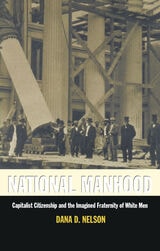
National Manhood
Capitalist Citizenship and the Imagined Fraternity of White MenDana D. Nelson
Duke University Press, 1998
Using political, scientific, medical, personal, and literary texts ranging from the Federalist papers to the ethnographic work associated with the Lewis and Clark expedition to the medical lectures of early gynecologists, Nelson explores the referential power of white manhood, how and under what conditions it came to stand for the nation, and how it came to be a fraternal articulation of a representative and civic identity in the United States. In examining early exemplary models of national manhood and by tracing its cultural generalization, National Manhood reveals not only how an impossible ideal has helped to form racist and sexist practices, but also how this ideal has simultaneously privileged and oppressed white men, who, in measuring themselves against it, are able to disavow their part in those oppressions.
Historically broad and theoretically informed, National Manhood reaches across disciplines to engage those studying early national culture, race and gender issues, and American history, literature, and culture.
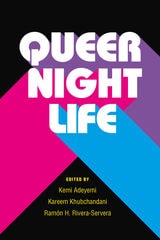
Queer Nightlife
Kemi Adeyemi, Kareem Khubchandani, Ramón H. Rivera-Servera, Editors
University of Michigan Press, 2021
The mass shooting at a queer Latin Night in Orlando in July 2016 sparked a public conversation about access to pleasure and selfhood within conditions of colonization, violence, and negation. Queer Nightlife joins this conversation by centering queer and trans people of color who apprehend the risky medium of the night to explore, know, and stage their bodies, genders, and sexualities in the face of systemic and social negation. The book focuses on house parties, nightclubs, and bars that offer improvisatory conditions and possibilities for “stranger intimacies,” and that privilege music, dance, and sexual/gender expressions. Queer Nightlife extends the breadth of research on “everynight life” through twenty-five essays and interviews by leading scholars and artists. The book’s four sections move temporally from preparing for the night (how do DJs source their sounds, what does it take to travel there, who promotes nightlife, what do people wear?); to the socialities of nightclubs (how are social dance practices introduced and taught, how is the price for sex negotiated, what styles do people adopt to feel and present as desirable?); to the staging and spectacle of the night (how do drag artists confound and celebrate gender, how are spaces designed to create the sensation of spectacularity, whose bodies become a spectacle already?); and finally, how the night continues beyond the club and after sunrise (what kinds of intimacies and gestures remain, how do we go back to the club after Orlando?).

Race and Sex in Latin America
Peter Wade
Pluto Press, 2009
The intersection of race and sex in Latin America is a subject touched upon by many disciplines but this is the first book to deal solely with these issues.
Interracial sexual relations are often a key mythic basis for Latin American national identities, but the importance of this has been underexplored. Peter Wade provides a pioneering overview of the growing literature on race and sex in the region, covering historical aspects and contemporary debates. He includes both black and indigenous people in the frame, as well as mixed and white people, avoiding the implication that "race" means "black-white" relations.
Challenging but accessible, this book will appeal across the humanities and social sciences, particularly to students of anthropology, gender studies, history and Latin American studies.
Sex Exposed
Sexuality and the Pornography DebateMcIntosh, Mary
Rutgers University Press, 1993
This provocative collection, by well-known feminists, surveys these arguments, and in particular asks why recent feminist debates about sexuality keep reducing to questions of pornography.
Sex Exposed
Sexuality and the Pornography DebateMcIntosh, Mary
Rutgers University Press, 1993
Over the past twenty years debates about pornography have raged within feminism and beyond. Throughout the 1970s feminists increasingly addressed the problem of men's sexual violence against women, and many women reduced the politics of men's power over women to questions about sexuality. By the 1980s these questions had become more and more focused on the issue of pornography––now a metaphor for the menace of male power. Collapsing feminist politics into sexuality and sexuality into pornography has not only caused some of the deepest splits between feminists, but made it harder to think clearly about either sexuality or pornography––indeed, about feminist politics more generally.
This provocative collection, by well-known feminists on both sides of the Atlantic, surveys these arguments, and in particular asks why recent feminist debates about sexuality keep reducing to questions of pornography. The authors open up the debate by looking at such topics as the improbable alliance between the right and pro-censorship feminists, the displacement of heterosexual desire and its discontents onto pornography, Andrea Dworkin's novel Mercy, psychoanalytic reflections on fantasy, censorship in relation to AIDS work, the new lesbian and bisexual pornography, the controversy over Robert Mapplethorpe's supposed racism in his photos of black nudes, Mae West as sexual icon and her brushes with the law, and the female nude in "high" art.
In addition to the editors, the contributors are Elizabeth Cowie, Harriett Gilbert, Robin Gorna, Marybeth Hamilton, Loretta Loach, Anne McClintock, Kobena Mercer, Jane Mills, Mandy Merck, Lynda Nead, Gillian Rodgerson, Carol Smart, Carole S. Vance, Linda Williams, and Elizabeth Wilson.
Teaching "Race" with a Gendered Edge
Brigitte Hipfl
Central European University Press, 2012
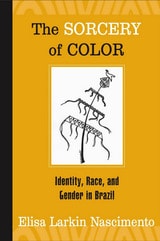
The Sorcery of Color
Identity, Race, and Gender in BrazilElisa Larkin Nascimento
Temple University Press, 2009
Originally published in 2003 in Portuguese, The Sorcery of Color argues that there are longstanding and deeply-rooted relationships between racial and gender inequalities in Brazil. In this pioneering book, Elisa Larkin Nascimento examines the social and cultural movements that have attempted, since the early twentieth century, to challenge and eradicate these conjoined inequalities.
The book's title describes the social sleight-of-hand that disguises the realities of Brazilian racial inequity. According to Nascimento, anyone who speaks of racism—or merely refers to another person as black—traditionally is seen as racist. The only acceptably non-racist attitude is silence. At the same time, Afro-Brazilian culture and history have been so overshadowed by the idea of a general "Brazilian identity" that to call attention to them is also to risk being labeled racist.
Incorporating leading international scholarship on Pan Africanism and Afrocentric philosophy with the writing of Brazilian scholars, Nascimento presents a compelling feminist argument against the prevailing policy that denies the importance of race in favor of a purposefully vague concept of ethnicity confused with color.
The Town of N
Leonid Dobychin
Northwestern University Press, 1998
The Women of Katrina
How Gender, Race, and Class Matter in an American DisasterEmmanuel David
Vanderbilt University Press, 2012
Theorizing Discrimination in an Era of Contested Prejudice
Discrimination in the United StatesSamuel Roundfield Lucas
Temple University Press, 2009
Despite several decades of attention, there is still no consensus on the effects of racial or sexual discrimination in the United States. In this landmark work, the well-known sociologist Samuel Lucas shows how discrimination is not simply an action that one person performs in relation to another individual, but something far more insidious: a pervasive dynamic that permeates the environment in which we live and work.
Challenging existing literature on the subject, Lucas makes a clear distinction between prejudice and discrimination. He maintains that when an era of “condoned exploitation” ended, the era of “contested prejudice,” as he terms it, began. He argues that the great strides made in the 1950s and 1960s repudiated prejudice, but not discrimination. Drawing on critical race theory, feminist theory, and a critique of dominant perspectives in the social sciences and law, Lucas offers a new understanding of racial and sexual discrimination that can guide our actions and laws into a more just future.
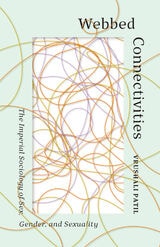
Webbed Connectivities
The Imperial Sociology of Sex, Gender, and SexualityVrushali Patil
University of Minnesota Press, 2022
Constructing a new approach for centering empire in productions of racialized, gendered, and sexualized difference
One of the oldest, most persistent issues in gender and sexuality studies is the dominance of white, northern theorizing and its consequences for what we know about sex, gender, and sexuality. There is an ongoing neglect of the significance of histories of empire and coloniality, particularly in U.S. sociology, where the United States and its theoretical productions are routinely sanitized of such histories. In Webbed Connectivities, Vrushali Patil offers a global historical sociology that reembeds the United States within histories of empire, situating the emergence of northern and U.S.-based concepts and frameworks squarely within these histories.
Webbed Connectivities intercepts the political economy of knowledge production within the social sciences to argue for the work of centering the role of imperial hierarchies in knowledge production and circulation. Patil develops a new approach—webbed connectivities—which tracks imperial processes and impacts across borders, shifting from an emphasis on particular experiences and identities to the constitution and creation of the categories themselves.
A sociologist of feminist thought and gender and sexuality studies, Patil explores the theoretical spaces that spotlighting imperial hierarchies within knowledge production might open, including making productive and essential connections across sites of the global south and north.
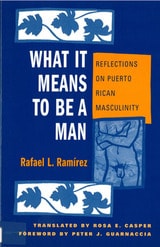
What It Means To Be A Man
Reflections on Puerto Rican MasculinityRafael L. Ramirez
Rutgers University Press, 1999
What It Means to Be a Man begins with a discussion of machismo set in the context of the social construction of masculinity. Ramírez presents his interpretation of what it means to be a Puerto Rican man, discussing the attributes and demands of masculinity, and pointing out the ways in which strength, competition, and sexuality are joined with power and pleasure. He examines the erotic relationships between men as part of the expressions of masculinity, and analyzes how the homosexual experience reproduces the dominant masculine ideology. Finally, Ramírez draws on the literature of the recent men's movements, offering Puerto Rican men the possibility of constructing a new masculinity, liberated from power games, to provide them with a chance to not only be better understood by others, but also to better understand themselves and their place in society.