Results by title
22 books match the query 'Sexual ethics'

Black, Quare, and Then to Where
Theories of Justice and Black Sexual Ethicsjennifer susanne leath
Duke University Press, 2023
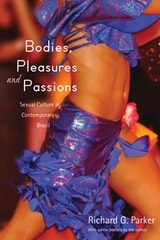
Bodies, Pleasures, and Passions
Sexual Culture in Contemporary Brazil, Second EditionRichard G. Parker
Vanderbilt University Press, 2009
Originally published in the early 1990s, Bodies, Pleasures, and Passions quickly became a classic ethnographic study of the social, cultural and historical construction of sexuality and sexual diversity. Drawing on extensive field research and interviews, together with the analysis of historical and literary texts, anthropologist Richard Parker mapped out the multiple cultural systems that structure gender, sexuality, and erotic practices in Brazil, and helped to open up a new wave of social science research on sexuality.
Using ethnographic methods focusing on sexual meanings as an alternative to traditional surveys of sexual behavior, Parker argues that sexual life can only be fully understood through an analysis of the cultural logics that shape experience. Drawing on the tradition of interpretive anthropology, he focuses on the diverse sexual scripts that have been articulated in Brazilian culture and examines the often contradictory ways in which these scripts shape the sexual experience of different individuals. He highlights the sexual socialization of children and young people, and the changing sexual realities of adults living in a rapidly changing world. He underlines the ways in which complex cultural forms such as carnaval can be understood as stories that Brazilians tell themselves about themselves and about the meaning of sexuality in contemporary Brazilian life.
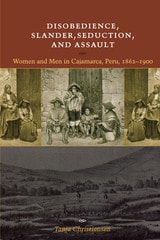
Disobedience, Slander, Seduction, and Assault
Women and Men in Cajamarca, Peru, 1862-1900By Tanja Christiansen
University of Texas Press, 2004
Though the law and courts of nineteenth-century Peru were institutions created by and for the ruling elite, women of all classes used the system to negotiate the complexities of property rights, childrearing, and marriage, and often to defend their very definitions of honor. Drawing on the trial transcripts of Cajamarca, a northern Peruvian province, from more than a century ago, this book shares eye-opening details about life among this community, in which reputation could determine a woman's chances of survival.
Exploring the processes of courtship, seduction, and familial duties revealed in these court records, historian Tanja Christiansen has unearthed a compelling panorama that includes marital strife, slander, disobedience, street brawls, and spousal abuse alongside documents that give evidence of affection and devotion. Her research also yields much new information about the protocols for conflict and cooperation among nineteenth-century Peruvian women from all social strata, and the prevalence of informal unions in an economy driven in large part by migratory male labor. Reviving a little-known aspect of Latin American history, Christiansen's book simultaneously brings to light an important microcosm of women's history during the nineteenth century.
God, Science, Sex, Gender
An Interdisciplinary Approach to Christian EthicsEdited by Patricia Beattie Jung and Aana Marie Vigen with John Anderson
University of Illinois Press, 2010
God, Sex, Science, Gender: An Interdisciplinary Approach to Christian Ethics is a timely, wide-ranging attempt to rescue dialogues on human sexuality, sexual diversity, and gender from insular exchanges based primarily on biblical scholarship and denominational ideology. Too often, dialogues on sexuality and gender devolve into the repetition of party lines and defensive postures, without considering the interdisciplinary body of scholarly research on this complex subject. This volume expands beyond the usual parameters, opening the discussion to scholars in the humanities, social sciences, and natural sciences to foster the development of Christian sexual ethics for contemporary times.
Essays by prominent and emerging scholars in the fields of anthropology, sociology, psychology, philosophy, literary studies, theology, and ethics reveal how faith and reason can illuminate our understanding of human sexual and gender diversity. Focusing on the intersection of theology and science and incorporating feminist theory, God, Science, Sex, Gender is a much-needed call for Christian ethicists to map the origins and full range of human sexual experience and gender identity. Essays delve into why human sexuality and gender can be so controversial in Christian contexts, investigate the complexity of sexuality in humans and other species, and reveal the implications of diversity for Christian moral theology.
Contributors are Joel Brown, James Calcagno, Francis J. Catania, Pamela L. Caughie, Robin Colburn, Robert Di Vito, Terry Grande, Frank Fennell, Anne E. Figert, Patricia Beattie Jung, Fred Kniss, John McCarthy, Jon Nilson, Stephen J. Pope, Susan A. Ross, Joan Roughgarden, and Aana Marie Vigen.

Heterosyncrasies
Female Sexuality When Normal Wasn’tKarma Lochrie
University of Minnesota Press, 2005

In Defense of Honor
Sexual Morality, Modernity, and Nation in Early-Twentieth-Century BrazilSueann Caulfield
Duke University Press, 2000
While some Brazilian elites used the issue of sexual purity to boast of their country’s moral superiority, others claimed that the veneration of such concepts as virginity actually frustrated efforts at modernization. Moreover, although individuals of all social classes invoked values they considered “traditional,” such as the confinement of women’s sexuality within marriage, these values were at odds with social practices—such as premarital sex, cohabitation, divorce, and female-headed households—that had been common throughout Brazil’s history. The persistence of these practices, together with post-World War I changes in both official and popular moral ideals, presented formidable obstacles to the Estado Novo’s renewed drive to define and enforce public morality and private family values in the late 1930s.
With sophisticated theoretical underpinnings, In Defense of Honor is written in a clear and lively manner, making it accessible to students and scholars in a variety of disciplines, including Brazilian and Latin American studies, gender studies, and legal history.
Nationalism and Sexuality
Middle-Class Morality and Sexual Norms in Modern EuropeGeorge L. Mosse, With a critical introduction by Mary Louise Roberts
University of Wisconsin Press, 2020

Public Affairs
Politics in the Age of Sex ScandalsPaul Apostolidis and Juliet A. Williams, eds.
Duke University Press, 2004
The essays in Public Affairs reflect on a number of sex scandals while emphasizing the Clinton/Lewinsky affair, certainly the most avidly followed and momentous sex scandal in American political history. Leading scholars situate contemporary public affairs in the context not only of earlier sex scandals in American politics (such as Thomas Jefferson’s and Sally Hemings’s affair), but also of more purely political scandals (including Teapot Dome and Watergate) and sex scandals centered around public figures other than politicians (such as the actor Hugh Grant and the minister Jimmy Swaggart). Some essays consider the Clinton affair in light of feminist and anti-racist politics, while others discuss the dynamics of scandals as major media events. By charting a critical path through the muck of scandal rather than around it, Public Affairs illuminates why sex scandals have become such a prominent feature of American public life.
Contributors. Paul Apostolidis, Jodi Dean, Joshua Gamson, Theodore J. Lowi, Joshua D. Rothman, George Shulman, Anna Marie Smith, Jeremy Varon, Juliet A. Williams
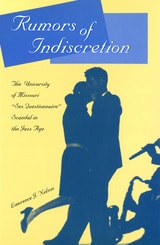
Rumors of Indiscretion
The University of Missouri's "Sex Questionnaire" Scandal in the Jazz AgeLawrence J. Nelson
University of Missouri Press, 2003
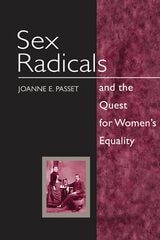
Sex Radicals and the Quest for Women's Equality
Joanne E. Passet
University of Illinois Press, 2003
In charting the growth of the sex radical movement, Joanne E. Passet draws on a host of documents from the period -- letters, periodicals, lectures, and pamphlets -- to establish a strong link between the rise of print culture and the freedom of citizens, especially women, to build geographically dispersed communities of ideas. She also advances models of sexuality that challenge the restrictive mores of society at large and shows that the majority of correspondents who participated in the sex radical movement resided in the Midwest and the Great Plains states, where ideas of individual freedom and sovereignty resonated particularly strongly.
Passet vividly demonstrates how this sex radical movement laid the foundations upon which later generations of women’s rights crusaders and feminists would build, placing discussions of sex and sexuality squarely in the public arena.
Sex and Virtue
An Introduction to Sexual Ethics (Catholic Moral Thought, Volume 2)John S. Grabowski
Catholic University of America Press, 2003
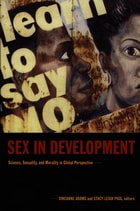
Sex in Development
Science, Sexuality, and Morality in Global PerspectiveVincanne Adams and Stacy Leigh Pigg, eds.
Duke University Press, 2005
Sex in Development combines the cultural analysis of sexuality, critiques of global development, and science and technology studies. Whether considering the resistance encountered by representatives of an American pharmaceutical company attempting to teach Russian doctors a “value free” way to offer patients birth control or the tension between Tibetan Buddhist ideas of fertility and the modernization schemes of the Chinese government, these essays show that attempts to make sex a universal moral object to be managed and controlled leave a host of moral ambiguities in their wake as they are engaged, resisted, and reinvented in different ways throughout the world.
Contributors. Vincanne Adams, Leslie Butt, Lawrence Cohen, Heather Dell, Vinh-Kim Nguyen, Shanti Parikh, Heather Paxson, Stacy Leigh Pigg, Michele Rivkin-Fish

Sex in Middlesex
Popular Mores in a Massachusetts County, 1649-1699Roger Thompson
University of Massachusetts Press, 1986
Drawing on an extraordinary wealth of court records from Middlesex County of the Colony and Province of Massachusetts Bay, Sex in Middlesex offers a richly revisionist account of social and moral life in seventeenth-century New England. Social historian Roger Thompson brings to life the forgotten men and women of colonial Massachusetts to challenge some of the most entrenched assumptions about Puritan society. Examining cases of fornication, adultery, breach of promise, premarital pregnancy, and sexual deviance recorded between 1649 and 1699, Thompson argues that the Puritan social system was far less rigid, and the relations between the sexes far less coercively regulated, than the dominant historiographical tradition, shaped by scholars such as Perry Miller and Lawrence Stone, has suggested.
Rather than a community defined by patriarchal tyranny and punitive moral control, Thompson discovers in the Middlesex records a society characterized by a striking degree of tolerance, mutual regard, and practical common sense, animated by a genuinely popular Puritan piety. The goal of the courts was not punishment and exclusion, but confession, reform, and the reintegration of offenders into the community. Structured with methodological rigor and written with narrative verve, Sex in Middlesex is at once a work of quantitative social history and a gallery of vivid individual portraits.
Sexting Panic
Rethinking Criminalization, Privacy, and ConsentAmy Adele Hasinoff
University of Illinois Press, 2015

Swinging Single
Representing Sexuality in the 1960sHilary Radner
University of Minnesota Press, 1999
The Heart of Whiteness
Normal Sexuality and Race in America, 1880–1940Julian B. Carter
Duke University Press, 2007
Carter builds her intricate argument from detailed readings of an array of popular texts, focusing on how sex education for children and marital advice for adults provided significant venues for the dissemination of the new ideal of normality. She concludes that because its overt concerns were love, marriage, and babies, normality discourse facilitated white evasiveness about racial inequality. The ostensible focus of “normality” on matters of sexuality provided a superficially race-neutral conceptual structure that whites could and did use to evade engagement with the unequal relations of power that continue to shape American life today.
The Law of Love
From Autonomy to CommunionStephen F. Brett, SSJ
University of Scranton Press, 2010
With an interdisciplinary combination of philosophy, theology, and family law, The Law of Love explores the impact of secular conceptions of autonomy on sexuality and family. Drawing from the thought of Aristotle, Cicero, Augustine, Aquinas, and the modern theologian Servais Pinckaers, Stephen F. Brett argues that the divorce of freedom from virtue has caused cultural relativism, and that a potent and healthy mix of temperance, chastity, and modesty is the antidote. Styled accessibly and quite cleverly with a broader audience in mind, The Law of Love will appeal to intellectuals of all faiths who are interested in facing the ambiguities and problems of contemporary life in a secularized society.
The Sleep of Reason
Erotic Experience and Sexual Ethics in Ancient Greece and RomeEdited by Martha C. Nussbaum and Juha Sihvola
University of Chicago Press, 2002
The Sleep of Reason brings together an international group of philosophers, philologists, literary critics, and historians to consider two questions normally kept separate: how is erotic experience understood in classical texts of various kinds, and what ethical judgments and philosophical arguments are made about sex? From same-sex desire to conjugal love, and from Plato and Aristotle to the Roman Stoic Musonius Rufus, the contributors demonstrate the complexity and diversity of classical sexuality. They also show that the ethics of eros, in both Greece and Rome, shared a number of commonalities: a focus not only on self-mastery, but also on reciprocity; a concern among men not just for penetration and display of their power, but also for being gentle and kind, and for being loved for themselves; and that women and even younger men felt not only gratitude and acceptance, but also joy and sexual desire.
Contributors:
* Eva Cantarella
* Kenneth Dover
* Chris Faraone
* Simon Goldhill
* Stephen Halliwell
* David M. Halperin
* J. Samuel Houser
* Maarit Kaimio
* David Konstan
* David Leitao
* Martha C. Nussbaum
* A. W. Price
* Juha Sihvola
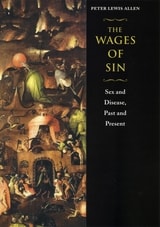
The Wages of Sin
Sex and Disease, Past and PresentPeter Lewis Allen
University of Chicago Press, 2000
Throughout history, Western society has often viewed sickness as a punishment for sin. It has failed to prevent and cure diseases—especially diseases tied to sex—that were seen as the retribution of a wrathful God. The Wages of Sin, the remarkable history of these diseases, shows how society's views of particular afflictions often heightened the suffering of the sick and substituted condemnation for care. Peter Allen moves from the medieval diseases of lovesickness and leprosy through syphilis and bubonic plague, described by one writer as "a broom in the hands of the Almighty, with which He sweepeth the most nasty and uncomely corners of the universe." More recently, medical and social responses to masturbation in the eighteenth and nineteenth centuries and AIDS in the twentieth round out Allen's timely and erudite study of the intersection of private morality and public health. The Wages of Sin tells the fascinating story of how ancient views on sex and sin have shaped, and continue to shape, religious life, medical practice, and private habits.

Transformed in Christ
John S. Grabowski
Catholic University of America Press, 2017
Undoing Monogamy
The Politics of Science and the Possibilities of BiologyAngela Willey
Duke University Press, 2016
Unsafe Words
Queering Consent in the #MeToo EraShantel Gabrieal Buggs
Rutgers University Press, 2023
Telling a queerer side of the #MeToo story, Unsafe Words dares to challenge dogmatic assumptions about sex and consent while developing tools and language to promote more ethical and more pleasurable sex for everyone.