Results by title
29 books match the query 'Shamanism'
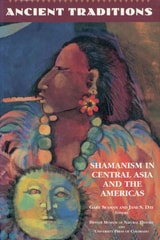
Ancient Traditions
Shamanism in Central Asia and the AmericasGary Seaman
University Press of Colorado, 1994
Over the centuries, shamanism has endured as an abiding topic of interest not only because of a human concern with the past but also because of a common yearning to acknowledge life lived in closer symbolic relationship to the earth. For readers interested in indigenous cultures and religions, this collection of essays clarifies much of the New Age speculation on universals in shamanism, offering solid research on specific ethnic and historical expressions.
In Ancient Traditions, prominent scholars in ethnography, anthropology, and the study of world religions bring to bear their diverse perspectives on this singularly fascinating topic. Contributors include Vladimir N. Basilov, Robert S. Carlsen, James A. Clifton, Jane S. Day, Vladimir Diachenko, Vera P. Diakonova, Peter T. Furst, Larisa R. Pavlinskaya, Martin Prechtel, Gary Seaman, Omer C. Stewart, Lawrence E. Sullivan, Robert J. Theodoratus, and Johannes Wilbert. Co-published with the Denver Museum of Nature and Science.
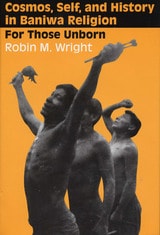
Cosmos, Self, and History in Baniwa Religion
For Those UnbornBy Robin M. Wright
University of Texas Press, 1998
The Baniwa Indians of the Northwest Amazon have engaged in millenarian movements since at least the middle of the nineteenth century. The defining characteristic of these movements is usually a prophecy of the end of this present world and the restoration of the primordial, utopian world of creation. This prophetic message, delivered by powerful shamans, has its roots in Baniwa myths of origin and creation.
In this ethnography of Baniwa religion, Robin M. Wright explores the myths of creation and how they have been embodied in religious movements and social action—particularly in a widespread conversion to evangelical Christianity. He opens with a discussion of cosmogony, cosmology, and shamanism, and then goes on to explain how Baniwa origin myths have played an active role in shaping both personal and community identity and history. He also explores the concepts of death and eschatology and shows how the mythology of destruction and renewal in Baniwa religion has made the Baniwa people receptive to both Catholic and Protestant missionaries.

Dark Shamans
Kanaimà and the Poetics of Violent DeathNeil L. Whitehead
Duke University Press, 2002
Neil L. Whitehead tells of his own involvement with kanaimà—including an attempt to kill him with poison—and relates the personal testimonies of kanaimà shamans, their potential victims, and the victims’ families. He then goes on to discuss the historical emergence of kanaimà, describing how, in the face of successive modern colonizing forces—missionaries, rubber gatherers, miners, and development agencies—the practice has become an assertion of native autonomy. His analysis explores the ways in which kanaimà mediates both national and international impacts on native peoples in the region and considers the significance of kanaimà for current accounts of shamanism and religious belief and for theories of war and violence.
Kanaimà appears here as part of the wider lexicon of rebellious terror and exotic horror—alongside the cannibal, vampire, and zombie—that haunts the western imagination. Dark Shamans broadens discussions of violence and of the representation of primitive savagery by recasting both in the light of current debates on modernity and globalization.
Divination and Healing
Potent VisionEdited by Michael Winkelman and Philip M. Peek
University of Arizona Press, 2004
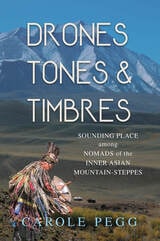
Drones, Tones, and Timbres
Sounding Place among Nomads of the Inner Asian Mountain-SteppesCarole Pegg
University of Illinois Press, 2024
Based on more than twenty years of collaborative research, Carole Pegg’s long-awaited participatory ethnography explores how Indigenous nomadic peoples of Russia’s southern Siberian republics (Altai, Khakassia, Tyva) sound multiphonies of place in a post-Soviet global world. Inspired by the mountain-steppe ecology and pathways of nomadism, soundscapes created in performative ritual events cross political and multiple-world boundaries in a shamanic-animist universe, enabling human and spirit actor interactions in a series of sensuous worlds. As with the “throat-singing” for which Indigenous Altai-Sayan peoples are famous, senses of place involve sonic relations, rootedness, movement, and plurality. Pegg echoes their drone-partials musical and ontological models in an innovative theoretical entwinement. Three strands form the book’s multivocal drone, the partials of which sound in each chapter: ontological sonicality and musicality that enables emplacement and movement; the importance of shamanism-animism--at the core of Indigenous spiritual practices--for personhood and community; and the agency of sonic performances. Sounding place, Pegg demonstrates, is essential to the identities, ways of life, and very senses of being of Indigenous Altai-Sayan peoples.

Encounters with Korean Folk Religion
The Goddesses of Eight Peaks MountainClark W. Sorensen
Rutgers University Press, 2027
Encounters with Korean Folk Religion is an account of forty-five years of engagement with the cult of goddesses on Eight Peaks Mountain in Korea’s western Kangwŏn Province, the shaman who tended to the goddesses there from 1977 to 2015, and the folk religion of the surrounding village of Eight Peaks. Since the 1980s, South Korea has urbanized and the village of Eight Peaks has been transformed from a remote agricultural village into a rafting and ski resort. While communal worship ceremonies have been dying out in most of Korea, they have only grown on Eight Peaks Mountain, which has been a site of worship since at least the 15th century. What was a small-scale local ceremony in 1977 has grown into a large-scale regional celebration attracting shamans and tourists from far and wide. The manuscript delves in a historically and anthropologically innovative way into the social, religious, and historical reasons for this efflorescence.
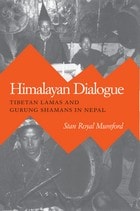
Himalayan Dialogue
Tibetan Lamas & Gurung Shamans In NepalStan Royal Mumford
University of Wisconsin Press, 1989
Here for the first time is a thorough anthropological study of Tibetan lamaism combining textual analysis with richly contextualized ethnographic data. The rites studied are of the Nyingma Tibetan Buddhist tradition. In contrast to the textual analyses that have viewed the culture as a finished entity, here we see an unbounded ritual process with unfinished interpretations.
Mumford’s focus is on the “dialogue” taking place between the lamaist and the shamanic regimes, as a historic development occurring between different cultural layers. The study powerfully demonstrates that interrelationships between subsystems within a given cultural matrix over time are critical to an understanding of religion as a cultural process.
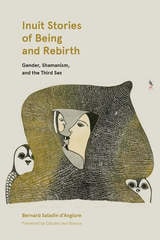
Inuit Stories of Being and Rebirth
Gender, Shamanism, and the Third SexBernard Saladin d' Anglure
University of Manitoba Press, 2018
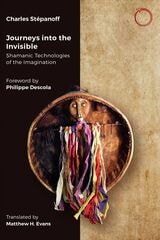
Journeys into the Invisible
Shamanic Technologies of the ImaginationCharles Stépanoff
HAU, 2025
Charles Stépanoff draws on ethnographic literature and his fieldwork in Siberia to reveal the immense contribution to the scope of human imagination made by shamans and the cognitive techniques they developed over the centuries.
Northern Shamans travel in mind in ways that appear mysterious to Westerners, but which rely on the human capacity of imagination. They perceive themselves simultaneously in two types of space—one visible, the other invisible—putting them in contact and establishing links with non-human beings in their surroundings. Shamans share their experience of mind travel with their patients, families, or the wider community, allowing them to participate in their odyssey through the invisible. Stépanoff offers an anthropological reflection on the relationships between our uses of the imagination, our relationships with the environment, and the emergence of social hierarchies.
This work will appeal to anthropologists as well as to anyone interested in learning about the power of imagination from the masters of the invisible, the shamans of the Far North.
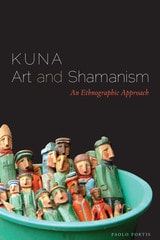
Kuna Art and Shamanism
An Ethnographic ApproachBy Paolo Fortis
University of Texas Press, 2013
Known for their beautiful textile art, the Kuna of Panama have been scrutinized by anthropologists for decades. Perhaps surprisingly, this scrutiny has overlooked the magnificent Kuna craft of nuchukana—wooden anthropomorphic carvings—which play vital roles in curing and other Kuna rituals. Drawing on long-term fieldwork, Paolo Fortis at last brings to light this crucial cultural facet, illuminating not only Kuna aesthetics and art production but also their relation to wider social and cosmological concerns.
Exploring an art form that informs birth and death, personhood, the dream world, the natural world, religion, gender roles, and ecology, Kuna Art and Shamanism provides a rich understanding of this society’s visual system, and the ways in which these groundbreaking ethnographic findings can enhance Amerindian scholarship overall. Fortis also explores the fact that to ask what it means for the Kuna people to carve the figure of a person is to pose a riddle about the culture’s complete concept of knowing.
Also incorporating notions of landscape (islands, gardens, and ancient trees) as well as cycles of life, including the influence of illness, Fortis places the statues at the center of a network of social relationships that entangle people with nonhuman entities. As an activity carried out by skilled elderly men, who possess embodied knowledge of lifelong transformations, the carving process is one that mediates mortal worlds with those of immortal primordial spirits. Kuna Art and Shamanism immerses readers in this sense of unity and opposition between soul and body, internal forms and external appearances, and image and design.
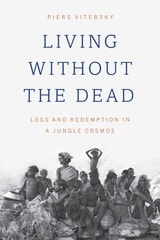
Living without the Dead
Loss and Redemption in a Jungle CosmosPiers Vitebsky
University of Chicago Press, 2017
Today, young Sora are rejecting the worldview of their ancestors and switching their allegiance to warring sects of fundamentalist Christianity or Hinduism. Communion with ancestors is banned as sacred sites are demolished, female shamans are replaced by male priests, and debate with the dead gives way to prayer to gods. For some, this shift means liberation from jungle spirits through literacy, employment, and democratic politics; others despair for fear of being forgotten after death.
How can a society abandon one understanding of reality so suddenly and see the world in a totally different way? Over forty years, anthropologist Piers Vitebsky has shared the lives of shamans, pastors, ancestors, gods, policemen, missionaries, and alphabet worshippers, seeking explanations from social theory, psychoanalysis, and theology. Living without the Dead lays bare today’s crisis of indigenous religions and shows how historical reform can bring new fulfillments—but also new torments and uncertainties.
Vitebsky explores the loss of the Sora tradition as one for greater humanity: just as we have been losing our wildernesses, so we have been losing a diverse range of cultural and spiritual possibilities, tribe by tribe. From the award-winning author of The Reindeer People, this is a heartbreaking story of cultural change and the extinction of an irreplaceable world, even while new religious forms come into being to take its place.

Performing with the Dead
Trances and TracesChristopher "Kit" Danowski
Intellect Books, 2024
In this book, Kit Danowski constructs a methodology called kanga (from the Bantu for tying and untying), using three methods based on aspects of the Afrolatinx ritual and modified for performance contexts: spell, charm, and trance. This methodology enacts and complicates distinctions between performance and ritual, serving as a contribution to respectful and responsible intercultural performance practices. The methodology is bricoleur, drawing from ethnography, psychoanalytic theory, and phenomenology. Kanga in practice leads to a state of consciousness that Danowski calls hauntological. This borrows from Derrida but is redefined to refer to the study of haunted states of consciousness, where reality is coconstituted by the living and the dead and ancestral spirits are invoked to do the work once reserved for characters.
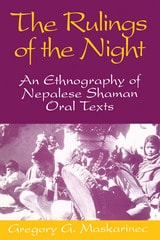
Rulings Of The Night
An Ethnography Of Nepalese Shaman Oral TextsGregory G. Maskarinec
University of Wisconsin Press, 1995
It is impossible to discuss what shamans are and what they do, contends Gregory G. Maskarinec, without knowing what shamans say. When Maskarinec took an interest in shaman rituals on his first visit to Nepal, he was told by many Nepalis and Westerners that the shamans he had encountered in the Himalayan foothills of western Nepal engaged in "meaningless mumblings." But in the course of several years of fieldwork he learned from the shamans that both their long, publicly chanted rituals and their whispered, secretive incantations are oral texts meticulously memorized through years of training. In The Rulings of the Night, he shows how the shamans, during their dramatic night-long performances, create the worlds of words in which shamans exist.
Maskarinec analyzes several complete repertoires of the texts that the shamans use to diagnose and treat afflictions that trouble their clients. Through these texts, they intervene to manipulate and change the world, replacing its unbalanced, inexpressible chaos with orderly, balanced, grammatical, and eloquently expressible states. They negotiate the relations between language, action, and social realities, providing a well-constructed and thoroughly consistent intentional universe—and only in that universe can all shaman actions and beliefs be fully comprehended.
Shamanic Trance in Modern Kabbalah
Jonathan Garb
University of Chicago Press, 2011
Bringing to light a hidden chapter in the history of modern Judaism, Shamanic Trance in Modern Kabbalah explores the shamanic dimensions of Jewish mysticism. Jonathan Garb integrates methods and models from the social sciences, comparative religion, and Jewish studies to offer a fresh view of the early modern kabbalists and their social and psychological contexts.
Through close readings of numerous texts—some translated here for the first time—Garb draws a more complete picture of the kabbalists than previous depictions, revealing them to be as concerned with deeper states of consciousness as they were with study and ritual. Garb discovers that they developed physical and mental methods to induce trance states, visions of heavenly mountains, and transformations into animals or bodies of light. To gain a deeper understanding of the kabbalists’ shamanic practices, Garb compares their experiences with those of mystics from other traditions as well as with those recorded by psychologists such as Milton Erickson and Carl Jung. Finally, Garb examines the kabbalists’ relations with the wider Jewish community, uncovering the role of kabbalistic shamanism in the renewal of Jewish tradition as it contended with modernity.
Shamanism and Vulnerability on the North and South American Great Plains
Kathleen Bolling Lowrey
University Press of Colorado, 2020
The book reveals the various ways in which anthropologists, historians, folklorists, and other writers have often misrepresented indigenous shamanism and revitalization movements by unconsciously projecting ideologies and assumptions derived from modern ‘contract societies’ onto ethnographic and historical realities. Lowrey also provides alternative ways of understanding indigenous American communities and their long histories of interethnic relations with expanding colonial and national states in the Americas. A creative historical and ethnographical reevaluation of the last few decades of scholarship on shamanism, disability, and dependence, Shamanism and Vulnerability on the North and South American Great Plains will be of interest to scholars of North and South American anthropology, indigenous history, American studies, and feminism.
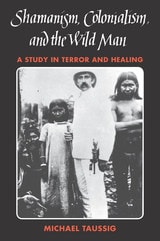
Shamanism, Colonialism, and the Wild Man
A Study in Terror and HealingMichael Taussig
University of Chicago Press, 1987
"This extraordinary book . . . will encourage ever more critical and creative explorations."—Fernando Coronil, [I]American Journal of Sociology[/I]
"Taussig has brought a formidable collection of data from arcane literary, journalistic, and biographical sources to bear on . . . questions of evil, torture, and politically institutionalized hatred and terror. His intent is laudable, and much of the book is brilliant, both in its discovery of how particular people perpetrated evil and others interpreted it."—Stehen G. Bunker, Social Science Quarterly
Shamanism, History, and the State
Nicholas Thomas and Caroline Humphrey, Editors
University of Michigan Press, 1994
The literature on shamanism and related topics is extensive, but has in general been biased toward curing and trance; the political and historical significance of shamanic activities has been largely neglected. The contributors to Shamanism, History, and the State—distinguished anthropologists and historians from England, Australia, and France—show that shamanism is not static and stable, but always changing as a result of political dynamics and historical processes. Contributors are Tamsyn Barton, Sysan Bayly, Mary Beard, Maurice Bloch, Peter Gow, Roberte N. Hamayon, Stephen Hugh-Jones, Caroline Humphrey, and Nicholas Thomas.
"The importance of this collection lies in the painstaking, many-sided ways in which it shows 'shamanism' to be a multifarious and continuously changing 'dialogue' or interaction with specific, local contexts. . . . Thus, rather than tackling the issue in principle, this collection tries to demonstrate through 'case studies' just how different 'shamanism' becomes if seen through a lens sensitive to history and the influence of institutions, such as the state, which seem far removed from it. I think the demonstrations add up to an impressive force." --Michael Taussig
"This new, ably edited volume provides . . . chapters that are rich in historic detail and that provide insights into general cultural processes and social interactions.
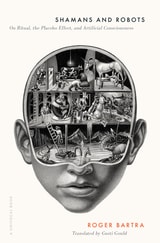
Shamans and Robots
On Ritual, the Placebo Effect, and Artificial ConsciousnessRoger Bartra
University of Minnesota Press, 2024
A profound exploration of the external influences that shape human consciousness, from healing rituals to digital devices
In this voyage through thousands of years of psychosomatic healing, distinguished anthropologist and sociologist Roger Bartra examines the placebo effect as a key to our understanding of human consciousness. Shamans and Robots demonstrates how biology and technology become intertwined within human culture by using the various histories of ritual and symbolic healing to speculate about future developments in artificial intelligence.
Charting the extensive history of the placebo effect through medieval healing, shamanism, and early psychoanalytic practices, Bartra posits that consciousness is not simply the province of the mind but something equally shaped by external systems and objects. He finds evidence of this “exocerebrum”—the extension of our brains outside the body—in the shamanistic concept of the placebo, in which external objects heal our bodies, and in modern technical devices like prostheses or robots, whose development of a mechanical consciousness would have to mimic, and in turn elucidate, the processes involved in the creation of consciousness in humans. Through this radical concept, he analyzes digital media’s relationship to the functions of the human brain and probes the possibility of artificial consciousness.
Both a look at the human body’s potential to restore itself and a profound reflection on the curative power of symbolic structures, Shamans and Robots explores how our technologies increasingly serve as extensions of our cognitive selves.
Shamans, Mystics and Doctors
A Psychological Inquiry into India and its Healing TraditionsSudhir Kakar
University of Chicago Press, 1990
"With extraordinary sympathy, open-mindedness, and insight Sudhir Kakar has drawn from both his Eastern and Western backgrounds to show how the gulf that divides native healer from Western psychiatrist can be spanned."—Rosemary Dinnage, New York Review of Books
"Each chapter describes the geographical and cultural context within which the healers work, their unique approach to healing mental illness, and . . . the philosophical and religious underpinnings of their theories compared with psychoanalytical theory."—Choice
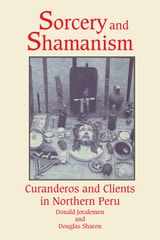
Sorcery And Shamanism
Donald Joralemon
University of Utah Press, 1993
The curanderos of northern Peru, traditional healing specialists who invoke Jesus Christ and the saints with a mescaline sacrament and a shamanic rattle, are not vestigial curiosities nor are their patients rural illiterates without access to "modern medicine." Instead, many of these shamans have thriving urban practices with clients from all levels of society.
Sorcery and Shamanism documents the lives and rituals of twelve curanderos, offering a perspective on their curing role and shared knowledge. Authors Donald Joralemon and Douglas Sharon also consider the therapeutic experiences of over one hundred patients, including case histories and follow-ups. They offer a broad view of the shamans’ work in modern Peruvian society, particularly in connection with gender-based conflicts.
The significant work goes a long way toward dispelling the stereotype of shamans as enigmatic and wise, showing them to be pragmatic curers confronting the health effects of everyday aggressions and betrayals.
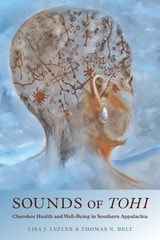
Sounds of Tohi
Cherokee Health and Well-Being in Southern AppalachiaLisa J. Lefler and Thomas N. Belt
University of Alabama Press, 2022
Dialogue between a medical anthropologist and a Cherokee linguist about health, well-being, and environmental issues
Sounds of Tohi: Cherokee Health and Well-Being in Southern Appalachia is the result of almost two decades of work by medical anthropologist Lisa J. Lefler and Cherokee elder and traditionalist Thomas N. Belt. The narrative consists of a dialogue between them that displays traditional Indigenous knowledge as well as the importance of place for two people from cultures and histories that intersect in the mountains of Southern Appalachia. Together, Lefler and Belt decolonize thinking about health, well-being, and environmental issues through the language and experiences of people whose identity is inextricably linked to the mountains and landscape of western North Carolina.
Lefler and Belt discuss several critical cultural concepts that explain the science of relationships with this world, with the spirit world, and with people. They explore tohi, the Cherokee concept of health, which offers a more pervasive understanding of relationships in life as balanced and moving forward in a good way. They converse about the importance of matrilineality, particularly in light of community healing, the epistemologies of Cherokee cosmography, and decolonizing counseling approaches.
The discussions here offer a different way of approaching the issues that face Americans in this difficult time of division. Lefler and Belt share their urgency to take action against the wholesale exploitation of public lands and the shared environment, to work to perpetuate tribal languages, to preserve the science that can make a difference in how people treat one another, and to create more forums that are inclusive of Native and marginalized voices and that promote respect and appreciation of one another and the protection of sacred places. Throughout, they rely on the preservation of traditional knowledge, or Native science, via Native language to provide insight as to why people should recognize a connection to the land.

State Healthcare and Yanomami Transformations
A Symmetrical EthnographyJosé Antonio Kelly
University of Arizona Press, 2011
That long-standing dichotomy is challenged in this new ethnography by anthropologist José Kelly. Kelly places the study of culture and cosmology squarely within the context of the modern nation-state and its institutions. He explores Indian-white relations as seen through the operation of a state-run health system among the indigenous Yanomami of southern Venezuela.
With theoretical foundations in the fields of medical and Amazonian anthropology, Kelly sheds light on how Amerindian cosmology shapes concepts of the state at the community level. The result is a symmetrical anthropology that treats white and Amerindian perceptions of each other within a single theoretical framework, thus expanding our understanding of each group and its influences on the other. This book will be valuable to those studying Amazonian peoples, medical anthropology, development studies, and Latin America. Its new takes on theory and methodology make it ideal for classroom use.
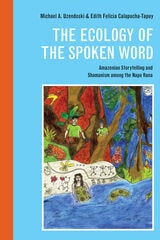
The Ecology of the Spoken Word
Amazonian Storytelling and the Shamanism among the Napo RunaMichael A. Uzendoski and Edith Felicia Calapucha-Tapuy
University of Illinois Press, 2012
This volume offers the first theoretical and experiential translation of Napo Runa mythology in English. Michael A. Uzendoski and Edith Felicia Calapucha-Tapuy present and analyze lowland Quichua speakers in the Napo province of Ecuador through narratives, songs, curing chants, and other oral performances, so readers may come to understand and appreciate Quichua aesthetic expression. Guiding readers into Quichua ways of thinking and being--in which language itself is only a part of a communicative world that includes plants, animals, and the landscape--Uzendoski and Calapucha-Tapuy weave exacting translations into an interpretive argument with theoretical implications for understanding oral traditions, literacy, new technologies, and language. A companion websiteoffers photos, audio files, and videos of original performances illustrates the beauty and complexity of Amazonian Quichua poetic expressions.
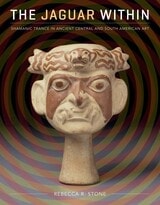
The Jaguar Within
Shamanic Trance in Ancient Central and South American ArtBy Rebecca R. Stone
University of Texas Press, 2011
An important new way of viewing the prehistoric art of the Americas, The Jaguar Within demonstrates that understanding a work of art’s connection with shamanic trance can lead to an appreciation of it as an extremely creative solution to the inherent challenge of giving material form to nonmaterial realities and states of being.
Shamanism—the practice of entering a trance state to experience visions of a reality beyond the ordinary and to gain esoteric knowledge—has been an important part of life for indigenous societies throughout the Americas from prehistoric times until the present. Much has been written about shamanism in both scholarly and popular literature, but few authors have linked it to another significant visual realm—art. In this pioneering study, Rebecca R. Stone considers how deep familiarity with, and profound respect for, the extra-ordinary visionary experiences of shamanism profoundly affected the artistic output of indigenous cultures in Central and South America before the European invasions of the sixteenth century.
Using ethnographic accounts of shamanic trance experiences, Stone defines a core set of trance vision characteristics, including enhanced senses; ego dissolution; bodily distortions; flying, spinning, and undulating sensations; synaesthesia; and physical transformation from the human self into animal and other states of being. Stone then traces these visionary characteristics in ancient artworks from Costa Rica and Peru. She makes a convincing case that these works, especially those of the Moche, depict shamans in a trance state or else convey the perceptual experience of visions by creating deliberately chaotic and distorted conglomerations of partial, inverted, and incoherent images.

The Jaguar and the Priest
An Ethnography of Tzeltal SoulsBy Pedro Pitarch
University of Texas Press, 2010
In contrast to western notions of the soul as the essence or most native part of a human being, the Tzeltal-speaking Indians of Chiapas, Mexico, regard the soul first and foremost as an Other. Made up of beings that personify the antithesis of their native selves—animals such as hummingbirds or jaguars, atmospheric phenomena like lightning bolts or rainbows, or spirits of European appearance such as Catholic priests or evangelical musicians—Tzeltal souls represent the maximum expression of that which is alien. And because their souls enfold that which is outside and Other, the Tzeltal contain within themselves the history of their relationship with Europeans from the beginning of the Spanish conquest to the present time. Thus, to understand the Indian self opens a window into the Tzeltal conception of culture and community, their notions of identity and alterity, and their interpretation of interethnic relations and types of historical memory.
In this pathfinding ethnography, which was originally published in Spanish in 1996 as Ch'ulel: una etnografía de las almas tzeltales and is now extensively rewritten and amplified in English, Pedro Pitarch offers a new understanding of indigenous concepts of the soul, personhood, and historical memory in highland Chiapas. Exploring numerous aspects of indigenous culture and history—medicine and shamanism, geography and cosmology, and politics and kinship among them—he engages in a radical rethinking of classic issues in Mesoamerican anthropology, such as ethnicity and alterity, community and tradition, and change and permanence.

The Oven
An Anti-LectureIlan Stavans
University of Massachusetts Press, 2018
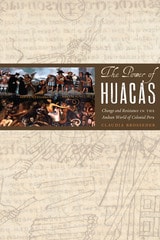
The Power of Huacas
Change and Resistance in the Andean World of Colonial PeruBy Claudia Brosseder
University of Texas Press, 2014
Based on extensive archival research, The Power of Huacas is the first book to take account of the reciprocal effects of religious colonization as they impacted Andean populations and, simultaneously, dramatically changed the culture and beliefs of Spanish Christians.
Winner, Award for Excellence in the Study of Religion in the category of Historical Studies, American Academy of Religion, 2015
The role of the religious specialist in Andean cultures of the sixteenth, seventeenth, and eighteenth centuries was a complicated one, balanced between local traditions and the culture of the Spanish. In The Power of Huacas, Claudia Brosseder reconstructs the dynamic interaction between religious specialists and the colonial world that unfolded around them, considering how the discourse about religion shifted on both sides of the Spanish and Andean relationship in complex and unexpected ways. In The Power of Huacas, Brosseder examines evidence of transcultural exchange through religious history, anthropology, and cultural studies. Taking Andean religious specialists—or hechizeros (sorcerers) in colonial Spanish terminology—as a starting point, she considers the different ways in which Andeans and Spaniards thought about key cultural and religious concepts. Unlike previous studies, this important book fully outlines both sides of the colonial relationship; Brosseder uses extensive archival research in Bolivia, Chile, Ecuador, Peru, Spain, Italy, and the United States, as well as careful analysis of archaeological and art historical objects, to present the Andean religious worldview of the period on equal footing with that of the Spanish. Throughout the colonial period, she argues, Andean religious specialists retained their own unique logic, which encompassed specific ideas about holiness, nature, sickness, and social harmony. The Power of Huacas deepens our understanding of the complexities of assimilation, showing that, within the maelstrom of transcultural exchange in the Spanish Americas, European paradigms ultimately changed more than Andean ones.
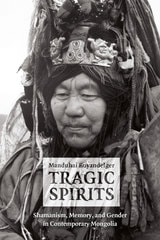
Tragic Spirits
Shamanism, Memory, and Gender in Contemporary MongoliaManduhai Buyandelger
University of Chicago Press, 2013
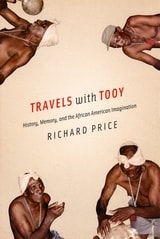
Travels with Tooy
History, Memory, and the African American ImaginationRichard Price
University of Chicago Press, 2007
Included on the itinerary for this hallucinatory expedition: forays into the eighteenth century to talk with slaves newly arrived from Africa; leaps into the midst of battles against colonial armies; close encounters with double agents and femme fatale forest spirits; and trips underwater to speak to the comely sea gods who control the world’s money supply. This enchanting book draws on Price’s long-term ethnographic and archival research, but above all on Tooy’s teachings, songs, stories, and secret languages to explore how Africans in the Americas have created marvelous new worlds of the imagination.