Results by title
4 books match the query 'Shandell, Jonathan'
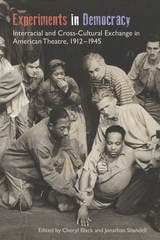
Experiments in Democracy
Interracial and Cross-Cultural Exchange in American Theatre, 1912-1945Edited by Cheryl Black and Jonathan Shandell
Southern Illinois University Press, 2016
In Experiments in Democracy, edited by Cheryl Black and Jonathan Shandell, theatre historians examine a wide range of performances—from Broadway, folk plays and dance productions to scripted political rallies and radio dramas. Contributors look at such diverse groups as the Theatre Union, La Unión Martí-Maceo, and the American Negro Theatre, as well as individual playwrights and their works, including Theodore Browne’s folk opera Natural Man, Josefina Niggli’s Soldadera, and playwright Lynn Riggs’s Cherokee Night and Green Grow the Lilacs (the basis for the musical Oklahoma!). Exploring the ways progressive artists sought to connect isolated racial and cultural groups in pursuit of a more just and democratic society, contributors take into account the blind spots, compromised methods, and unacknowledged biases at play in their practices and strategies. Essays demonstrate how the gap between the ideal of American democracy and its practice—mired in entrenched systems of white privilege, economic inequality, and social prejudice—complicated the work of these artists.
Focusing on questions of race, ethnicity, gender, and sexuality on the stage in the decades preceding the Civil Rights era, Experiments in Democracy fills an important gap in our understanding of the history of the American stage—and sheds light on these still-relevant questions in contemporary American society.
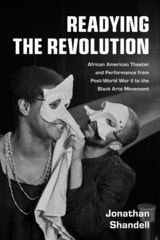
Readying the Revolution
African American Theater and Performance from Post-World War II to the Black Arts MovementJonathan Shandell
University of Michigan Press, 2025
2026 American Theatre and Drama Society John W. Frick Book Award Winner
Starting in 1966, African American activist Stokely Carmichael and other political leaders adopted the phrase "Black Power!" The slogan captured a militant, revolutionary spirit that was already emerging in the work of playwrights, poets, musicians, and visual artists throughout the Black Arts movement of the mid-1960s. But the story of those theater artists and performers whose work helped bring about the Black Arts revolution has not fully been told. Readying the Revolution: African American Theater and Performance from Post-World War II to the Black Arts Movement explores the dynamic era of Black culture between the end of World War II and the start of the Black Arts Movement (1946-1964) by illuminating how artists and innovators such as Jackie Robinson, Lorraine Hansberry, Ossie Davis, Nina Simone, and others helped radicalize Black culture and Black political thought. In doing so, these artists defied white cultural hegemony in the United States, and built the foundation for the revolutionary movement in Black theater that followed in the mid 1960s. Through archival research, close textual reading, and an analysis of performance artifacts, Shandell demonstrates how these artists negotiated a space on the public stage for cultivating radical Black aesthetics and built the foundation for the revolutionary movement in Black theater that followed in the mid-1960s.
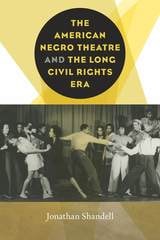
The American Negro Theatre and the Long Civil RIghts Era
Jonathan Shandell
University of Iowa Press, 2018
Jonathan Shandell provides the first in-depth study of the historic American Negro Theatre (ANT) and its lasting influence on American popular culture. Founded in 1940 in Harlem, the ANT successfully balanced expressions of African American consciousness with efforts to gain white support for the burgeoning civil rights movement. The theatre company featured innovative productions with emerging artists—Sidney Poitier, Harry Belafonte, Ruby Dee, and many others—who would become giants of stage, film, and television. In 1944, the ANT made theatrical history by creating the smash hit Anna Lucasta, the most popular play with an African American cast ever to perform on Broadway. Starting from a shoestring budget, the ANT grew into one of the most important companies in the history of African American theatre. Though the group folded in 1949, it continued to shape American popular culture through the creative work of its many talented artists.
Examining oral histories, playbills, scripts, production stills, and journalistic accounts, Shandell gives us the most complete picture to date of the theatre company by analyzing well-known productions alongside groundbreaking and now-forgotten efforts. Shedding light on this often-overlooked chapter of African American history, which fell between the New Negro Renaissance and the Black Arts Movement, Shandell reveals how the ANT became a valued community institution for Harlem—an important platform for African American artists to speak to racial issues—and a trailblazer in promoting integration and interracial artistic collaboration in the U.S. In doing so, Shandell also demonstrates how a small amateur ensemble of the 1940s succeeded in challenging, expanding, and transforming how African Americans were portrayed in the ensuing decades. The result is a fascinating and entertaining examination that will be of interest to scholars and students of African American and American studies and theatre history, as well as popular culture enthusiasts.
Theatre History Studies 2021, Vol 40
Edited by Lisa Jackson-Schebetta
University of Alabama Press, 2021
A peer-reviewed journal of theatre history and scholarship published annually since 1981 by the Mid-America Theatre Conference
Theatre History Studies 2021, Vol. 40, edited by Lisa Jackson-Schebetta, marks the fortieth volume of the respected, peer-reviewed journal published by the Mid-America Theatre Conference, a leading forum for innovative scholarship in theatre and performance studies. Bringing together a diverse collection of essays from established and emerging scholars, this volume examines the intersections of theatre history, cultural memory, performance, identity, race, gender, and social change across a wide range of historical and contemporary contexts.
The volume opens with a series of studies that challenge conventional narratives of theatre history and performance. Contributors explore topics including Voltaire and Enlightenment thought, the contributions and erasure of African American artists within the Federal Theatre Project's Negro Unit, questions of empathy and historical consciousness in contemporary drama, and the influence of Asian aesthetics on the work of modern dance innovator Alwin Nikolais. Together, these essays demonstrate the ongoing importance of theatre history as a lens through which to understand cultural power, representation, and artistic expression.
A special section,"Witch Characters and Witchy Performance," investigates the enduring cultural fascination with witches on stage and in popular performance. Essays examine witchcraft in the works of Joanna Baillie and Shakespeare, representations of female bodies and power in Caryl Churchill's Vinegar Tom, the feminist dimensions of Wicked, and the immersive theatrical worlds of productions such as Sleep No More and Then She Fell. Through these studies, the collection highlights how witch figures continue to serve as powerful symbols for exploring gender, authority, resistance, and cultural imagination.
The volume also features the recipient of the Robert A. Schanke Award, recognizing outstanding scholarship presented at the Mid-America Theatre Conference. This essay examines the evolving relationship between Broadway and high school musical theatre in the 2010s, offering valuable insight into theatre education, performance culture, and the transmission of theatrical traditions to new generations.
In addition to original research articles, Theatre History Studies 2021, Vol. 40 includes scholarly book reviews, contributor notes, and discussions of recent publications in the field, making it an essential resource for researchers, educators, students, and theatre practitioners. By bringing together rigorous historical inquiry and contemporary critical perspectives, this landmark volume showcases the breadth, vitality, and continuing relevance of theatre and performance scholarship in the twenty-first century.