Results by title
13 books match the query 'Shanghai (China)'
Chang Ch’un-ch’iao and Shanghai’s January Revolution
Andrew G. Walder
University of Michigan Press, 1977
China's Trial by Fire
The Shanghai War of 1932Donald A. Jordan
University of Michigan Press, 2001
Unlike other histories' brief generalizations of the incident, this study traces the war from the initial January 28th Japanese marine raid on Chinese Shanghai. It also studies the roles played by the prevailing Japanese leaders, including the last prewar civilian Prime Minister, Emperor Hirohito, and Admiral Nomura, who was later assigned to pre-Pearl Harbor negotiations.
Not least, the work bridges scholarly boundaries by highlighting the economics of China's leading trade metropolis, Shanghai; the desperate attempts of Chinese politicians and press to manipulate anti-imperialist and anti-Japanese propaganda; and the ways in which the failure of positional trench warfare against Japanese mechanized mobility provided lessons to German observers and the Communists.
Donald Jordan has drawn from as complete a range of primary sources as are available. Both the Nanking and Taipei archives, as well as resources from Tokyo, Settlement Shanghai's police records, Washington, the League of Nations, and London were researched.
Knowing how greatly the Nationalist defense in 1932 influenced the Chinese Communists expands the relevance for scholars of this illustrated study. Others, especially those curious about the U. S. entanglement leading to Pearl Harbor, will find much more than the story of a regional skirmish.
Donald Jordan is Professor of East Asian History, Ohio University.

Cultural Industries in Shanghai
Policy and Planning inside a Global CityEdited by Rong Yueming and Justin O’Connor
Intellect Books, 2018
In the Mood for Texture
The Revival of Bangkok as a Chinese CityArnika Fuhrmann
Duke University Press, 2026
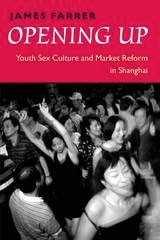
Opening Up
Youth Sex Culture and Market Reform in ShanghaiJames Farrer
University of Chicago Press, 2002
More and more men and women in China these days are having sex before marriage, creating a new youth sex culture based on romance, leisure, and free choice. The Chinese themselves describe these changes as an "opening up" in response to foreign influences and increased Westernization. Farrer explores these changes by tracing the basic elements in talk about sex and sexuality in Shanghai. He then shows how Chinese youth act out the sometimes-contradictory meanings of sex in the new market society. For Farrer, sexuality is a lens through which we can see how China imagines and understands itself in the wake of increased globalization. Through personal storytelling, neighborhood gossip, and games of seduction, young men and women in Shanghai balance pragmatism with romance, lust with love, and seriousness with play, collectively constructing and individually coping with a new culture based on market principles. With its provocative glimpse into the sex lives of young Chinese, then, Opening Up offers something even greater: a thoughtful consideration of China as it continues to develop into an economic superpower.
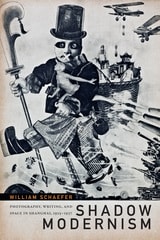
Shadow Modernism
Photography, Writing, and Space in Shanghai, 1925-1937William Schaefer
Duke University Press, 2017
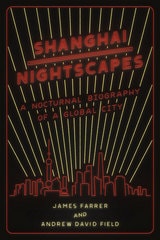
Shanghai Nightscapes
A Nocturnal Biography of a Global CityJames Farrer and Andrew David Field
University of Chicago Press, 2015
The book begins by examining the history of the jazz-age dance scenes that arose in the ballrooms and nightclubs of Shanghai’s foreign settlements. During its heyday in the 1930s, Shanghai was known worldwide for its jazz cabarets that fused Chinese and Western cultures. The 1990s have seen the proliferation of a drinking, music, and sexual culture collectively constructed to create new contact zones between the local and tourist populations. Today’s Shanghai night scenes are simultaneously spaces of inequality and friction, where men and women from many different walks of life compete for status and attention, and spaces of sociability, in which intercultural communities are formed. Shanghai Nightscapes highlights the continuities in the city’s nightlife across a turbulent century, as well as the importance of the multicultural agents of nightlife in shaping cosmopolitan urban culture in China’s greatest global city.
To listen to an audio diary of a night out in Shanghai with Farrer and Field, click here: http://n.pr/1VsIKAw.
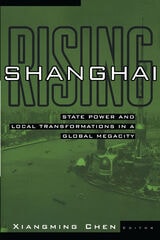
Shanghai Rising
State Power and Local Transformations in a Global MegacityXiangming Chen
University of Minnesota Press, 2009
Analyzing a Chinese city’s dazzling rise to global megacity status
Until around 1990, Shanghai was China’s premier but sluggish industrial center. Now at the beginning of the twenty-first century, the joint impact of global forces and state power has turned Shanghai into a dynamic megacity. Shanghai’s remarkable growth in economy, infrastructure, and global presence has prompted questions about the Shanghai “miracle.” This collection places the city’s unprecedented rise in a rare comparative examination of U.S. cities, as well as with Asian megacities Singapore and Hong Kong, providing a nuanced account of how Shanghai’s politics, economy, society, and space have been transformed by macro- and micro-level forces.
Contributors: Stephen W. K. Chiu, Chinese U of Hong Kong; K. C. Ho, National U of Singapore; John D. Kasarda, U of North Carolina; Hanlong Lu, Shanghai Academy of Social Sciences; Tai-lok Lui, Chinese U of Hong Kong; Ann R. Markusen, U of Minnesota; Anthony M. Orum, U of Illinois, Chicago; Yuan Ren, Fudan U Shanghai; Saskia Sassen, Columbia U; Jiaming Sun, Texas A&M U, Commerce; Fulong Wu, Cardiff U; Pingkang Yu, George Washington U; Tingwei Zhang, U of Illinois, Chicago; Zhenhua Zhou, Development Research Center, Shanghai Municipal Government.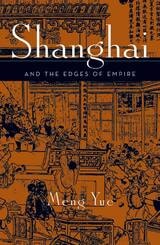
Shanghai and the Edges of Empires
Meng Yue
University of Minnesota Press, 2006
Calling into question conventional ways of conceptualizing modernity, colonialism, and intercultural relations, Meng Yue examines such cultural practices as the work of the commercial press, street theater, and literary arts, and shows that what appear to be minor cultural changes often signal the presence of larger political and economic developments. Engaging theories of modernity and postcolonial and global cultural studies, Meng Yue reveals the paradoxical interdependence between imperial and imperialist histories and the retranslation of culture that characterized the most notable result of China’s urban relocation—the emergence of the international city of Shanghai.
Meng Yue is assistant professor of East Asian languages and literature at the University of California, Irvine.
The Dianshizhai Pictorial
Shanghai Urban Life, 1884–1898Ye Xiaoqing
University of Michigan Press, 2003
The Worlds of Victor Sassoon
Bombay, London, Shanghai, 1918–1941Rosemary Wakeman
University of Chicago Press, 2024
In this book, historian Rosemary Wakeman brings to life the frenzied, crowded streets, markets, ports, and banks of Bombay, London, and Shanghai. In the early twentieth century, these cities were at the forefront of the sweeping changes taking the world by storm as it entered an era of globalized commerce and the unprecedented circulation of goods, people, and ideas. Wakeman explores these cities and the world they helped transform through the life of Victor Sassoon, who in 1924 gained control of his powerful family’s trading and banking empire. She tracks his movements between these three cities as he grows his family’s fortune and transforms its holdings into a global juggernaut. Using his life as its point of entry, The Worlds of Victor Sassoon paints a broad portrait not just of wealth, cosmopolitanism, and leisure but also of the discrimination, exploitation, and violence wreaked by a world increasingly driven by the demands of capital.
Tuberculosis Control and Institutional Change in Shanghai, 1911–2011
Rachel S. Core
Hong Kong University Press, 2023
Tuberculosis Control and Institutional Change in Shanghai, 1911–2011 is the first book on the most widespread and deadly infectious disease in China, both historically and today. Weaving together interviews with data from periodicals and local archives in Shanghai, Rachel Core examines the rise and fall of tuberculosis control in China from the 1950s to the 1990s. Under the socialist work unit system, the vast majority of people had guaranteed employment, a host of benefits tied to their workplace, and there was little mobility—factors that made the delivery of medical and public health services possible in both urban and rural areas. The dismantling of work units amid wider market reforms in the 1980s and 1990s led to the rise of temporary and casual employment and a huge migrant worker population, with little access to health care, creating new challenges in TB control. This study of Shanghai will provide valuable lessons for historians, social scientists, public health specialists, and many others working on public health infrastructure on both the national and global levels.
Voices from Shanghai
Jewish Exiles in Wartime ChinaEdited by Irene Eber
University of Chicago Press, 2008
When Hitler came to power and the German army began to sweep through Europe, almost 20,000 Jewish refugees fled to Shanghai. A remarkable collection of the letters, diary entries, poems, and short stories composed by these refugees in the years after they landed in China, Voices from Shanghai fills a gap in our historical understanding of what happened to so many Jews who were forced to board the first ship bound for anywhere.
Once they arrived, the refugees learned to navigate the various languages, belief systems, and ethnic traditions they encountered in an already booming international city, and faced challenges within their own community based on disparities in socioeconomic status, levels of religious observance, urban or rural origin, and philosophical differences. Recovered from archives, private collections, and now-defunct newspapers, these fascinating accounts make their English-languge debut in this volume. A rich new take on Holocaust literature, Voices from Shanghai reveals how refugees attempted to pursue a life of creativity despite the hardships of exile.