Results by title
2 books match the query 'Shome, Raka'
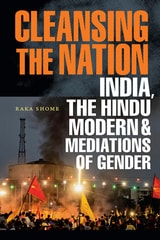
Cleansing the Nation
India, the Hindu Modern, and Mediations of GenderRaka Shome
Duke University Press, 2025
In Cleansing the Nation, Raka Shome explores the logics of governmentality of contemporary Hindu nationalism in India by advancing the concept of the “Hindu modern.” Analyzing a national cleanliness program and other development projects, Shome shows how the Hindu modern—a form of national governmentality that disciplines and regulates individual subjects to create desirable “clean” citizens—inscribes Hindu nationalism in India. Focused on security, progress, and development while celebrating and protecting the figure of the upper-caste Hindu woman, the Hindu modern works toward a religious and casteist cleansing of the nation that rewrites Indian modernity as a purified and cleansed Hindu modernity. It shores up caste and religious inequalities around who is authentically Indian, reproducing historical violence against and exclusions of caste, gender, and religion, especially toward Muslims, Dalits, and Adivasis. By outlining how the Hindu modern sutures Hindu-ness to the contemporary Indian national project of modernity, Shome helps us further understand projects of national purification and cleanliness within global populist authoritarian movements.
[more]
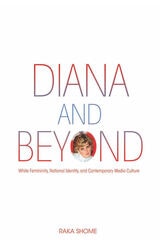
Diana and Beyond
White Femininity, National Identity, and Contemporary Media CultureRaka Shome
University of Illinois Press, 2014
The death of Princess Diana unleashed an international outpouring of grief, love, and press attention virtually unprecedented in history. Yet the exhaustive effort to link an upper class white British woman with "the people" raises questions. What narrative of white femininity transformed Diana into a simultaneous signifier of a national and global popular? What ideologies did the narrative tap into to transform her into an idealized woman of the millennium? Why would a similar idealization not have appeared around a non-white, non-Western, or immigrant woman?
Raka Shome investigates the factors that led to this defining cultural/political moment and unravels just what the Diana phenomenon represented for comprehending the relation between white femininity and the nation in postcolonial Britain and its connection to other white female celebrity figures in the millennium. Digging into the media and cultural artifacts that circulated in the wake of Diana's death, Shome investigates a range of theoretical issues surrounding motherhood and the production of national masculinities, global humanitarianism, transnational masculinities, the intersection of fashion and white femininity, and spirituality and national modernity. Her analysis explores how images of white femininity in popular culture intersect with issues of race, gender, class, sexuality, and transnationality in the performance of Anglo national modernities.
Moving from ideas on the positioning of privileged white women in global neoliberalism to the emergence of new formations of white femininity in the millennium , Diana and Beyond fearlessly explains the late princess's never-ending renaissance and ongoing cultural relevance.
[more]