Results by title
20 books match the query 'Silent films'
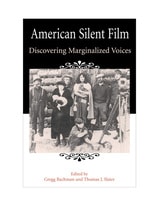
American Silent Film
Discovering Marginalized VoicesEdited by Gregg Bachman and Thomas J. Slater
Southern Illinois University Press, 2002
Gregg Bachman and Thomas J. Slater present an array of essays that reveal the incredible complexity of silent films and the era in which they were produced. Essentially, silent films conjure the names of Mary Pickford and a few white men, including Charlie Chaplin and D. W. Griffith. These eleven essays, however, demonstrate that minorities and women other than Pickford also responded to the times through film. The contributors deal with changing American society at a crucial time, examining our hopes and fears as a nation during the silent film era.
Opening new vistas, this book introduces us to people, films, issues, and concepts that few of us have encountered. One example is screenwriter June Mathis, who wrote more than one hundred scripts, brought Rudolph Valentino to stardom, and supervised all productions at the Goldwyn Studios in 1923. Equally intriguing is Nita Naldi, whose career and tragic life speak volumes about America’s combined fascination with and fear of ethnic minorities. Other key players in the drama of silent films include John Randolph Bray (animated cartoons), Roscoe “Fatty” Arbuckle, and female producer, writer, and director Nell Shipman.
Contributors are Kay Armatage, Jean Chateauvert, Maureen Furniss, Mark Langer, Anne Morey, Diane Negra, George Potamianos, Joanna Rapf, Thomas J. Slater, Sam Stoloff, and Judith Thissen.
Seventeen illustrations enliven this study of silent film.
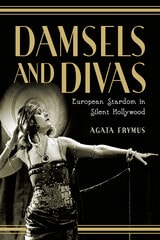
Damsels and Divas
European Stardom in Silent HollywoodAgata Frymus
Rutgers University Press, 2020
Damsels and Divas investigates the meanings of Europeanness in Hollywood during the 1920s by charting professional trajectories of three movie stars: Pola Negri, Vilma Bánky and Jetta Goudal. It combines the investigation of American fan magazines with the analysis of studio documents, and the examination of the narratives of their films, to develop a thorough understanding of the ways in which Negri, Bánky and Goudal were understood within the realm of their contemporary American culture. This discussion places their star personae in the context of whiteness, femininity and Americanization. Every age has its heroines, and they reveal a lot about prevailing attitudes towards women in their respective eras. In the United States, where the stories of rags-to-riches were especially potent, stars could offer models of successful cultural integration.

Kafka Goes to the Movies
Hanns Zischler
University of Chicago Press, 2002
Since many of Kafka's visits to the cinema occurred during bachelor trips with Max Brod, Zischler's research took him not only to Kafka's native Prague but to film archives in Munich, Milan, and Paris. Matching Kafka's cinematic references to reviews and stills from daily papers, Zischler hunted down rare films in collections all across Europe. A labor of love, then, by a true man of the cinema, Kafka Goes to the Movies brims with discoveries about the pioneering years of European film. With a wealth of illustrations, including reproductions of movie posters and other rare materials, Zischler opens a fascinating window onto movies that have been long forgotten or assumed lost.
But the real highlights of the book are those about Kafka himself. Long considered one of the most enigmatic figures in literature, the Kafka that emerges in this work is strikingly human. Kafka Goes to the Movies offers an absorbing look at a witty, passionate, and indulgently curious writer, one who discovered and used the cinema as a place of enjoyment and escape, as a medium for the ambivalent encounter with modern life, and as a filter for the changing world around him.
Love Rules
Silent Hollywood And The Rise Of The Managerial ClassMark Garrett Cooper
University of Minnesota Press, 2003
Traces the surprising connections between silent films and the rise of bureaucracy
Arguing for a sweeping new consideration of the shift from print to cinema as a governing system for organizing modern American social relations, this book uncovers an intimate connection between Hollywood romances of the silent era and the empowerment of a managerial class.
During the 1910s and 1920s, American movies told love stories through what rapidly became ubiquitous images. Again and again, silent features showed lovers separated by seeming happenstance and reunited as if by magical forces. Mark Garrett Cooper argues that this “magic” implies the expertise of the corporate movie studio with its hierarchies of professional experts. In other words, the Hollywood love story amounts to a managerial technique. Through close study of such films as Birth of a Nation, Enoch Arden, The Crowd, Why Change Your Wife? and The Jazz Singer, Love Rules shows how cinematic romance offers an object lesson in how to arrange American society—a lesson that implies that such work can be accomplished only by a managerial class.Love Rules offers a boldly original account of how the Hollywood feature film supplanted the “imagined community” of print culture and, in doing so, played a key role in the transformation of American mass culture.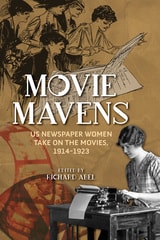
Movie Mavens
US Newspaper Women Take On the Movies, 1914-1923Edited by Richard Abel
University of Illinois Press, 2021
An invaluable collection of rare archival sources, Movie Mavens reveals women's essential contribution to the creation of American film culture.
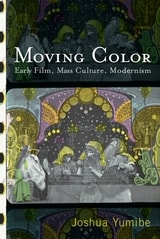
Moving Color
Early Film, Mass Culture, ModernismYumibe, Joshua
Rutgers University Press, 2012
Color was used in film well before The Wizard of Oz. Thomas Edison, for example, projected two-colored films at his first public screening in New York City on April 23, 1896. These first colors of early cinema were not photographic; they were applied manually through a variety of laborious processes—most commonly by the hand-coloring and stenciling of prints frame by frame, and the tinting and toning of films in vats of chemical dyes. The results were remarkably beautiful.
Moving Color is the first book-length study of the beginnings of color cinema. Looking backward, Joshua Yumibe traces the legacy of color history from the beginning of the nineteenth century to the cinema of the early twentieth century. Looking forward, he explores the implications of this genealogy on experimental and contemporary digital cinemas in which many colors have become, once again, vividly unhinged from photographic reality. Throughout this history, Moving Color revolves around questions pertaining to the sensuousness of color: how color moves us in the cinema—visually, emotionally, and physically.

Parallel Tracks
The Railroad and Silent CinemaLynne Kirby
Duke University Press, 1997
In wide-ranging and provocative analyses of dozens of silent films—icons of film history like The General and The Great Train Robbery as well as many that are rarely discussed—Kirby examines how trains and rail travel embodied concepts of spectatorship and mobility grounded in imperialism and the social, sexual, and racial divisions of modern Western culture. This analysis at the same time provides a detailed and largely unexamined history of the railroad in silent filmmaking. Kirby also devotes special attention to the similar ways in which the railroad and cinema structured the roles of men and women. As she demonstrates, these representations have had profound implications for the articulation of gender in our culture, a culture in some sense based on the machine as embodied by the train and the camera/projector.
Ultimately, this book reveals the profound and parallel impact that the railroad and the cinema have had on Western society and modern urban industrial culture. Parallel Tracks will be eagerly awaited by those involved in cinema studies, American studies, feminist theory, and the cultural study of modernity.
Picturing American Modernity
Traffic, Technology, and the Silent CinemaKristen Whissel
Duke University Press, 2008
Whissel shows that by portraying key events, achievements, and anxieties, the cinema invited American audiences to participate in the rapidly changing world around them. Moving pictures provided astonishing visual dispatches from military camps prior to the outbreak of fighting in the Spanish-American War. They allowed audiences to delight in images of the Pan-American Exposition, and also to mourn the assassination of President McKinley there. One early film genre, the reenactment, presented spectators with renditions of bloody battles fought overseas during the Philippine-American War. Early features offered sensational dramatizations of the scandalous “white slave trade,” which was often linked to immigration and new forms of urban work and leisure. By bringing these frequently distant events and anxieties “near” to audiences in cities and towns across the country, the cinema helped construct an American national identity for the machine age.
Pink-Slipped
What Happened to Women in the Silent Film Industries?Jane M Gaines
University of Illinois Press, 2018
Seeing Sarah Bernhardt
Performance and Silent FilmVictoria Duckett
University of Illinois Press, 2015
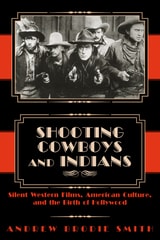
Shooting Cowboys and Indians
Silent Western Films, American Culture, and the Birth of HollywoodAndrew Brodie Smith
University Press of Colorado, 2003
Tracing the western from its hazy silent-picture origins in the 1890s to the advent of talking pictures in the 1920s, Smith examines the ways in which silent westerns contributed to the overall development of the film industry.
Focusing on such early important production companies as Selig Polyscope, New York Motion Picture, and Essanay, Smith revises current thinking about the birth of Hollywood and the establishment of Los Angeles as the nexus of filmmaking in the United States. Smith also reveals the role silent westerns played in the creation of the white male screen hero that dominated American popular culture in the twentieth century.
Illustrated with dozens of historic photos and movie stills, this engaging and substantive story will appeal to scholars interested in Western history, film history, and film studies as well as general readers hoping to learn more about this little-known chapter in popular filmmaking.
Silent Film
Able, Richard
Rutgers University Press, 1996
Silent Medievalisms
Reimagining the Middle Ages During Film’s Foundational EraEdited by Tison Pugh and Angela Jane Weisl
The Ohio State University Press, 2026
Contributors:
Kimberly Ball, Elizabeth Coggeshall, John Haines, Kevin J. Harty, Valerie B. Johnson, Tison Pugh, Sabina Rahman, Carol L. Robinson, Robert Squillace, Alexandra Sterling-Hellenbrand, Alfred Thomas, Laura E. Wangerin, Angela Jane Weisl
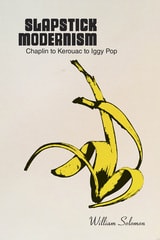
Slapstick Modernism
Chaplin to Kerouac to Iggy PopWilliam Solomon
University of Illinois Press, 2018
William Solomon charts the origins and evolution of what he calls slapstick modernism--a merging of artistic experimentation with the socially disruptive lunacy made by the likes of Charlie Chaplin. Romping through texts, films, and theory, Solomon embarks on an intellectual odyssey from the high modernism of Dos Passos and Williams to the late modernism of the Beats and Burroughs before a head-on crash into the raw power of punk rock. Throughout, he shows the links between the experimental writers and silent screen performers of the early century, and explores the potent cultural undertaking that drew inspiration from anarchical comedy after World War II.
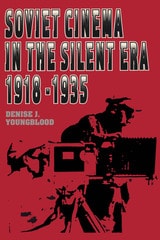
Soviet Cinema in the Silent Era, 1918–1935
By Denise J. Youngblood
University of Texas Press, 1991
The golden age of Soviet cinema, in the years following the Russian Revolution, was a time of both achievement and contradiction, as reflected in the films of Eisenstein, Pudovkin, and Kuleshov. Tensions ran high between creative freedom and institutional constraint, radical and reactionary impulses, popular and intellectual cinema, and film as social propaganda and as personal artistic expression. In less than a decade, the creative ferment ended, subjugated by the ideological forces that accompanied the rise of Joseph Stalin and the imposition of the doctrine of Socialist Realism on all the arts.
Soviet Cinema in the Silent Era, 1918–1935 records this lost golden age. Denise Youngblood considers the social, economic, and industrial factors that influenced the work of both lesser-known and celebrated directors. She reviews all major and many minor films of the period, as well as contemporary film criticism from Soviet film journals and trade magazines. Above all, she captures Soviet film in a role it never regained—that of dynamic artform of the proletarian masses.
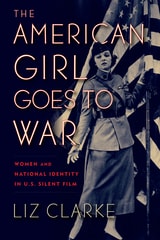
The American Girl Goes to War
Women and National Identity in U.S. Silent FilmLiz Clarke
Rutgers University Press, 2022
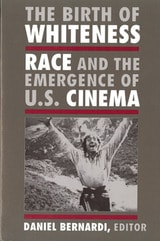
The Birth of Whiteness
Race and the Emergence of United States CinemaEdited by Daniel Leonard Bernardi
Rutgers University Press, 1996
As indelible components of the history of the United States, race and racism have permeated nearly all aspects of life: cultural, economic, political, and social. In this first anthology on race in early cinema, fourteen scholars examine the origins, dynamics, and ramifications of racism and Eurocentrism and the resistance to both during the early years of American motion pictures. Any discussion of racial themes and practices in any arena inevitably begins with the definition of race. Is race an innate and biologically determined "essence" or is it a culturally constructed category? Is the question irrelevant? Perhaps race exists as an ever-changing historical and social formation that, regardless of any standard definition, involves exploitation, degradation, and struggle. In his introduction, Daniel Bernardi writes that "early cinema has been a clear partner in the hegemonic struggle over the meaning of race" and that it was steadfastly aligned with a Eurocentric world view at the expense of those who didn't count as white.
The contributors to this work tackle these problems and address such subjects as biological determinism, miscegenation, Manifest Destiny, assimilation, and nativism and their impact on early cinema. Analyses of The Birth of a Nation, Romona, Nanook of the North and Madame Butterfly and the directorial styles of D. W. Griffith, Oscar Micheaux, and Edwin Porter are included in the volume.
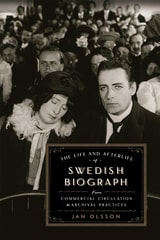
The Life and Afterlife of Swedish Biograph
From Commercial Circulation to Archival PracticesJan Olsson
University of Wisconsin Press, 2022
Sweden’s early film industry was dominated by Swedish Biograph (Svenska Biografteatern), home to star directors like Victor Sjöström and Mauritz Stiller. It is nostalgically remembered as the generative site of a nascent national artform, encapsulating a quintessentially Nordic aesthetic—the epicenter of Sweden’s cinematic Golden Age. In The Life and Afterlife of Swedish Biograph, veteran film scholar Jan Olsson takes a hard look at this established, romanticized narrative and offers a far more complete, complex, and nuanced story.
Nearly all of the studio’s original negatives were destroyed in an explosion in 1941, but Olsson’s comprehensive archival research shows how the company operated in a commercial, international arena, and how it was influenced not just by Nordic aesthetics or individual genius but also by foreign audiences’ expectations, technological demands, Hollywood innovations, and the gritty back-and-forth between economic pressures, government interference, and artistic desires. Olsson’s focus is wide, encompassing the studio’s production practices, business affairs, and cinematographic conventions, as well as the latter-day archival efforts that both preserved and obscured parts of Swedish Biograph’s story, helping construct the company’s rosy legacy. The result is a necessary rewrite to Swedish film historiography and a far fuller picture of a canonical film studio.
The Movies as a World Force
American Silent Cinema and the Utopian ImaginationFriedman, Ryan J
Rutgers University Press, 2019

The Reel Thrilling Events of Bank Robber Henry Starr
From Gentleman Bandit to Movie Star and Back AgainMark Archuleta
University of North Texas Press, 2025