Results by title

5 books match the query 'Silicon Valley'

cover of A History of the Global Stock Market: From Ancient Rome to Silicon Valley

A History of the Global Stock Market

From Ancient Rome to Silicon Valley

B. Mark Smith

University of Chicago Press, 2004

The stock market is central to the global economy. Tens of millions of people look to it to provide for a comfortable retirement. Central bankers watch it closely as they set monetary policy. Businesses around the world are forced to adjust the way they operate to meet the demands of equity investors. Yet very little has been written about how the modern global stock market came to be. In A History of the Global Stock Market, B. Mark Smith weaves an entertaining tale that ranges from medieval trading companies and nineteenth-century robber barons to modern theorists and international speculators. Here, Smith debunks the popular myth that the market is inevitably subject to recurring speculative bubbles and discredits the notion that the current "globalization" of the market is something radically different from what has occurred in the past.

Informative, entertaining, and written for specialists and non-specialists alike, A History of the Global Stock Market is a worthy read for anyone who wants to understand the role of the stock market in the global economy.

[more]
cover of Be Not Conformed: Rene Girard at the Nexus of Athens, Jerusalem, and Silicon Valley

Be Not Conformed

Rene Girard at the Nexus of Athens, Jerusalem, and Silicon Valley

Luke Burgis

Catholic University of America Press, 2026
René Girard (1923–2015) was one of the most influential interdisciplinary thinkers of the 20th century. His mimetic theory—which argues that human desire is fundamentally imitative and that rivalry and conflict arise from this imitation—cuts across philosophy, anthropology, history, literary criticism, theology, and more. To manage the destructive potential of mimetic rivalry, societies resort to violence, often in the form of what he called the scapegoat mechanism. The implications of his theory for today’s world are profound. This volume brings together essays that place Girard in conversation with other major thinkers, including Dietrich von Hildebrand, Luigi Giussani, and Marshall McLuhan, while exploring his insights on technology, education, and race. Though Girard spent most of his career as a professor at Stanford, his influence extends beyond academia. His thought has shaped Silicon Valley entrepreneurs, who recognized the impact of mimetic dynamics on innova­tion, competition, and value creation. Many of the essays in Be Not Conformed originated from the NOVITĀTE Con­ference at The Catholic University of America held in November 2023 to mark the centennial of Girard’s birth. The book’s subtitle—René Girard at the Nexus of Athens, Jerusalem, and Silicon Valley—reflects his synthesis of classical philosophy, theological depth, and modern technological discourse. Bishop Robert Barron has called Girard a potential future “father of the Church,” underscoring the lasting significance of his work. This volume of­fers an exploration of Girard’s legacy, revealing why his ideas remain essential for understanding today’s cultural and intellectual landscape. You will find in the pages of Be Not Conformed a glimpse of the width, breadth, depth, and grandeur of this singular thinker.
[more]
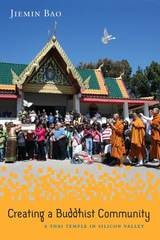
cover of Creating a Buddhist Community: A Thai Temple in Silicon Valley

Creating a Buddhist Community

A Thai Temple in Silicon Valley

Jiemin Bao

Temple University Press, 2015

The Wat Thai Buddhist Temple in Silicon Valley was founded in 1983 by a group of predominantly middle-class men and women with different ethnic and racial identities. The temple, which functions as a religious, social, economic, educational, and cultural hub, has become a place for the community members to engage in spiritual and cultural practices.
 
In Creating a Buddhist Community, Jiemin Bao shows how the Wat Thai participants practice Buddhism and rework gender relationships in the course of organizing temple space, teaching meditation, schooling children in Thai language and culture, merit making, fundraising, and celebrating festivals.
 
Bao’s detailed account of the process of creating an inclusive temple community with Thai immigrants as the majority helps to deconstruct the exoticized view of Buddhism in American culture. Creating a Buddhist Community also explores Wat Thai’s identification with both the United States and Thailand and how this transnational perspective reimagines and reterritorializes what is called American Buddhism.
[more]
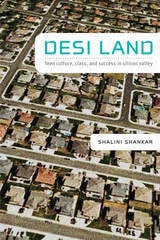
cover of Desi Land: Teen Culture, Class, and Success in Silicon Valley

Desi Land

Teen Culture, Class, and Success in Silicon Valley

Shalini Shankar

Duke University Press, 2008

Desi Land is Shalini Shankar’s lively ethnographic account of South Asian American teen culture during the Silicon Valley dot-com boom. Shankar focuses on how South Asian Americans, or “Desis,” define and manage what it means to be successful in a place brimming with the promise of technology. Between 1999 and 2001 Shankar spent many months “kickin’ it” with Desi teenagers at three Silicon Valley high schools, and she has since followed their lives and stories. The diverse high-school students who populate Desi Land are Muslims, Hindus, Christians, and Sikhs, from South Asia and other locations; they include first- to fourth-generation immigrants whose parents’ careers vary from assembly-line workers to engineers and CEOs. By analyzing how Desi teens’ conceptions and realizations of success are influenced by community values, cultural practices, language use, and material culture, she offers a nuanced portrait of diasporic formations in a transforming urban region.

Whether discussing instant messaging or arranged marriages, Desi bling or the pressures of the model minority myth, Shankar foregrounds the teens’ voices, perspectives, and stories. She investigates how Desi teens interact with dialogue and songs from Bollywood films as well as how they use their heritage language in ways that inform local meanings of ethnicity while they also connect to a broader South Asian diasporic consciousness. She analyzes how teens negotiate rules about dating and reconcile them with their longer-term desire to become adult members of their communities. In Desi Land Shankar not only shows how Desi teens of different socioeconomic backgrounds are differently able to succeed in Silicon Valley schools and economies but also how such variance affects meanings of race, class, and community for South Asian Americans.

[more]
cover of The War on the Social Factory: The Struggle for Community Safety in the Silicon Valley

The War on the Social Factory

The Struggle for Community Safety in the Silicon Valley

Annie Paradise

Northwestern University Press, 2024

A collective ethnography of grassroots mobilizations for community safety across the Silicon Valley
 
This is a narrative of struggle and solidarity and a collective toolkit for grassroots opposition to militarization, policing, and ongoing conditions of war in the current conjuncture of racial patriarchal capitalism. Grassroots researcher Annie Paradise presents here a collective ethnography of the mothers and community matriarchs whose children have been murdered by police across the San Francisco Bay Area as they develop and practice autonomous, creative forms of resistance.
 
The War on the Social Factory: The Struggle for Community Safety in the Silicon Valley maps local families’ struggles to reclaim their households and their communities—to create a social infrastructure of care, justice, and safety outside state- and market-determined modes of “security.” Practices such as sustained vigil, testimony, and the production and circulation of insurgent knowledges are shown here to be part of interconnected justice efforts to demilitarize and decarcerate communities in the face of the multiple forms of violence enacted under late racial patriarchal capitalism. Paradise examines the expanding carceral processes of enclosure, criminalization, dispossession, expropriation, and disposability that mark the neoliberal "security” regime across the Silicon Valley and offers counter-counterinsurgent strategies and practices of co-generative, dynamic resistance.

[more]