Results by title
496 books match the query 'Jewish' and 40 start with a
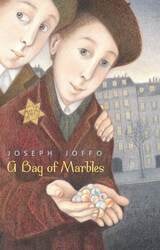
A Bag of Marbles
Joseph Joffo
University of Chicago Press, 2000
A Century of Jewish Life In Dixie
The Birmingham ExperienceMark H. Elovitz
University of Alabama Press, 2003
Exploring the resilience, identity, and contributions of Southern Jews in the heart of Alabama.
This is the first substantial history of the Jews in any inland town or city of the industrial South. A Century of Jewish Life in Dixie offers a vivid and deeply researched portrait of Birmingham, Alabama’s Jewish community. Mark H. Elovitz traces the community’s evolution from its immigrant roots in the late 19th century through its growth into a vibrant and influential part of Southern society. Drawing on archival records, oral histories, and cultural analysis, Elovitz explores how Southern Jews balanced tradition and assimilation, navigated racial and religious tensions, and contributed to civic and economic life in a region undergoing dramatic transformation. This book provides a rare and nuanced look at Jewish identity in the American South, making it an essential resource for scholars of Jewish studies, Southern history, and American cultural life.
A Children's Haggadah
Rabbi Howard Bogot
Central Conference of American Rabbis, 1996
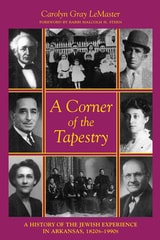
A Corner of the Tapestry
A History of the Jewish Experience in Arkansas, 1820s–1990sCarolyn LeMaster
University of Arkansas Press, 1994
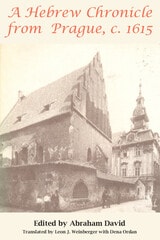
A Hebrew Chronicle from Prague, C. 1615
Abraham David
University of Alabama Press, 1993
"This slender anonymous work, spanning 1389 to 1611, presents the priorities and concerns of a Jewish community straddling the late medieval and early modern periods. Ample footnotes and explanations provide the lay reader with sufficient background to understand the references to historical events and figures, to ideologies and to institutions. A comprehensive introduction presents the realities of Prague and Bohemia, as well as offering a helpful discussion of the chronicle and other contemporary Jewish accounts."
—Conservative Jewish Quarterly
"In about 1615 an anonymous Jew from Prague composed a short Hebrew chronicle to recount 'the expulsions, miracles, and other occurrences befalling [the Jews] in Prague and the other lands of our long exile.' Abraham David discovered the manuscript [and] added glosses, historical notes, and an introduction. . . . The chronicle, with its brief annual entries, is not a continuous narrative, but does give a feeling of immediacy, like a newspaper."
—Polin: Studies in Polish Jewry
A Home for All Jews
Citizenship, Rights, and National Identity in the New Israeli StateOrit Rozin
Brandeis University Press, 2016

A Hundred Acres of America
The Geography of Jewish American Literary HistoryHoberman, Michael
Rutgers University Press, 2019
Jewish writers have long had a sense of place in the United States, and interpretations of American geography have appeared in Jewish American literature from the colonial era forward. But troublingly, scholarship on Jewish American literary history often limits itself to an immigrant model, situating the Jewish American literary canon firmly and inescapably among the immigrant authors and early environments of the early twentieth century. In A Hundred Acres of America, Michael Hoberman combines literary history and geography to restore Jewish American writers to their roles as critical members of the American literary landscape from the 1850s to the present, and to argue that Jewish history, American literary history, and the inhabitation of American geography are, and always have been, contiguous entities.
A Jewish Kapo in Auschwitz
History, Memory, and the Politics of SurvivalTuvia Friling
Brandeis University Press, 2014
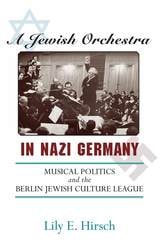
A Jewish Orchestra in Nazi Germany
Musical Politics and the Berlin Jewish Culture LeagueLily E. Hirsch
University of Michigan Press, 2011
"Offers a clear introduction to a fascinating, yet little known, phenomenon in Nazi Germany, whose very existence will be a surprise to the general public and to historians. Easily blending general history with musicology, the book provides provocative yet compelling analysis of complex issues."
---Michael Meyer, author of The Politics of Music in the Third Reich
"Hirsch poses complex questions about Jewish identity and Jewish music, and she situates these against a political background vexed by the impossibility of truly viable responses to such questions. Her thorough archival research is complemented by her extensive use of interviews, which gives voice to those swept up in the Holocaust. A Jewish Orchestra in Nazi Germany is a book filled with the stories of real lives, a collective biography in modern music history that must no longer remain in silence."
---Philip V. Bohlman, author of Jewish Music and Modernity
"An engaging and downright gripping history. The project is original, the research is outstanding, and the presentation lucid."
---Karen Painter, author of Symphonic Aspirations: German Music and Politics, 1900-1945
The Jewish Culture League was created in Berlin in June 1933, the only organization in Nazi Germany in which Jews were not only allowed but encouraged to participate in music, both as performers and as audience members. Lily E. Hirsch's A Jewish Orchestra in Nazi Germany is the first book to seriously investigate and parse the complicated questions the existence of this unique organization raised, such as why the Nazis would promote Jewish music when, in the rest of Germany, it was banned. The government's insistence that the League perform only Jewish music also presented the organization's leaders and membership with perplexing conundrums: what exactly is Jewish music? Who qualifies as a Jewish composer? And, if it is true that the Nazis conceived of the League as a propaganda tool, did Jewish participation in its activities amount to collaboration?
Lily E. Hirsch is Assistant Professor of Music at Cleveland State University.
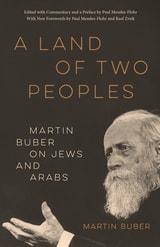
A Land of Two Peoples
Martin Buber on Jews and ArabsMartin Buber
University of Chicago Press, 2025
The theologian and philosopher Martin Buber (1878–1965) was committed to radical socioeconomic reconstruction in pursuit of international peace. His voluminous writings on Arab-Jewish relations in Palestine interweave his religious and philosophical teachings with his politics, each essential to Buber’s vision of democratic and religious life.
A Land of Two Peoples collects the letters, talks, and essays in which Buber advocated for a binationalism that reconciled Arabs and Jews as a solution to the conflict in the Middle East. As relevant today as when it was first published nearly fifty years ago, this edition of A Land of Two Peoples includes two forewords from the preeminent Jewish and Palestinian scholars Paul Mendes-Flohr and Raef Zreik.
A New Orient
From German Scholarship to Middle Eastern Studies in IsraelAmit Levy
Brandeis University Press, 2024
This study examines the history of Zionist academic Orientalism—referred to throughout as Oriental studies, the term contemporary English speakers would have used—in light of its German-Jewish background, as a history of knowledge transfer stretching along an axis from Germany to Palestine. The transfer, which took place primarily during the 1920s and 1930s, involved questions about the re-establishment, far from Germany, of a field of knowledge with deep German roots. Like other German-Jewish scholars arriving in Palestine at the time, some of the Orientalist agents of transfer did so out of Zionist conviction as olim (immigrants making aliyah, or literally “ascending” to the homeland), while others joined them later as refugees from Nazi Germany; both groups were integrated into the institutional apparatus of the Hebrew University. Unlike other fields of knowledge or professions, however, the transfer of Orientalist knowledge was unique in that the axis involved an essential change in the nature of its encounter with the Orient: from a textual-scientific encounter at German universities, largely disconnected from contemporary issues to a living, substantive, and unmediated encounter with an essentially Arab region—and the escalating Jewish-Arab conflict in the background. Within the new context, German-Jewish Orientalist expertise was charged with political and cultural significance it had not previously faced, fundamentally influencing the course of the discipline’s development in Palestine and Israel.
A New Vision of Southern Jewish History
Studies in Institution Building, Leadership, Interaction, and MobilityMark K. Bauman, Foreword by Ronald H. Bayor
University of Alabama Press, 2019
Essays from a prolific career that challenge and overturn traditional narratives of southern Jewish history
Mark K. Bauman, one of the foremost scholars of southern Jewish history working today, has spent much of his career, as he puts it, “rewriting southern Jewish history” in ways that its earliest historians could not have envisioned or anticipated, and doing so by specifically targeting themes and trends that might not have been readily apparent to those scholars. A New Vision of Southern Jewish History: Studies in Institution Building, Leadership, Interaction, and Mobility features essays collected from over a forty-year career, including a never-before-published article.
The prevailing narrative in southern Jewish history tends to emphasize the role of immigrant Jews as merchants in small southern towns and their subsequent struggles and successes in making a place for themselves in the fabric of those communities. Bauman offers assessments that go far beyond these simplified frameworks and draws upon varieties of subject matter, time periods, locations, tools, and perspectives over three decades of writing and scholarship.
A New Vision of Southern Jewish History contains Bauman’s studies of Jewish urbanization, acculturation and migration, intra- and inter-group relations, economics and business, government, civic affairs, transnational diplomacy, social services, and gender—all complicating traditional notions of southern Jewish identity. Drawing on role theory as informed by sociology, psychology, demographics, and the nature and dynamics of leadership, Bauman traverses a broad swath—often urban—of the southern landscape, from Savannah, Charleston, and Baltimore through Atlanta, New Orleans, Galveston, and beyond the country to Europe and Israel.
Bauman’s retrospective volume gives readers the opportunity to review a lifetime of work in a single publication as well as peruse newly penned introductions to his essays. The book also features an “Additional Readings” section designed to update the historiography in the essays.
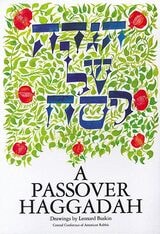
A Passover Haggadah
Rabbi Herbert Bronstein
Central Conference of American Rabbis, 0
This classic Haggadah has sold over 1 million copies since its introduction. Illustrated with twenty-three original full-color watercolors by Leonard Baskin and written in contemporary, gender-inclusive language, it contains a complete Passover home service, an extensive song section, and supplemental readings and meditations from which participants can choose during the course of the Seder. All optional selections are printed in color.
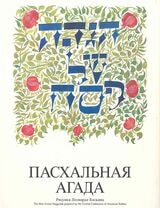
A Passover Haggadah - Russian-Hebrew Edition
Rabbi Herbert Bronstein
Central Conference of American Rabbis, 1982
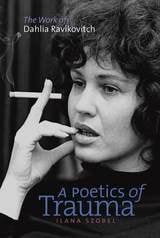
A Poetics of Trauma
The Work of Dahlia RavikovitchIlana Szobel
Brandeis University Press, 2013
A Pragmatic Alliance
Jewish-Lithuanian political cooperation at the beginning of the 20th centuryVladas Sirutavicius
Central European University Press, 2011
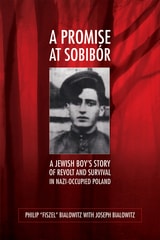
A Promise at Sobibór
A Jewish Boy’s Story of Revolt and Survival in Nazi-Occupied PolandPhilip “Fiszel” Bialowitz, with Joseph Bialowitz; Foreword by Wladyslaw Bartoszewski
University of Wisconsin Press, 2012
A Promise at Sobibór is the story of Fiszel Bialowitz, a teenaged Polish Jew who escaped the Nazi gas chambers. Between April 1942 and October 1943, about 250,000 Jews from European countries and the Soviet Union were sent to the Nazi death camp at Sobibór in occupied Poland. Sobibór was not a transit camp or work camp: its sole purpose was efficient mass murder. On October 14, 1943, approximately half of the 650 or so prisoners still alive at Sobibór undertook a daring and precisely planned revolt, killing SS officers and fleeing through minefields and machine-gun fire into the surrounding forests, farms, and towns. Only about forty-two of them, including Fiszel, are known to have survived to the end of the war.
Philip (Fiszel) Bialowitz, now an American citizen, tells his eyewitness story here in the real-time perspective of his own boyhood, from his childhood before the war and his internment in the brutal Izbica ghetto to his harrowing six months at Sobibór—including his involvement in the revolt and desperate mass escape—and his rescue by courageous Polish farmers. He also recounts the challenges of life following the war as a teenaged displaced person, and his eventual efforts as a witness to the truth of the Holocaust.
In 1943 the heroic leaders of the revolt at Sobibór, Sasha Perchersky and Leon Feldhendler, implored fellow prisoners to promise that anyone who survived would tell the story of Sobibór: not just of the horrific atrocities committed there, but of the courage and humanity of those who fought back. Bialowitz has kept that promise.
Best Books for General Audiences, selected by the American Association for School Libraries
Best Books for High Schools, selected by the American Association for School Libraries
Best Books for Special Interests, selected by the Public Library Association
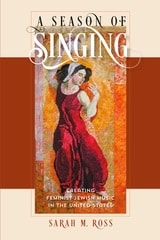
A Season of Singing
Creating Feminist Jewish Music in the United StatesSarah M. Ross
Brandeis University Press, 2016
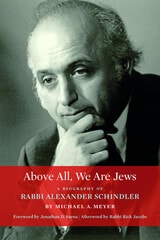
Above All, We Are Jews
A Biography of Rabbi Alexander SchindlerMichael A. Meyer
Central Conference of American Rabbis, 2025
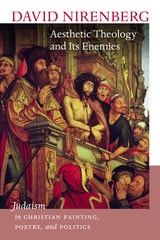
Aesthetic Theology and Its Enemies
Judaism in Christian Painting, Poetry, and PoliticsDavid Nirenberg
Brandeis University Press, 2015
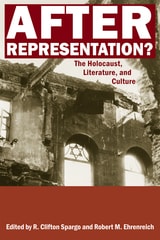
After Representation?
The Holocaust, Literature, and CultureSpargo, R. Clifton
Rutgers University Press, 2010
As experts in the study of literature and culture, the scholars in this collection examine the shifting cultural contexts for Holocaust representation and reveal how writersùwhether they write as witnesses to the Holocaust or at an imaginative distance from the Nazi genocideùarticulate the shadowy borderline between fact and fiction, between event and expression, and between the condition of life endured in atrocity and the hope of a meaningful existence. What imaginative literature brings to the study of the Holocaust is an ability to test the limits of language and its conventions. After Representation? moves beyond the suspicion of representation and explores the changing meaning of the Holocaust for different generations, audiences, and contexts.
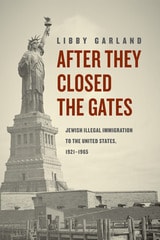
After They Closed the Gates
Jewish Illegal Immigration to the United States, 1921-1965Libby Garland
University of Chicago Press, 2014
In After They Closed the Gates, Libby Garland tells the untold stories of the Jewish migrants and smugglers involved in that underworld, showing how such stories contributed to growing national anxieties about illegal immigration. Garland also helps us understand how Jews were linked to, and then unlinked from, the specter of illegal immigration. By tracing this complex history, Garland offers compelling insights into the contingent nature of citizenship, belonging, and Americanness.
Alibi Lullaby
Norma Cole
Omnidawn, 2025
Alibi, in Latin, meant “elsewhere,” and “lullaby”—from lull, to soothe, and bye, near, close by—has elements linguistic elements that appear across cultures. Music, from ancient songs recorded on tables to contemporary compositions, share related framing elements that have persisted across time: formal patterns and rhythms, peaceful and hypnotic movements, and elements of terror arising from the moving frontier of “thrill, dread, certainty.”
In this collection, Norma Cole considers the ancient and transcendent patterns of music, finding them through nature, heart sounds, the spectral elegance of blood flow, the murmur of melody, and many diverse patterns and beats. Sounds of summer, massacres, “empathy through distress,” unknowing, energy, suspense, and fragility echo throughout the poems and other writings. Drawing on a poetics that embraces formal freefall and looks forward while holding up the shifting mirror of memory, Alibi Lullaby is a lyrical montage at the edges of musicality.
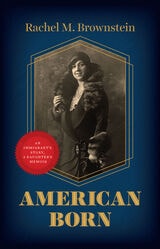
American Born
An Immigrant's Story, a Daughter's MemoirRachel M. Brownstein
University of Chicago Press, 2023
When she arrived alone in New York in 1924, eighteen-year-old Reisel Thaler resembled the other Yiddish-speaking immigrants from Eastern Europe who accompanied her. Yet she already had an American passport tucked in her scant luggage. Reisel had drawn her first breath on the Lower East Side of Manhattan in 1905, then was taken back to Galicia (in what is now Poland) by her father before she turned two. She was, as she would boast to the end of her days, “American born.”
The distinguished biographer and critic Rachel M. Brownstein began writing about her mother Reisel during the Trump years, dwelling on the tales she told about her life and the questions they raised about nationalism, immigration, and storytelling. For most of the twentieth century, Brownstein’s mother gracefully balanced her identities as an American and a Jew. Her values, her language, and her sense of timing inform the imagination of the daughter who recalls her in her own old age. The memorializing daughter interrupts, interprets, and glosses, sifting through alternate versions of the same stories using scenes, songs, and books from their time together.
But the central character of this book is Reisel, who eventually becomes Grandma Rose—always watching and judging, singing, baking, and bustling. Living life as the heroine of her own story, she reminds us how to laugh despite tragedy, find our courage, and be our most unapologetically authentic selves.
American Jewish History
A Primary Source ReaderEdited by Gary Phillip Zola and Marc Dollinger
Brandeis University Press, 2014
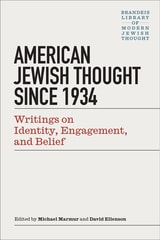
American Jewish Thought Since 1934
Writings on Identity, Engagement, and BeliefEdited by Michael Marmur and David Ellenson
Brandeis University Press, 2020
In this volume, editors Michael Marmur and David Ellenson bring together the distinctive voices of those who have shaped the bold and shifting soundscape of American Jewish thought over the last few generations. The contributors tackle an array of topics including theological questions; loyalty and belonging; the significance of halakhic, spiritual, and ritual practice; secularization and its discontents; and the creative recasting of Jewish peoplehood. The editors are careful to point out how a plurality of approaches emerged in response to the fundamental ruptures and challenges of continuity posed by the Holocaust, the establishment of the state of Israel, and the civil rights movement in the twentieth century.
This volume also includes a wide swath of the most distinctive currents and movements over the last eighty years: post-Holocaust theology, secular forms of Jewish spirituality, ultra-orthodoxy, American neo-orthodoxy, neo-Hasidism, feminism and queer theory, diasporist critiques of Zionism, and Zionist militancy. This collection will serve as both a testament to the creativity of American Jewish thought so far, and as an inspiration for the new thinkers of its still unwritten future.
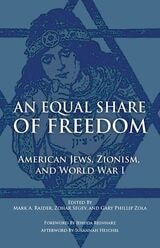
An Equal Share of Freedom
American Jews, Zionism, and World War IEdited by Mark Raider, Zohar Segev, and Gary Phillip Zola
University of Minnesota Press, 2024
An Equal Share of Freedom sheds new light on several important and interrelated dimensions of American, Jewish, and world history in the World War I era. Paying close attention to the Balfour Declaration as a hub around which to explore the period’s unfolding and turbulent social, cultural, and political developments, this collection of essays covers a diverse range of topics including Jewish doughboys, Zionist women authors, and political elites such as Golda Meir and Woodrow Wilson. The volume demonstrates the complex nature of Jewish ethnonational consciousness in the American setting and the impact of Zionism on US wartime and postwar activity.
The essays in this volume overturn timeworn assumptions that have long shaped the fields of American history and modern Jewish history. Taken as a whole, they demonstrate the war’s profound impact on American Jewish life and the transformation of American Jewry’s relationship with wider American society. These essays also illustrate the centrality of Zionism to the American Jewish experience and the extent to which American Jewry’s national consciousness and the future direction of the Zionist project were forged in the crucible of the Great War. An Equal Share of Freedom is the first volume in the Jacob Rader Marcus Series on the American Jewish Experience. In this series, Raider, Segev, and Zola highlight the myriad possibilities for expanding and deepening scholarly understanding of American Jews and the shared history of American society and the Jewish people in the twentieth century, starting with a look at World War I.
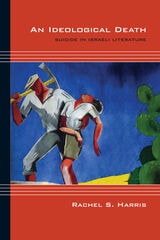
An Ideological Death
Suicide in Israeli LiteratureRachel S. Harris
Northwestern University Press, 2014
Yehudit Katzir, Etgar Keret, Amos Oz, Yaakov Shabtai, Benjamin Tammuz, and A. B. Yehoshua are among the writers who engage with depictions of suicide in a critical and rhetorical process that reconsiders myths at the heart of the Zionist project. In Israeli literature, suicide is linked to a society’s compulsion to create impossible ideals that leave its populace disappointed and deluded. Yet, as Rachel S. Harris shows, even at their harshest these writers also acknowledge the idealism that helped build Israel as a modern nation-state.
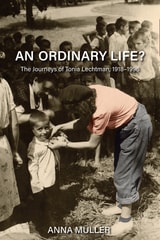
An Ordinary Life?
The Journeys of Tonia Lechtman, 1918–1996Anna Müller
Ohio University Press, 2024
One woman’s national, political, ethnic, social, and personal identities impart an extraordinary perspective on the histories of Europe, Polish Jews, Communism, activism, and survival during the twentieth century.
Tonia Lechtman was a Jew, a loving mother and wife, a Polish patriot, a committed Communist, and a Holocaust survivor. Throughout her life these identities brought her to multiple countries—Poland, Palestine, Spain, France, Germany, Switzerland, and Israel—during some of the most pivotal and cataclysmic decades of the twentieth century. In most of those places, she lived on the margins of society while working to promote Communism and trying to create a safe space for her small children.
Born in Łódź in 1918, Lechtman became fascinated with Communism in her early youth. In 1935, to avoid the consequences of her political activism during an increasingly antisemitic and hostile political environment, the family moved to Palestine, where Tonia met her future husband, Sioma. In 1937, the couple traveled to Spain to participate in the Spanish Civil War. After discovering she was pregnant, Lechtman relocated to France while Sioma joined the International Brigades. She spent the Second World War in Europe, traveling with two small children between France, Germany, and Switzerland, at times only miraculously avoiding arrest and being transported east to Nazi camps. After the war, she returned to Poland, where she planned to (re)build Communist Poland. However, soon after her arrival she was imprisoned for six years. In 1971, under pressure from her children, Lechtman emigrated from Poland to Israel, where she died in 1996.
In writing Lechtman’s biography, Anna Müller has consulted a rich collection of primary source material, including archival documentation, private documents and photographs, interviews from different periods of Lechtman’s life, and personal correspondence. Despite this intimacy, Müller also acknowledges key historiographical questions arising from the lacunae of lost materials, the selective preservation of others, and her own interpretive work translating a life into a life story.
An Uncompromising Generation
The Nazi Leadership of the Reich Security Main OfficeMichael Wildt
University of Wisconsin Press, 2009
Wildt’s study traces the intellectual evolution of key members of the Reich Security Main Office (RSHA) from their days as students until the end of World War II. Established in 1939, this office fused together the Gestapo, the Criminal Police, and the Sicherheitsdienst (Security Service) of the SS. Far from being small cogs in a big bureaucratic machine, Wildt finds that the people who made up the RSHA constructed the concepts and operated the apparatus that carried out the Holocaust.
At the center of both theory and practice of persecution and genocide in Nazi-occupied Europe, these young men of the RSHA—none of whom envisioned the systematic annihilation of the European Jews—became radicalized. How this occurred is the central question of Wildt’s book. Wildt also discusses the postwar careers of the members of the RSHA. Strikingly, he shows how the leaders of the RSHA evaded the consequences of their actions under the Nazi regime and went on to have important careers in the rebuilt West Germany.
An alternate selection of the History Book Club and Military Book Club
And Yet I Still Have Dreams
A Story of Certain LonelinessJoanna Wiszniewicz
Northwestern University Press, 2004
The book provides a connection to seldom discussed aspects of the Holocaust: the gulf between rich and poor Jews and how this translated into everyday survival; the refusal by Alex to see himself or Jews in general as heroes or victims; his own self-absorption as a teen in the ghetto; and his "priviliged" family's near-indifference to the suffering of those around them. Alex paints a picture of complex and diverse Jewish society in prewar Poland, revealing how, many years later and despite his determine to leave it in the past, the burdens of memory--and the dreams--linger.
And Yet, I Am Here!
Halina Nelken
University of Massachusetts Press, 1999
When Germany invaded Poland in 1939, Halina Nelken was a precocious fifteen-year-old, living a middle-class life in Krakow. Like other girls her age, she recorded her personal observations and feelings in a diary. As conditions in Krakow deteriorated and her family was forced into the Jewish ghetto, she continued to write, eventually smuggling her diary out with a Catholic friend. This remarkable book tells the story of Nelken's experiences in the ghetto and later in eight Nazi concentration camps, including Plaszow, Auschwitz, and Ravensbrück. Her diary entries, written between 1938 and 1943, form the core of the volume and are supplemented by recollections written shortly after the war, and by later commentaries and explanatory notes which she added in the mid-1980s. Although there exist numerous published and unpublished memoirs by Holocaust survivors, Nelken's book presents one of the few extant diaries written at the time. Already released in Polish and German editions, it has been hailed as one of the finest works of its kind. Now it is available in English for the first time.
And the War Is Over . . .
Shmuel T. Meyer
Seagull Books, 2024
Sharp as a razor and as subtle as gossamer, Shmuel T. Meyer’s masterfully crafted stories evoke unique individual sensibilities and destinies, resonating with the sensual details, smells, tastes, music, and sounds of a specific time and place. And the War Is Over brings together three collections of short stories set on three continents in the aftermath of war: World War II and the Shoah in Grand European Express, the Korean War in The Great American Disaster, and the Arab-Israeli conflict in Kibbutz.
Characters both real and imagined run through a fabric so tightly woven that the threads of history and fiction can barely be separated: the Roman poet Clara who will never write again; Saul, a New York City police detective haunted by memories of the Pusan Perimeter; a brother out to avenge his sister’s murder; the son of a former Nazi who joins the Red Army Faction. Tracing moments of encounter, their paths cross those of Allen Ginsberg, Albert Cossery, John Coltrane, and Duke Ellington. Characters travel by train from Venice to Paris, hike up the Val d’Annivers, listen to jazz in Greenwich Village, and ride a motorcycle along the sandy road to Haifa. Under the shadow of war, with death lurking, these multifaceted, evocative lives move in a space between coincidence and fate.
Anna's Shtetl
Lawrence A. Coben
University of Alabama Press, 2007
Antisemitism and the Politics of History
Edited by Scott Ury and Guy Miron
Brandeis University Press, 2023
The book begins with a revised and updated version of David Engel’s seminal essay “Away from a Definition of Antisemitism.” Subsequent contributions by renowned specialists in ancient, medieval, and modern history, religious studies, and other fields explore the various and changing definitions and uses of the term “antisemitism” in a range of contexts, including ancient Rome and Greece, the Byzantine Empire, medieval Europe, early modern and modern Europe, North America, and the United Kingdom. The volume also includes a section that focuses on the Second World War, including the Holocaust and its memory. Engel offers a contemporary response to conclude the book.
First published in Hebrew in 2020 as a special issue of the journal Zion: A Quarterly for Research in Jewish History in cooperation with the Zalman Shazar Center in Jerusalem, this compelling collection has already had an impact on the study of antisemitism in Israel. It is certain to become a critical resource for scholars, policymakers, and journalists researching antisemitism, Holocaust studies, and related fields.
Argentina and the Jews
A History of Jewish ImmigrationHaim Avni
University of Alabama Press, 1991
Traces the shifting patterns of Jewish immigration and Argentine immigration policy.
Argentina is home to the largest Jewish community in the Hispanic world, the second largest in the Western hemisphere. During successive political and social regimes, Argentina alternately barred Jews from entering the country and recruited them to immigrate, persecuted Jews as heretics or worse and welcomed them as productive settlers, restricted Jews by law and invested them with the fullest rights of citizenship. This volume traces the shifting patterns of Jewish immigration and Argentine immigration policy, both as manifestations of cultural and historical processes and as forces shaping the emergence of a large and energetic Jewish community.
Within Argentina, many Jews followed traditional immigration strategies by consolidating communities and institutions in Buenos Aires and other cities. But many others settled on the land, in agricultural colonies sponsored by Baron Maurice de Hirsch’s Jewish Colonization Association, a group with far-reaching impact that is examined closely in this book. The Israeli kibbutz movement drew strength from the Argentine farming colonies, when beginning in 1949 groups of Argentine Jews immigrated to Israel to found kibbutzes. Eventually, in the face of political and economic upheavals with anti-Semitic undercurrents, almost 40,000 Jews left Argentina for Israel. A country of absorption became a country of exodus, and Zionism became a central focus of Argentine Jewry, interlocking families and fates separated by oceans and continents.
Arrogant Beggar
Anzia Yezierska
Duke University Press, 1996
The second half of the novel takes Adele back to her ghetto origins as she explores an alternative model of philanthropy by opening a restaurant that combines the communitarian ideals of Old World shtetl tradition with the contingencies of New World capitalism. Within the context of this radical message, Yezierska revisits the themes that have made her work famous, confronting complex questions of ethnic identity, assimilation, and female self-realization.
Katherine Stubbs’s introduction provides a comprehensive and compelling historical, social, and literary context for this extraordinary novel and discusses the critical reaction to its publication in light of Yezierska’s biography and the once much-publicized and mythologized version of her life story. Unavailable for over sixty years, Arrogant Beggar will be enjoyed by general readers of fiction and be of crucial importance for feminist critics, students of ethnic literature. It will also prove an exciting and richly rewarding text for students and scholars of Jewish studies, immigrant literature, women’s writing, American history, and working-class fiction.
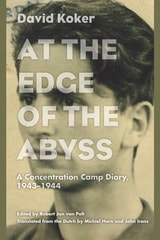
At the Edge of the Abyss
A Concentration Camp Diary, 1943-1944David Koker; Edited by Robert Jan van Pelt; Translated from the Dutch by Michiel Horn and John Irons
Northwestern University Press, 2012
Finalist for 2012 National Jewish Book Award in the Holocaust category
David Koker's diary is one of the most notable accounts of life in a German concentration camp written by a Jew during the years of the Holocaust. First brought to attention when the Dutch historian Jacob Presser-Koker's history teacher in high school-quoted from Koker's diary in his monumental history, published in English as The Destruction of the Dutch Jews (1968), the diary itself became a part of the Dutch literary canon when it was published in 1977 as Dagboek geschreven in Vught (Diary Written in Vught). It has remained in print ever since, and is notable for its literary qualities, weaving poetry and powerful observations of the emotional life of a camp prisoner, including reflections after an in-person visit by Heinrich Himmler. Surprisingly, the book has never before been translated into English.
During his time in the Vught concentration camp, the 21-year-old David recorded on an almost daily basis his observations, thoughts, and feelings. He mercilessly probed the abyss that opened around him and, at times, within himself. David's diary covers almost a year, both charting his daily life in Vught as it developed over time and tracing his spiritual evolution as a writer. Until early February 1944, David was able to smuggle some 73,000 words from the camp to his best friend Karel van het Reve, a non-Jew.
With an informative introduction, annotation, and list of dramatis personae by Robert Jan van Pelt, At the Edge of the Abyss offers an immediate and wholly original look into the life of a concentration camp prisoner.
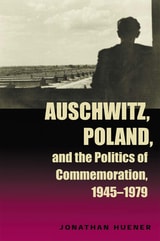
Auschwitz, Poland, and the Politics of Commemoration, 1945–1979
Jonathan Huener
Ohio University Press, 2003
Few places in the world carry as heavy a burden of history as Auschwitz. Recognized and remembered as the most prominent site of Nazi crimes, Auschwitz has had tremendous symbolic weight in the postwar world.
Auschwitz, Poland, and the Politics of Commemoration is a history of the Auschwitz memorial site in the years of the Polish People’s Republic. Since 1945, Auschwitz has functioned as a memorial and museum. Its monuments, exhibitions, and public spaces have attracted politicians, pilgrims, and countless participants in public demonstrations and commemorative events.
Jonathan Huener’s study begins with the liberation of the camp and traces the history of the State Museum at Auschwitz from its origins immediately after the war until the 1980s, analyzing the landscape, exhibitions, and public events at the site.
Based on extensive research and illustrated with archival photographs, Auschwitz, Poland, and the Politics of Commemoration accounts for the development and durability of a Polish commemorative idiom at Auschwitz. Emphasis on Polish national “martyrdom” at Auschwitz, neglect of the Shoah as the most prominent element of the camp’s history, political instrumentalization of the grounds and exhibitions—these were some of the more controversial aspects of the camp’s postwar landscape.
Professor Huener locates these and other public manifestations of memory at Auschwitz in the broad scope of Polish history, in the specific context of postwar Polish politics and culture, and against the background of Polish-Jewish relations. Auschwitz, Poland, and the Politics of Commemoration will be of interest to scholars, students, and general readers of the history of modern Poland and the Holocaust.
Authentically Jewish
Identity, Culture, and the Struggle for RecognitionStuart Z. Charmé
Rutgers University Press, 2022
Author Stuart Z. Charmé explores how debates over authenticity and struggles for recognition are a key to understanding a wide range of controversies between Orthodox and liberal Jews, Zionist and diaspora Jews, white Jews and Jews of color, as well as the status of intermarried and messianic Jews, and the impact of Jewish genetics. In addition, it discusses how and when various cultural practices and traditions such as klezmer music, Israeli folk dance, Jewish yoga and meditation, and others are recognized as authentically Jewish, or not.