Results by title
10 books match the query 'Single women'
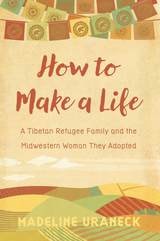
How to Make a Life
A Tibetan Refugee Family and the Midwestern Woman They AdoptedMadeline Uraneck
Wisconsin Historical Society Press, 2018
When Madeline Uraneck said hello to the Tibetan woman cleaning her office cubicle, she never imagined the moment would change her life. After learning that Tenzin Kalsang had left her husband and four children behind in a Tibetan refugee settlement in India to try to forge a better life for them, Madeline took on the task of helping her apply for US visas. When the family reunited in their new Midwestern home, Madeline became swept up in their lives, from homework and soccer games to family dinners and shared holiday traditions. By reaching out, she found more than she bargained for—a family who welcomed her as their own and taught her more than she offered them.
An evocative blend of immersion journalism and memoir, How to Make a Life shares the immigration story of a Tibetan refugee family who crossed real and cultural bridges to make a life in Madison, Wisconsin, with the assistance of the Midwestern woman they befriended. From tales of escaping Tibet over the Himalayas, to striking a balance between old traditions with new, to bridging divides one friendly gesture at a time, readers will expand their understanding of family, culture, and belonging.
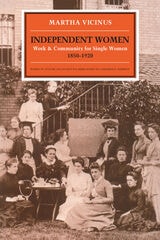
Independent Women
Work and Community for Single Women, 1850-1920Martha Vicinus
University of Chicago Press, 1985
"Feminist insight combines with vast research to produce a dramatic narrative. Independent Women chronicles the energetic lives and imaginative communal structures invented by women who 'pioneered new occupations, new living conditions, and new public roles.'"—Lee R. Edwards, Ms.
"Vicinus is to be congratulated for her brave and unflinching portraits of twisted spinsters as well as stolid saints. That she stretches her net up into the '20s and covers the women's suffrage momement is a brilliant stroke, for one may see clearly how it was possible for women to mount such an enormous and successful political campaign."—Jane Marcus, Chicago Tribune Book World
"Vicinus' beautifully written book abounds in rich historical detail and in subtle psychological insights in the character of its protagonists. The author understands the complexities of the interplay between economic and social conditions, cultural values, and the aims and aspirations of individual personalities who act in history. . . . A superb achievement."—Gerda Lerner, Reviews in American History
"Martha Vicinus has with intelligence and energy paved and landscaped the road on which scholars and students of activist women all travel for many years."—Blanche Wiesen Cook, Women's Review of Books
"Independent Women can be read by anyone with an interest in women's history. But for all contemporary women, unconsciously enjoying privileges and freedoms once bought so dearly, this book should be required reading."—Catharine E. Boyd, History
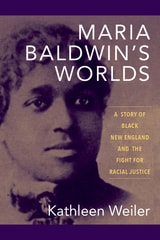
Maria Baldwin's Worlds
A Story of Black New England and the Fight for Racial JusticeKathleen Weiler
University of Massachusetts Press, 2019
Maria Baldwin (1856–1922) held a special place in the racially divided society of her time, as a highly respected educator at a largely white New England school and an activist who carried on the radical spirit of the Boston area's internationally renowned abolitionists from a generation earlier.
African American sociologist Adelaide Cromwell called Baldwin “the lone symbol of Negro progress in education in the greater Boston area” during her lifetime. Baldwin used her respectable position to fight alongside more radical activists like William Monroe Trotter for full citizenship for fellow members of the black community. And, in her professional and personal life, she negotiated and challenged dominant white ideas about black womanhood. In Maria Baldwin's Worlds, Kathleen Weiler reveals both Baldwin's victories and what fellow activist W. E. B. Du Bois called her “quiet courage” in everyday life, in the context of the wider black freedom struggle in New England.
Never Married Women
Barbara Levy Simon
Temple University Press, 1989
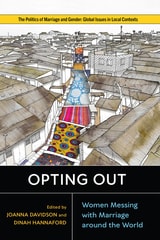
Opting Out
Women Messing with Marriage around the WorldJoanna Davidson
Rutgers University Press, 2023
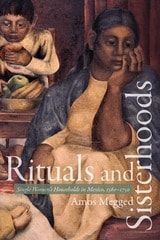
Rituals and Sisterhoods
Single Women's Households in Mexico, 1560–1750Amos Megged
University Press of Colorado, 2019
Megged analyzes these women’s life stories recorded during the Spanish Inquisition, as well as wills and bequests, petitions, parish records, and private letters that describe—in their own words—how they exercised agency in male-dominated and religious spaces. Translations of select documents and accompanying analysis illustrate the conditions in which women dissolved their marriages, remained in long-lasting extramarital cohabitations, and formed female-led households and “sisterhoods” of their own. Megged provides evidence that single women in colonial Mexico played a far more active and central role in economic systems, social organizations, cults, and political activism than has been previously thought, creating spaces for themselves in which they could initiate and maintain autonomy and values distinct from those of elite society.
The institutionalization of female-headed households in mid-colonial Mexico had wide-ranging repercussions and effects on general societal values. Rituals and Sisterhoods details the particular relevance of these changes to the history of emotions, sexuality, gender concepts, perceptions of marriage, life choices, and views of honor and shame in colonial society. This book will be of significant interest to students and scholars of colonial Latin American history, the history of Early Modern Spain and Europe, and gender and women’s studies.
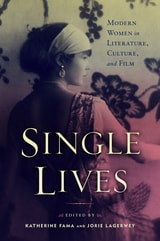
Single Lives
Modern Women in Literature, Culture, and FilmKatherine Fama
Rutgers University Press, 2022

Stray Home
Amy M. Clark
University of North Texas Press, 2010
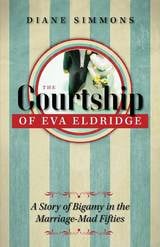
The Courtship of Eva Eldridge
A Story of Bigamy in the Marriage Mad FiftiesDiane Simmons
University of Iowa Press, 2016
Everyone got married in the 1950s, then moved to the suburbs to have the children of the soon-to-be-famous baby boom. For Americans who had survived the Great Depression and World War II, prosperous married life was a triumph. The unwed were objects of pity, scorn, even suspicion. And so in the 1950s, Eva Eldridge, no longer so young and marginally employed, was the perfect target for handsome Vick, who promised everything: storybook romance, marital respectability, and the lively social life she loved. When he disappeared not long after their honeymoon, she was devastated.
Eva hadn’t always been so vulnerable. Growing up pretty and popular in rural Oregon, she expected to marry young and live a life much like that of her parents, farming and rearing children. But then the United States threw its weight into World War II and as men headed to battle, the government started recruiting women to work in their places. Eva, like many other young women, found that life in the city with plenty of money, personal freedom, and lots of soldiers and sailors eager to pay court was more exhilarating than life down on the farm. After the war, she was ambivalent about getting married and settling down—at least until Vick arrived.
Refusing to believe her brand-new husband had abandoned her, Eva set about tracking down a man who, she now believed, was more damaged by wartime trauma than she had known. But instead of a wounded hero, she found a long string of women much like herself—hard-working, intelligent women who had loved and married Vick and now had no idea where—or even who—he was.
Drawing on a trove of some eight hundred letters and papers, Diane Simmons tells the story of Eva’s poignant struggle to get her dream husband back, as well as the stories of the women who had stood at the altar with Vick before and after her. Eva’s remarkable life illuminates women’s struggle for happiness at a time when marriage—and the perfect husband—meant everything.
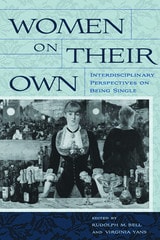
Women on Their Own
Interdisciplinary Perspectives on Being SingleEdited by Rudolph M. Bell and Virginia Yans
Rutgers University Press, 2007
Modern American culture has raised generations of women who believed that their true and most important role in society was to get married and have children. Anything short of this role was considered abnormal, unfulfilling, and suspect. This female stereotype has been exploited and perpetuated by some key films in the late 40's and early 50's. But more recently we have seen a shift in the cultural view of the spinster. The erosion of the traditional nuclear family, as well as a larger range of acceptable life choices, has caused our perceptions of unmarried women to change. The film industry has reflected this shift with updated stereotypes that depict this cultural trend. The shift in the way we perceive spinsters is the subject of current academic research which shows that a person's perception of particular societal roles influences the amount of stress or depression they experience when in that specific role. Further, although the way our culture perceives spinsters and the way the film industry portrays them may be evolving, we still are still left with a negative stereotype.
Themes of choice and power have informed the lives of single women in all times and places. When considered at all in a scholarly context, single women have often been portrayed as victims, unhappily subjected to forces beyond their control. This collection of essays about "women on their own" attempts to correct that bias, by presenting a more complex view of single women in nineteenth- and twentieth-century United States and Europe.
Topics covered in this book include the complex and ambiguous roles that society assigns to widows, and the greater social and financial independence that widows have often enjoyed; widow culture after major wars; the plight of homeless, middle-class single women during the Great Depression; and comparative sociological studies of contemporary single women in the United States, Britain, Ireland, and Cuba.
Composed of papers presented to the Rutgers Center for Historical Analysis project on single women, this collection incorporates the work of specialists in anthropology, art history, history, and sociology. It is deeply connected with the emerging field of singleness studies (to which the RCHA has contributed an Internet-based bibliography of more than 800 items). All of the essays are new and have not been previously published.