Results by title
6 books match the query 'Slaughtering and slaughter-houses'
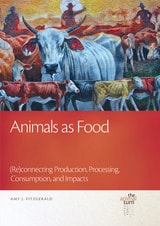
Animals as Food
(Re)connecting Production, Processing, Consumption, and ImpactsAmy J. Fitzgerald
Michigan State University Press, 2015
Every day, millions of people around the world sit down to a meal that includes meat. This book explores several questions as it examines the use of animals as food: How did the domestication and production of livestock animals emerge and why? How did current modes of raising and slaughtering animals for human consumption develop, and what are their consequences? What can be done to mitigate and even reverse the impacts of animal production? With insight into the historical, cultural, political, legal, and economic processes that shape our use of animals as food, Fitzgerald provides a holistic picture and explicates the connections in the supply chain that are obscured in the current mode of food production. Bridging the distance in animal agriculture between production, processing, consumption, and their associated impacts, this analysis envisions ways of redressing the negative effects of the use of animals as food. It details how consumption levels and practices have changed as the relationship between production, processing, and consumption has shifted. Due to the wide-ranging questions addressed in this book, the author draws on many fields of inquiry, including sociology, (critical) animal studies, history, economics, law, political science, anthropology, criminology, environmental science, geography, philosophy, and animal science.
[more]
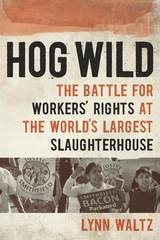
Hog Wild
The Battle for Workers' Rights at the World's Largest SlaughterhouseLynn Waltz
University of Iowa Press, 2018
When Smithfield Foods opened its pork processing plant in Tar Heel, North Carolina, in 1992, workers in the rural area were thrilled to have jobs at what was billed as “the largest slaughterhouse in the world.” However, they soon left in droves because of the fast, unrelenting line speed and high rate of injury. Those who stayed wanted higher wages and safer working conditions, but every time they tried to form a union, the company quickly cracked down, firing union leaders, assaulting organizers, and setting minority groups against each other.
Author and journalist Lynn Waltz reveals how these aggressive tactics went unchecked for years until Sherri Buffkin, a higher-up manager at Smithfield, blew the lid off the company’s corrupt practices. Through meticulous reporting, in-depth interviews with key players, and a mind for labor and environmental histories, Waltz weaves a fascinating tale of the nearly two-decade struggle that eventually brought justice to the workers and accountability to the food giant, pitting the world’s largest slaughterhouse against the world’s largest meatpacking union.
Following in a long tradition of books that expose the horrors of the meatpacking industry—from Upton Sinclair’s The Jungle to Eric Schlosser’s Fast Food Nation—Hog Wild uncovers rampant corporate environmental hooliganism, labor exploitation, and union-busting by one of the nation’s largest meat producers. Waltz’s eye-opening examination sheds new light on the challenges workers face not just in meatpacking, but everywhere workers have lost their power to collectively bargain with powerful corporations.
[more]
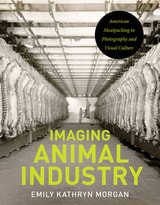
Imaging Animal Industry
American Meatpacking in Photography and Visual CultureEmily Kathryn Morgan
University of Iowa Press, 2024
Imaging Animal Industry focuses on the visual culture of the American meat industry between 1890 and 1960. It describes how, during that period, photographs and other images helped to shape public perceptions of industrial-scale meat production. Although the meat industry today bans most photography at its facilities, in the past this was not always the case: the meat industry not only tolerated but welcomed cameras. Meatpacking companies and industry organizations regarded photographs as useful tools for creating and managing a vision of their activities, their innovations, and their contributions to the march of American economic and industrial progress.
Drawing on archival collections across the American Midwest, this book relates a history of the meatpacking industry’s use of images in the early to mid-twentieth century. In the process, it reveals the key role that images, particularly photographs, have played in assisting with the rise of industrial meat production.
Drawing on archival collections across the American Midwest, this book relates a history of the meatpacking industry’s use of images in the early to mid-twentieth century. In the process, it reveals the key role that images, particularly photographs, have played in assisting with the rise of industrial meat production.
[more]
Killing Animals
The Animal Studies Group
University of Illinois Press, 2000
[more]
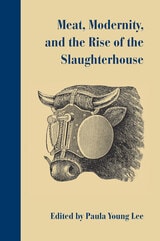
Meat, Modernity, and the Rise of the Slaughterhouse
Paula Young Lee
University of New Hampshire Press, 2008
Over the course of the nineteenth century, factory slaughterhouses replaced the hand-slaughter of livestock by individual butchers, who often performed this task in back rooms, letting blood run through streets. A wholly modern invention, the centralized municipal slaughterhouse was a political response to the public's increasing lack of tolerance for "dirty" butchering practices, corresponding to changing norms of social hygiene and fear of meat-borne disease. The slaughterhouse, in Europe and the Americas, rationalized animal slaughter according to capitalist imperatives. What is lost and what is gained when meat becomes a commodity? What do the sites of animal slaughter reveal about our relationship to animals and nature? Essays by the best international scholars come together in this cutting-edge interdisciplinary volume to examine the cultural significance of the slaughterhouse and its impact on modernity.
Contributors include: Dorothee Brantz, Kyri Claflin, Jared Day, Roger Horowitz, Lindgren Johnson, Ian MacLachlan, Christopher Otter, Dominic Pacyga, Richard Perren, Jeffrey Pilcher, and Sydney Watts.
Contributors include: Dorothee Brantz, Kyri Claflin, Jared Day, Roger Horowitz, Lindgren Johnson, Ian MacLachlan, Christopher Otter, Dominic Pacyga, Richard Perren, Jeffrey Pilcher, and Sydney Watts.
[more]
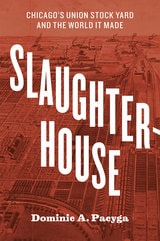
Slaughterhouse
Chicago's Union Stock Yard and the World It MadeDominic A. Pacyga
University of Chicago Press, 2015
From the minute it opened—on Christmas Day in 1865—it was Chicago’s must-see tourist attraction, drawing more than half a million visitors each year. Families, visiting dignitaries, even school groups all made trips to the South Side to tour the Union Stock Yard. There they got a firsthand look at the city’s industrial prowess as they witnessed cattle, hogs, and sheep disassembled with breathtaking efficiency. At their height, the kill floors employed 50,000 workers and processed six hundred animals an hour, an astonishing spectacle of industrialized death.
Slaughterhouse tells the story of the Union Stock Yard, chronicling the rise and fall of an industrial district that, for better or worse, served as the public face of Chicago for decades. Dominic A. Pacyga is a guide like no other—he grew up in the shadow of the stockyards, spent summers in their hog house and cattle yards, and maintains a long-standing connection with the working-class neighborhoods around them. Pacyga takes readers through the packinghouses as only an insider can, covering the rough and toxic life inside the plants and their lasting effects on the world outside. He shows how the yards shaped the surrounding neighborhoods and controlled the livelihoods of thousands of families. He looks at the Union Stock Yard’s political and economic power and its sometimes volatile role in the city’s race and labor relations. And he traces its decades of mechanized innovations, which introduced millions of consumers across the country to an industrialized food system.
Once the pride and signature stench of a city, the neighborhood is now home to Chicago’s most successful green agriculture companies. Slaughterhouse is the engrossing story of the creation and transformation of one of the most important—and deadliest—square miles in American history.
[more]