Results by title
7 books match the query 'Slave insurrections'
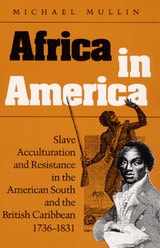
Africa in America
Slave Acculturation and Resistance in the American South and the British Caribbean, 1736-1831Michael Mullin
University of Illinois Press, 1992
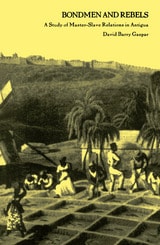
Bondmen and Rebels
A Study of Master-Slave Relations in AntiguaDavid Barry Gaspar
Duke University Press, 1985
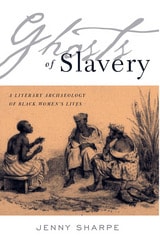
Ghosts Of Slavery
A Literary Archaeology of Black Women’s LivesJenny Sharpe
University of Minnesota Press, 2002
Questions traditional assumptions about power and agency in slave women’s everyday lives.
Through their open defiance, women like Harriet Tubman and Sojourner Truth had a significant impact on the institution of slavery. But what of the countless other women who did not commit public or even private acts of resistance? Are their stories worthy of our attention? While some scholars imply that only the struggle for freedom was legitimate, Jenny Sharpe complicates the linear narrative-from slavery to freedom and literacy-that emerged from the privileging of autobiographical accounts like that of Frederick Douglass. She challenges a paradigm that equates agency with resistance and self-determination, and introduces new ways to examine negotiations for power within the constraints of slavery.
In Ghosts of Slavery, Sharpe introduces a wider range of everyday practices by examining the lives of three distinctive Caribbean women: a maroon leader, a mulatto concubine, and a fugitive slave. Through them she explains how the diasporic experience of slavery enabled black women to claim an authority that they didn’t possess in Africa, how concubines empowered themselves through their mimicry of white women, and how less-privileged slave women manipulated situations that they were powerless to change. Finding the highly mediated portrayal of slave women in the historical records limited and sometimes misleading, Sharpe turns to unconventional sources for investigating these women’s lives. In this fascinating and historically rich account, she calls for new strategies of reading that question traditional narratives of history, and she finds alternative ways to integrate oral storytelling, slave songs, travel writing, court documents, proslavery literature, and contemporary literature into black history. Ultimately, this layered approach not only produces a more complex picture of the slave women’s agency than conventional readings, it encourages a more nuanced understanding of the roles of slaves in the history of slavery.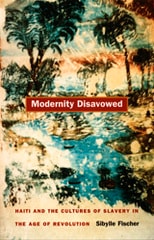
Modernity Disavowed
Haiti and the Cultures of Slavery in the Age of RevolutionSibylle Fischer
Duke University Press, 2004
Fischer draws on history, literary scholarship, political theory, philosophy, and psychoanalytic theory to examine a range of material, including Haitian political and legal documents and nineteenth-century Cuban and Dominican literature and art. She demonstrates that at a time when racial taxonomies were beginning to mutate into scientific racism and racist biology, the Haitian revolutionaries recognized the question of race as political. Yet, as the cultural records of neighboring Cuba and the Dominican Republic show, the story of the Haitian Revolution has been told as one outside politics and beyond human language, as a tale of barbarism and unspeakable violence. From the time of the revolution onward, the story has been confined to the margins of history: to rumors, oral histories, and confidential letters. Fischer maintains that without accounting for revolutionary antislavery and its subsequent disavowal, Western modernity—including its hierarchy of values, depoliticization of social goals having to do with racial differences, and privileging of claims of national sovereignty—cannot be fully understood.
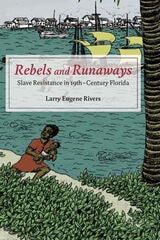
Rebels and Runaways
Slave Resistance in Nineteenth-Century FloridaLarry Eugene Rivers
University of Illinois Press, 2013
Against a smoldering backdrop of violence, this study analyzes the various degrees of slave resistance--from the perspectives of both slave and master--and how they differed in various regions of antebellum Florida. In particular, Rivers demonstrates how the Atlantic world view of some enslaved blacks successfully aided their escape to freedom, a path that did not always lead North but sometimes farther South to the Bahama Islands and Caribbean. Identifying more commonly known slave rebellions such as the Stono, Louisiana, Denmark (Telemaque) Vesey, Gabriel, and the Nat Turner insurrections, Rivers argues persuasively that the size, scope, and intensity of black resistance in the Second Seminole War makes it the largest sustained slave insurrection ever to occur in American history.
Meticulously researched, Rebels and Runaways offers a detailed account of resistance, protest, and violence as enslaved blacks fought for freedom.
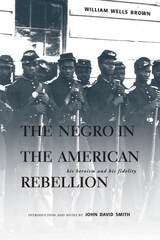
The Negro in the American Rebellion
His Heroism and His FidelityWilliam Wells Brown
Ohio University Press, 1997
In 1863, as the Civil War raged, the escaped slave, abolitionist, and novelist William Wells Brown identified two groups most harmful to his race. “The first and most relentless,” he explained, “are those who have done them the greatest injury, by being instrumental in their enslavement and consequent degradation. They delight to descant upon the ‘natural inferiority’ of the blacks, and claim that we were destined only for a servile condition, entitled neither to liberty nor the legitimate pursuit of happiness.”
“The second class,” Brown concluded, “are those who are ignorant of the characteristics of the race, and are the mere echoes of the first.” Four years later, Brown wrote the first military history of African Americans, The Negro in the American Rebellion. This text assailed those whose hatred and ignorance inclined them to keep blacks oppressed after Appomattox.
This critical edition of The Negro in the American Rebellion, one of Brown’s least-analyzed texts, is the first to appear in more than three decades. In his introduction, historian John David Smith identifies the text’s Anglo-American abolitionist roots, sets it in the context of Brown’s other writings, appraises it as military history, analyzes its interpretation of black masculinity and honor, and focuses closely on Brown’s assessment of contemporary racial tensions.
Largely ignored by scholars, The Negro in the American Rebellion, Smith argues, is a powerful transitional text, one that confronted squarely the neo-slavery of the Reconstruction era.
“Whites,” Brown wrote, “appear determined to reduce the blacks to a state of serfdom if they cannot have them as slaves.” His important text was a call to arms in the ongoing race struggle. Smith’s analysis, framed within recent scholarship on slavery, emancipation, and African American participation in the U.S. army, is long overdue.

The Slumbering Volcano
American Slave Ship Revolts and the Production of Rebellious MasculinityMaggie Montesinos Sale
Duke University Press, 1997
This comparison of narrative response with written public reaction to the actual revolts allows Sale to investigate the precise manner in which public opinion regarding definitions of liberty evolved over this crucial period of time between the Revolutionary and Civil Wars. Mapping the ways in which unequally empowered groups claimed and transformed statements associated with the discourse of national identity, Sale succeeds in recovering a historically informed sense of the discursive and activist options available to people of another era.
In its demonstration of how the United States has been uniquely shaped by its dual status as both an imperial and a postcolonial power, this study on the discourse of natural rights and national identity in the pre-Civil War United States will interest students and scholars of American studies, African American studies, gender studies, and American history and literature.