Results by title
11 books match the query 'Slave-trade'

Economic Change in Precolonial Africa
Supplementary EvidencePhilip D. Curtin
University of Wisconsin Press, 0
Eurafricans in Western Africa
Commerce, Social Status, Gender, and Religious Observance from the Sixteenth to the Eighteenth CenturyGeorge E. Brooks
Ohio University Press, 2003
Eurafricans in Western Africa traces the rich social and commercial history of western Africa. The most comprehensive study to date, it begins prior to the sixteenth century when huge profits made by middlemen on trade in North African slaves, salt, gold, pepper, and numerous other commodities prompted Portuguese reconnaissance voyages along the coast of western Africa. From Senegal to Sierra Leone, Portuguese, including “New Christians” who reverted to Judaism while living in western Africa, thrived where riverine and caravan networks linked many African groups.
Portuguese and their Luso-African descendants contended with French, Dutch, and English rivals for trade in gold, ivory, slaves, cotton textiles, iron bars, cowhides, and other African products. As the Atlantic slave trade increased, French and Franco-Africans and English and Anglo-Africans supplanted Portuguese and Luso-Africans in many African places of trade.
Eurafricans in Western Africa follows the changes that took root in the eighteenth century when French and British colonial officials introduced European legal codes, and concludes with the onset of the French Revolution and Napoleonic Wars, when suppression of the slave trade and expanding commerce in forest and agricultural commodities again transformed circumstances in western Africa.
Professor George E. Brooks’s outstanding history of these vital aspects of western Africa is enriched by his discussion of the roles of the women who married or cohabited with European traders. Through accounts of incidents and personal histories, which are integrated into the narrative, the lives of these women and their children are accorded a prominent place in Professor Brooks’s fascinating discussion of this dynamic region of Africa.
European Slave Trading in the Indian Ocean, 1500–1850
Richard B. Allen
Ohio University Press, 2015
Between 1500 and 1850, European traders shipped hundreds of thousands of African, Indian, Malagasy, and Southeast Asian slaves to ports throughout the Indian Ocean world. The activities of the British, Dutch, French, and Portuguese traders who operated in the Indian Ocean demonstrate that European slave trading was not confined largely to the Atlantic but must now be viewed as a truly global phenomenon. European slave trading and abolitionism in the Indian Ocean also led to the development of an increasingly integrated movement of slave, convict, and indentured labor during the late eighteenth and early nineteenth centuries, the consequences of which resonated well into the twentieth century.
Richard B. Allen’s magisterial work dramatically expands our understanding of the movement of free and forced labor around the world. Drawing upon extensive archival research and a thorough command of published scholarship, Allen challenges the modern tendency to view the Indian and Atlantic oceans as self-contained units of historical analysis and the attendant failure to understand the ways in which the Indian Ocean and Atlantic worlds have interacted with one another. In so doing, he offers tantalizing new insights into the origins and dynamics of global labor migration in the modern world.
Slaves, Spices and Ivory in Zanzibar
Integration of an East African Commercial Empire into the World Economy, 1770–1873Abdul Sheriff
Ohio University Press, 1987
The rise of Zanzibar was based on two major economic transformations. Firstly slaves became used for producing cloves and grains for export. Previously the slaves themselves were exported.
Secondly, there was an increased international demand for luxuries such as ivory. At the same time the price of imported manufactured gods was falling. Zanzibar took advantage of its strategic position to trade as far as the Great Lakes.
However this very economic success increasingly subordinated Zanzibar to Britain, with its anti-slavery crusade and its control over the Indian merchant class.
Professor Sheriff analyses the early stages of the underdevelopment of East Africa and provides a corrective to the dominance of political and diplomatic factors in the history of the area.
Specters of the Atlantic
Finance Capital, Slavery, and the Philosophy of HistoryIan Baucom
Duke University Press, 2005
Baucom contends that the massacre and the trials that followed it bring to light an Atlantic cycle of capital accumulation based on speculative finance, an economic cycle that has not yet run its course. The extraordinarily abstract nature of today’s finance capital is the late-eighteenth-century system intensified. Yet, as Baucom highlights, since the late 1700s, this rapacious speculative culture has had detractors. He traces the emergence and development of a counter-discourse he calls melancholy realism through abolitionist and human-rights texts, British romantic poetry, Scottish moral philosophy, and the work of late-twentieth-century literary theorists. In revealing how the Zong tragedy resonates within contemporary financial systems and human-rights discourses, Baucom puts forth a deeply compelling, utterly original theory of history: one that insists that an eighteenth-century atrocity is not past but present within the future we now inhabit.
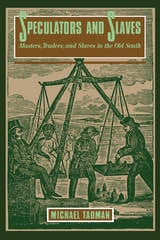
Speculators And Slaves
Masters, Traders, And Slaves In The Old SouthMichael Tadman
University of Wisconsin Press, 1996
The Anthropology of Slavery
The Womb of Iron and GoldClaude Meillassoux
University of Chicago Press, 1991
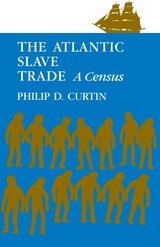
The Atlantic Slave Trade
A CensusPhilip D. Curtin
University of Wisconsin Press, 1972
Curtin combines modern research and statistical methods with his broad knowledge of the field to present the first book-length quantitative analysis of the Atlantic slave trade. Its basic evidence suggests revision of currently held opinions concerning the place of the slave trade in the economies of the Old World nations and their American colonies.
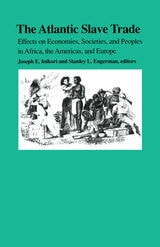
The Atlantic Slave Trade
Effects on Economies, Societies and Peoples in Africa, the Americas, and EuropeJoseph E. Inikori and Stanley L. Engerman
Duke University Press, 1992
Among the questions these essays address are: the social cost to Africa of this forced migration; the role of slavery in the economic development of Europe and the United States; the short-term and long-term effects of the slave trade on black mortality, health, and life in the New World; and the racial and cultural consequences of the abolition of slavery. Some of these essays originally appeared in recent issues of Social Science History; the editors have added new material, along with an introduction placing each essay in the context of current debates.
Based on extensive archival research and detailed historical examination, this collection constitutes an important contribution to the study of an issue of enduring significance. It is sure to become a standard reference on the Atlantic slave trade for years to come.
Contributors. Ralph A. Austen, Ronald Bailey, William Darity, Jr., Seymour Drescher, Stanley L. Engerman, David Barry Gaspar, Clarence Grim, Brian Higgins, Jan S. Hogendorn, Joseph E. Inikori, Kenneth Kiple, Martin A. Klein, Paul E. Lovejoy, Patrick Manning, Joseph C. Miller, Johannes Postma, Woodruff Smith, Thomas Wilson
The French Atlantic Triangle
Literature and Culture of the Slave TradeChristopher L. Miller
Duke University Press, 2008
Miller offers a historical introduction to the cultural and economic dynamics of the French slave trade, and he shows how Enlightenment thinkers such as Montesquieu and Voltaire mused about the enslavement of Africans, while Rousseau ignored it. He follows the twists and turns of attitude regarding the slave trade through the works of late-eighteenth- and early-nineteenth-century French writers, including Olympe de Gouges, Madame de Staël, Madame de Duras, Prosper Mérimée, and Eugène Sue. For these authors, the slave trade was variously an object of sentiment, a moral conundrum, or an entertaining high-seas “adventure.” Turning to twentieth-century literature and film, Miller describes how artists from Africa and the Caribbean—including the writers Aimé Césaire, Maryse Condé, and Edouard Glissant, and the filmmakers Ousmane Sembene, Guy Deslauriers, and Roger Gnoan M’Bala—have confronted the aftermath of France’s slave trade, attempting to bridge the gaps between silence and disclosure, forgetfulness and memory.
Way of Death
Merchant Capitalism and the Angolan Slave Trade, 1730–1830Joseph Calder Miller
University of Wisconsin Press, 1996
This acclaimed history of Portuguese and Brazilian slaving in the southern Atlantic is now available in paperback.
With extraordinary skill, Joseph C. Miller explores the complex relationships among the separate economies of Africa, Europe, and the South Atlantic that collectively supported the slave trade. He places the grim history of the trade itself within the context of the rise of merchant capitalism in the eighteenth century. Throughout, Miller illuminates the experiences of the slaves themselves, reconstructing what can be known of their sufferings at the hands of their buyers and sellers.