Results by title
4 books match the query 'Smith, Adam'

Adam Smith
The Rhetoric of ProprietyStephen J. McKenna
Southern Illinois University Press, 2006
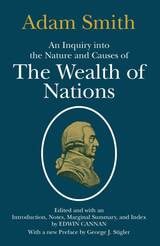
An Inquiry into the Nature and Causes of the Wealth of Nations
Adam Smith
University of Chicago Press, 1977
Adam Smith's The Wealth of Nations was recognized as a landmark of immediately upon publication in 1776. As the first serious, data-driven argument for the principles of political economy, it is the point of departure for all subsequent economic thought. Smith's argument that human self-interest is the primary driver of economic activity, and that in aggregate that self-interest--acting through a market freed from government intervention-guides markets and economies toward the best outcomes for business and society, remains foundational for contemporary free-market economics.
This edition presents the definitive 1904 version of The Wealth of Nations, painstakingly edited by Edwin Cannan and featuring Cannan's illuminating introduction, and notes, as well as a a full index. An additional preface by distinguished economist George J. Stigler places Smith's book and thought in a contemporary context. The result is the best edition of this classic for students and general readers alike.

An Inquiry into the Nature and Causes of the Wealth of Nations
The Definitive EditionAdam Smith
University of Chicago Press, 0
The book that made the modern world, reissued in its definitive scholarly form and featuring a new foreword from Nobel Prize winner Amartya Sen.
First published in 1776, Adam Smith’s masterwork The Wealth of Nations formalized the first unified theory of modern economies—how human nature, public institutions, and private interests can coalesce in a society greater than the sum of its parts. More than 250 years later, it remains one of humanity’s most defining and lasting literary works.
This definitive edition includes Edwin Cannan’s famous annotations of the original text, accounting for both Smith’s early drafts and his lectures at the University of Glasgow, where he originated the book’s concepts. The result is the most complete edition of the work to date, maintaining unprecedented fidelity to Smith’s ideas and packaging them in fluent and elevating terms.
In a new foreword, Nobel laureate Amartya Sen offers context and contemporary incision for twenty-first-century readers, discussing the uses—and occasional misuses—of Smith’s ideas for the advancement of political agendas. The Wealth of Nations, Sen makes clear, is a book about societies, not just economies. “Smith’s economics accommodated his values,” he writes. As readers of The Wealth of Nations will discover and rediscover, those values prioritized the lives of everyday working people above all else.

Being Me Being You
Adam Smith and EmpathySamuel Fleischacker
University of Chicago Press, 2019
After laying out a range of meanings for the concept of empathy, Fleischacker proposes that what Smith called “sympathy” is very much what we today consider empathy. Smith’s version has remarkable value, as his empathy calls for entering into the perspective of another—a uniquely human feat that connects people while still allowing them to define their own distinctive standpoints. After discussing Smith’s views in relation to more recent empirical and philosophical studies, Fleischacker shows how turning back to Smith promises to enrich, clarify, and advance our current debates about the meaning and uses of empathy.