Results by title
5 books match the query 'Smith, Christian'
American Evangelicalism
Embattled and ThrivingChristian Smith
University of Chicago Press, 1998
Based on a national telephone survey and more than three hundred personal interviews with evangelicals and other churchgoing Protestants, this study provides a detailed analysis of the commitments, beliefs, concerns, and practices of this thriving group. Examining how evangelicals interact with and attempt to influence secular society, this book argues that traditional, orthodox evangelicalism endures not despite, but precisely because of, the challenges and structures of our modern pluralistic environment. This work also looks beyond evangelicalism to explore more broadly the problems of traditional religious belief and practice in the modern world.
With its impressive empirical evidence, innovative theory, and substantive conclusions, American Evangelicalism will provoke lively debate over the state of religious practice in contemporary America.
Resisting Reagan
The U.S. Central America Peace MovementChristian Smith
University of Chicago Press, 1996
Focusing on the movement's three most important national campaigns—Witness for Peace, Sanctuary, and the Pledge of Resistance—this book demonstrates the centrality of morality as a political motivator, highlights the importance of political opportunities in movement outcomes, and examines the social structuring of insurgent consciousness. Based on extensive surveys, interviews, and research, Resisting Reagan makes significant contributions to our understanding of the formation of individual activist identities, of national movement dynamics, and of religious resources for political activism.
The Emergence of Liberation Theology
Radical Religion and Social Movement TheoryChristian Smith
University of Chicago Press, 1991
To Flourish or Destruct
A Personalist Theory of Human Goods, Motivations, Failure, and EvilChristian Smith
University of Chicago Press, 2015
In his 2010 book What Is a Person?, Christian Smith argued that sociology had for too long neglected this fundamental question. Prevailing social theories, he wrote, do not adequately “capture our deep subjective experience as persons, crucial dimensions of the richness of our own lived lives, what thinkers in previous ages might have called our ‘souls’ or ‘hearts.’” Building on Smith’s previous work, To Flourish or Destruct examines the motivations intrinsic to this subjective experience: Why do people do what they do? How can we explain the activity that gives rise to all human social life and social structures?
Smith argues that our actions stem from a motivation to realize what he calls natural human goods: ends that are, by nature, constitutionally good for all human beings. He goes on to explore the ways we can and do fail to realize these ends—a failure that can result in varying gradations of evil. Rooted in critical realism and informed by work in philosophy, psychology, and other fields, Smith’s ambitious book situates the idea of personhood at the center of our attempts to understand how we might shape good human lives and societies.
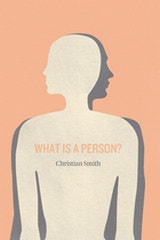
What Is a Person?
Rethinking Humanity, Social Life, and the Moral Good from the Person UpChristian Smith
University of Chicago Press, 2010
What is a person? This fundamental question is a perennial concern of philosophers and theologians. But, Christian Smith here argues, it also lies at the center of the social scientist’s quest to interpret and explain social life. In this ambitious book, Smith presents a new model for social theory that does justice to the best of our humanistic visions of people, life, and society.
Finding much current thinking on personhood to be confusing or misleading, Smith finds inspiration in critical realism and personalism. Drawing on these ideas, he constructs a theory of personhood that forges a middle path between the extremes of positivist science and relativism. Smith then builds on the work of Pierre Bourdieu, Anthony Giddens, and William Sewell to demonstrate the importance of personhood to our understanding of social structures. From there he broadens his scope to consider how we can know what is good in personal and social life and what sociology can tell us about human rights and dignity.
Innovative, critical, and constructive, What Is a Person? offers an inspiring vision of a social science committed to pursuing causal explanations, interpretive understanding, and general knowledge in the service of truth and the moral good.