Results by title
17 books match the query 'Smith, Joseph, Jr.'
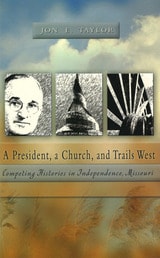
A President, a Church and Trails West
Competing Histories in Independence, MissouriJon E. Taylor
University of Missouri Press, 2008
Over the past century, three nationally significant histories have vied for space and place in Independence, Missouri. Independence was declared Zion by Joseph Smith, served as a gathering and provisioning point for trails west, and was called home by President Harry S. Truman for sixty-four years. Historian Jon E. Taylor has integrated research from newspapers, public documents, oral histories, and private papers to detail how the community has preserved and remembered these various legacies.
Truman’s legacy would appear to have been secured in Independence via three significant designations—his presidential library opened there in 1957, his neighborhood was designated a national historic landmark in 1972, and his home was declared a national historic site in 1982. However, Taylor argues that Truman’s seeming dominance in the community’s memory is in fact endangered by competition from the other aspects of the town’s historical heritage.
Taylor considers the role Mormon history has played in the city's history and chronicles how the Reorganized Church of Jesus Christ of Latter Day Saints returned to Independence to fulfill Joseph Smith's dream of creating Zion in the city, a situation that impacted neighborhoods near the Truman home. Taylor also examines the city's fascination with the Santa Fe, Oregon, and California trails, detailing how that history was lost and remembered and is now immortalized on the Independence square and in the National Frontier Trails Museum.
In the 1980s, the city council reduced the size of the Truman Heritage District, created to maintain Truman’s association with his neighborhood, after church opposition. At the same time, city officials pushed to make Independence a major tourist destination, a move largely dependent upon the city capitalizing on its association with Truman. These inconsistent policies and incongruous goals have led to innumerable changes in the landscape Truman enjoyed during his legendary morning walks.
A President, a Church, and Trails West chronicles one city’s struggle to preserve its history and the built environment. Taylor places the role of preservation in Independence not only within the larger context of preservation in the United States but also within the context of American environmental history. This volume is sure to appeal to anyone interested in public history, historic preservation, history and memory, and local history.
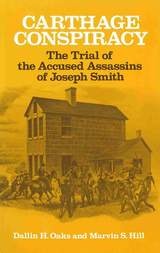
Carthage Conspiracy
The Trial of the Accused Assassins of Joseph SmithDallin H. Oaks and Marvin S. Hill
University of Illinois Press, 1975
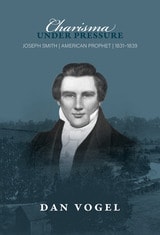
Charisma under Pressure
Joseph Smith, American Prophet, 1831–1839Dan Vogel
Signature Books, 2023
But just who was Joseph Smith? What motivated him? In examining Smith’s life during his Ohio and Missouri sojourns, Vogel seeks to answer those questions. But, Vogel is quick to note, “There are, in fact, many possible constructions of Joseph Smith, and depending on how one assesses the evidence for his truth-claims, a completely different Joseph Smith emerges. But this is probably as Smith wanted it.”
During this period, Smith established a temple, printing presses, additional scripture, expanded church offices, and built a bank—all indicating a sense of permanence and strength for his young church at one level while causing its near collapse at another.
Envisioning Scripture
Joseph Smith’s Revelations in Their Early American ContextsColby Townsend
Signature Books, 2022
Contributors include Catherine A. Brekus, William Davis, Elizabeth Fenton, Kathleen Flake, Paul Gutjahr, Jared Hickman, Susan Juster, Seth Perry, Laura Thiemann Scales, and Roberto A. Valdeón.
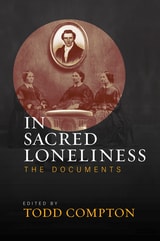
In Sacred Loneliness
The DocumentsTodd Compton
Signature Books, 2022
This volume includes many autobiographical writings, diaries, and letters, with Compton providing annotations and introductory material that illuminates these crucial primary sources. This allows readers to take their understanding of this unique group of women to a new level and to drive home that fact that their lives go far beyond the Nauvoo experiment that forever links them to Mormonism’s founding prophet.
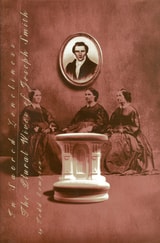
In Sacred Loneliness
The Plural Wives of Joseph SmithTodd Compton
Signature Books, 1997
The majority of Smith’s wives were younger than he, and one-third were between fourteen and twenty years of age. Another third were already married, and some of the husbands served as witnesses at their own wife’s polyandrous wedding. In addition, some of the wives hinted that they bore Smith children—most notably Sylvia Sessions’s daughter Josephine—although the children carried their stepfather’s surname.
For all of Smith’s wives, the experience of being secretly married was socially isolating, emotionally draining, and sexually frustrating. Despite the spiritual and temporal benefits, which they acknowledged, they found their faith tested to the limit of its endurance. After Smith’s death in 1844, their lives became even more “lonely and desolate.” One even joined a convent. The majority were appropriated by Smith’s successors, based on the Old Testament law of the Levirate, and had children by them, though they considered these guardianships unsatisfying. Others stayed in the Midwest and remarried, while one moved to California. But all considered their lives unhappy, except for the joy they found in their children and grandchildren.
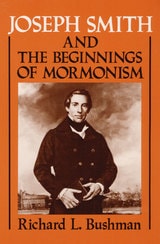
Joseph Smith and the Beginnings of Mormonism
Richard L. Bushman
University of Illinois Press, 1984
Winner of the David Woolley Evans and Beatrice Evans Biography Award and a History Book Club selection, 1985.
The core of Mormon belief was a conviction about actual events. The test of faith was not adherence to a certain confession of faith but belief that Christ was resurrected, that Joseph Smith saw God, that the Book of Mormon was true history, and that Peter, James, and John restored the apostleship. Mormonism was history, not philosophy.
It is as history that Richard L. Bushman analyzes the emergence of Mormonism in the early nineteenth century. Bushman, however, brings to his study a unique set of credentials--he is both a prize-winning historian and a faithful member of the Latter-day Saints church. For Mormons and non-Mormons alike, his book provides a very special perspective on an endlessly fascinating subject.
Building upon previous accounts and incorporating recently discovered contemporary sources, Bushman focuses on the first twenty-five years of Joseph Smith's life--up to his move to Kirtland, Ohio, in 1831. Bushman shows how the rural Yankee culture of New England and New York--especially evangelical revivalism, Christian rationalism, and folk magic--both influenced and hindered the formation of Smith's new religion.
Mormonism, Bushman argues, must be seen not only as the product of this culture, but also as an independent creation based on the revelations of its charismatic leader. In the final analysis, it was Smith's ability to breathe new life into the ancient sacred stories and to make a sacred story out of his own life which accounted for his own extraordinary influence. By presenting Smith and his revelations as they were viewed by the early Mormons themselves, Bushman leads us to a deeper understanding of their faith.
Joseph Smith
History, Methods, and MemoryRonald O. Barney
University of Utah Press, 2020
Ronald O. Barney, a former editor of the Joseph Smith Papers, applies new interpretations to Smith in history and memory, re-examining both his writings and contemporary accounts of him. The book explores the best methodologies for appraising the historical record, including a review of Smith’s world and its contextual background, an analysis of his foundational experiences, and a characterization of Smith as a man and prophet. Though the premise of re-evaluation may be unsettling to traditionalists, a modern reconsideration of the historical record’s entire range of sources is necessary to fashion a strategy for evaluating Smith and his enduring but complex legacy.
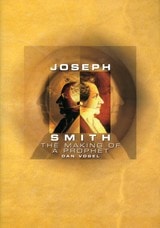
Joseph Smith
The Making of a ProphetDan Vogel
Signature Books, 2004
Vogel weaves together strands of evidence into a complete fabric including, among other aspects of Smith’s environment, the content of his daily dictation of scriputre and revelation—all contributing to a nearly complete view of what occurred on any given day in Smith’s lfie. The result is as much intellectual history as traditional biography. Readers will feel engaged in the dramatic, formative events in the prophet’s life against a backdrop of theology, local and national politics, Smith family dynamics, organizational issues, and interpersonal relations. One can form a mental picture, and many will find themselves carrying on an internal dialogue about the issues raised.
Vogel addresses the following broad themes:
1. The home that Joseph Smith was raised in was religiously divided. His mother’s family was orthodox and partly mystical; his father’s family tended toward rationalism and skepticism. Joseph’s maternal grandfather published an account of seeing a heavenly light and hearing Jesus’ voice. Joseph’s paternal grandfather promoted Thomas Paine’s skeptical critique of the Bible, The Age of Reason.
2. When Andrew Jackson was elected U.S. president in 1828, it was a key transitional period in American history. Jackson was a Mason and an advocate of secularism, which alarmed evangelical Protestants.
3. The Smith family experienced a series of financial setbacks and lost their farm in 1825. Joseph felt disinherited and saw no way of escape—no chance for his family to regain its former standing in the community.
4. Joseph found solace in religion. In the early 1820s, he had a powerful conversion experience and felt that Jesus had forgiven him of his sins. This inspired him to share the gospel message with others, particularly with his own family. About the same time, Smith found a talent for preaching and delivered “passable” Methodist sermons at a nearby revival.
5. Over time, Joseph became aware that people trusted him and that he could be an influence for good or ill, that even through nefarious means, God worked through him when his heart was right. He realized this when he led groups in search of Spanish treasure in New York and Pennsylvania. Although no treasure was found, the men sincerely believed that Smith had a spiritual gift and could see where casks of gold were hidden in the earth. This training ground in spiritual leadership was invaluable because the prophet learned how to create an environment for belief—one in which people could exercise faith and be converted to Christ through the sensible influence of the Spirit, all prior to the overarching work of restoring primitive Christianity.
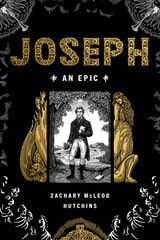
Joseph
An EpicZachary McLeod Hutchins
University of Illinois Press, 2025
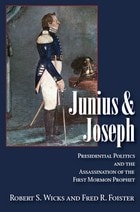
Junius And Joseph
Presidential Politics and the Assassination of the First Mormon ProphetRobert S. Wicks & Fred R. Foister
Utah State University Press, 2005
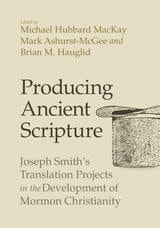
Producing Ancient Scripture
Joseph Smith's Translation Projects in the Development of Mormon ChristianityEdited by Michael Hubbard MacKay, Mark Ashurst-McGee, and Brian M. Hauglid
University of Utah Press, 2020
This collaborative volume is the first to study Joseph Smith’s translation projects in their entirety. In this carefully curated collection, experts contribute cutting-edge research and incisive analysis. The chapters explore Smith’s translation projects in focused detail and in broad contexts, as well as in comparison and conversation with one another. Authors approach Smith’s sacred texts historically, textually, linguistically, and literarily to offer a multidisciplinary view. Scrupulous examination of the production and content of Smith’s translations opens new avenues for understanding the foundations of Mormonism, provides insight on aspects of early American religious culture, and helps conceptualize the production and transmission of sacred texts.
Reconsidering No Man Knows My History
edited by Newell G. Bringhurst
Utah State University Press, 1996
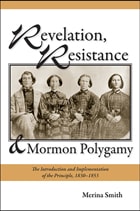
Revelation, Resistance, and Mormon Polygamy
The Introduction and Implementation of the Principle, 1830–1853Merina Smith
Utah State University Press, 2013
When Joseph Smith began to reveal and teach the doctrine of plural marriage in 1841, even stalwart members like Brigham Young were shocked and confused. In this thoughtful study, Smith argues that the secret introduction of plural marriage among the leadership coincided with an evolving public theology that provided a contextualizing religious narrative that persuaded believers to accept the principle.
This fresh interpretation draws from diaries, letters, newspapers, and other primary sources and is especially effective in its use of family narratives. It will be of great interest not only to scholars and the general public interested in Mormon history but in American history, religion, gender and sexuality, and the history of marriage and families.
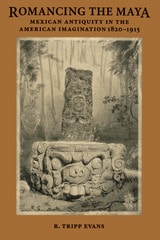
Romancing the Maya
Mexican Antiquity in the American Imagination, 1820-1915By R. Tripp Evans
University of Texas Press, 2004
During Mexico's first century of independence, European and American explorers rediscovered its pre-Hispanic past. Finding the jungle-covered ruins of lost cities and artifacts inscribed with unintelligible hieroglyphs—and having no idea of the age, authorship, or purpose of these antiquities—amateur archaeologists, artists, photographers, and religious writers set about claiming Mexico's pre-Hispanic patrimony as a rightful part of the United States' cultural heritage.
In this insightful work, Tripp Evans explores why nineteenth-century Americans felt entitled to appropriate Mexico's cultural heritage as the United States' own. He focuses in particular on five well-known figures—American writer and amateur archaeologist John Lloyd Stephens, British architect Frederick Catherwood, Joseph Smith, founder of the Church of Jesus Christ of Latter-Day Saints, and the French émigré photographers Désiré Charnay and Augustus Le Plongeon. Setting these figures in historical and cultural context, Evans uncovers their varying motives, including the Manifest Destiny-inspired desire to create a national museum of American antiquities in New York City, the attempt to identify the ancient Maya as part of the Lost Tribes of Israel (and so substantiate the Book of Mormon), and the hope of proving that ancient Mesoamerica was the cradle of North American and even Northern European civilization. Fascinating stories in themselves, these accounts of the first explorers also add an important new chapter to the early history of Mesoamerican archaeology.

Secret Covenants
New Insights on Early Mormon PolygamyBruno, Cheryl L.
Signature Books, 2024
Navigating the intricate labyrinth of early Mormon plural marriage can be fascinating, frustrating, and often confusing. The essays in this volume venture into the depths of historical inquiry, presenting a diverse array of perspectives on the subject. Authored by a consortium of esteemed scholars and researchers in the field of Mormon studies, it addresses the nuanced intricacies of Joseph Smith’s involvement in plural marriage.
Delving into the core of this discourse, these experts meticulously analyze foundational documents, highlighting the complexities Joseph Smith faced in practicing plural marriage and shedding light on the legal aspects of polygamy in 1840s Illinois. It navigates lesser-known details of Smith’s proposals and relationships, including the enigmatic story of Fanny Alger.
Secret Covenants presents a balanced exploration. It critiques traditional portrayals, providing multiple viewpoints, such as the examination of Emma Smith’s vehement rejection of polygamy after her husband’s death, and an analysis of the societal impact on women within polygamous unions. Furthermore, the authors address evolving doctrinal debates triggered by the “Marriage Revelation” and its impact on Mormon philosophy and thought.
This anthology serves as a foundational resource for academic scholars, individuals interested in religious history, and anyone seeking to understand the many layers of Mormon plural marriage.
Unsettling Scripture
Iroquois and the Book of MormonThomas W Murphy
University of Utah Press, 2025
In Unsettling Scripture: Iroquois and the Book of Mormon, anthropologist Thomas W Murphy delves into the visions of Seneca prophet Handsome Lake, the epic narratives of the Iroquois Confederacy, and the origin story of the Book of Mormon, revealing surprising parallels between Indigenous and Mormon traditions.
Through ethnohistorical research and decolonizing methodologies, Murphy reexamines how both communities understand their origins, faith, and prophecy. From Handsome Lake’s revelations to Joseph Smith’s seer stone, from ancient sibling rivalries to the Great Peace, this book unsettles traditional narratives while opening new conversations on scripture, identity, and cultural exchange. Drawing from living Indigenous voices, Unsettling Scripture challenges readers to rethink sacred texts and the histories they tell.