Results by title

11 books match the query 'Smith, Terry'
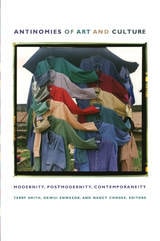
cover of Antinomies of Art and Culture: Modernity, Postmodernity, Contemporaneity

Antinomies of Art and Culture

Modernity, Postmodernity, Contemporaneity

Terry Smith, Okwui Enwezor, and Nancy Condee, eds.

Duke University Press, 2008

In this landmark collection, world-renowned theorists, artists, critics, and curators explore new ways of conceiving the present and understanding art and culture in relation to it. They revisit from fresh perspectives key issues regarding modernity and postmodernity, including the relationship between art and broader social and political currents, as well as important questions about temporality and change. They also reflect on whether or not broad categories and terms such as modernity, postmodernity, globalization, and decolonization are still relevant or useful. Including twenty essays and seventy-seven images, Antinomies of Art and Culture is a wide-ranging yet incisive inquiry into how to understand, describe, and represent what it is to live in the contemporary moment.

In the volume’s introduction the theorist Terry Smith argues that predictions that postmodernity would emerge as a global successor to modernity have not materialized as anticipated. Smith suggests that the various situations of decolonized Africa, post-Soviet Europe, contemporary China, the conflicted Middle East, and an uncertain United States might be better characterized in terms of their “contemporaneity,” a concept which captures the frictions of the present while denying the inevitability of all currently competing universalisms. Essays range from Antonio Negri’s analysis of contemporaneity in light of the concept of multitude to Okwui Enwezor’s argument that the entire world is now in a postcolonial constellation, and from Rosalind Krauss’s defense of artistic modernism to Jonathan Hay’s characterization of contemporary developments in terms of doubled and even para-modernities. The volume’s centerpiece is a sequence of photographs from Zoe Leonard’s Analogue project. Depicting used clothing, both as it is bundled for shipment in Brooklyn and as it is displayed for sale on the streets of Uganda, the sequence is part of a striking visual record of new cultural forms and economies emerging as others are left behind.

Contributors: Monica Amor, Nancy Condee, Okwui Enwezor, Boris Groys, Jonathan Hay, Wu Hung, Geeta Kapur, Rosalind Krauss, Bruno Latour, Zoe Leonard, Lev Manovich, James Meyer, Gao Minglu, Helen Molesworth, Antonio Negri, Sylvester Okwunodu Ogbechie, Nikos Papastergiadis, Colin Richards, Suely Rolnik, Terry Smith, McKenzie Wark
[more]
cover of Art to Come: Histories of Contemporary Art

Art to Come

Histories of Contemporary Art

Terry Smith

Duke University Press, 2019
In Art to Come Terry Smith—who is widely recognized as one of the world's leading historians and theorists of contemporary art—traces the emergence of contemporary art and further develops his concept of contemporaneity. Smith shows that embracing contemporaneity as both a historical concept and a condition of the globalized world allows us to grasp how contemporary art exists in a fluid space of increasing interdependencies, multiple contemporaneous modernities, and persistent inequalities. Throughout these essays, Smith offers systematic proposals for writing contemporary art's histories while assessing how curators, critics, philosophers, artists, and art historians are currently doing so. Among other topics, Smith examines the intersection of architecture with other visual arts, Chinese art since the Cultural Revolution, how philosophers are theorizing concepts associated with the contemporary, Australian Indigenous art, and the current state of art history. Art to Come will be essential reading for artists, art students, curators, gallery workers, historians, critics, and theorists.
[more]
cover of Impossible Presence: Surface and Screen in the Photogenic Era

Impossible Presence

Surface and Screen in the Photogenic Era

Edited by Terry Smith

University of Chicago Press, 2001

Impossible Presence brings together new work in film studies, critical theory, art history, and anthropology for a multifaceted exploration of the continuing proliferation of visual images in the modern era. It also asks what this proliferation—and the changing technologies that support it—mean for the ways in which images are read today and how they communicate with viewers and spectators.
Framed by Terry Smith's introduction, the essays focus on two kinds of strangeness involved in experiencing visual images in the modern era. The first, explored in the book's first half, involves the appearance of oddities or phantasmagoria in early photographs and cinema. The second type of strangeness involves art from marginalized groups and indigenous peoples, and the communicative formations that result from the trafficking of images between people from vastly different cultures. With a stellar list of contributors, Impossible Presence offers a wide-ranging look at the fate of the visual image in modernity, modern art, and popular culture.

Contributors:
Jean Baudrillard
Marshall Berman
Jeremy Gilbert-Rolfe
Elizabeth Grosz
Tom Gunning
Peter Hutchings
Fred R. Myers
Javier Sanjines
Richard Shiff
Hugh J. Silverman
Terry Smith

[more]
cover of In Visible Touch: Modernism and Masculinity

In Visible Touch

Modernism and Masculinity

Edited by Terry Smith

University of Chicago Press, 1997

In this collection, outstanding historians and theorists explore the representation of heterosexual masculinity embodied in modernist art.

Examining such major European modernists as Cézanne, Caillebotte, Matisse, Wyndham Lewis, and Boccioni, these writings offer a history of how artists sought to shape their sexuality in their work. In turn, the essays also show how the artists were shaped by the historical shifts in the gender order and by the exchanges between sexualities occurring in their social worlds. For example, the piece on Wyndham Lewis shows how he subscribed to an exaggerated masculinism, while the essays on Boccioni and Matisse bring out the efforts by these men to understand feminine sexuality.

In the theoretical essays, Bernard Smith questions modernism itself as a style category. And Richard Shiff and W.J.T. Mitchell trace the consequences for art theory of recognizing the physical presence of modernist artworks and the agency of imagery in our encounter with contemporary art.
[more]
cover of Making the Modern: Industry, Art, and Design in America

Making the Modern

Industry, Art, and Design in America

Terry Smith

University of Chicago Press, 1993
In this ambitious book, Terry Smith chronicles the modernist revolution in American art and design between the world wars—from its origins in the new industrial age of mass production, automation, and corporate culture to its powerful and transforming effects on the way Americans came to see themselves and their world. From Ford Motor's first assembly line in 1913 to the New York World's Fair of 1939, Smith traces the evolution of visual imagery in the first half of America's century of progress.
[more]
cover of One and Five Ideas: On Conceptual Art and Conceptualism

One and Five Ideas

On Conceptual Art and Conceptualism

Terry Smith

Duke University Press, 2017
In One and Five Ideas eminent critic, historian, and former member of the Art & Language collective Terry Smith explores the artistic, philosophical, political, and geographical dimensions of Conceptual Art and conceptualism. These four essays and a conversation with Mary Kelly—published between 1974 and 2012—contain Smith's most essential work on Conceptual Art and his argument that conceptualism was key to the historical transition from modern to contemporary art. Nothing less than a distinctive theory of Conceptual and contemporary art, One and Five Ideas showcases the critical voice of one of the major art theorists of our time.
[more]
cover of Selected Writings, Volume 1: Toward a New African Art Discourse

Selected Writings, Volume 1

Toward a New African Art Discourse

Okwui Enwezor. Edited by Terry Smith.

Duke University Press, 2025
Okwui Enwezor is widely regarded as a leader among the brilliant curators who emerged in the 1990s to set agendas for understanding the global expansiveness of contemporary art. Among his pathfinding exhibitions were the second Johannesburg Biennale (1997), the paradigm-shifting Documenta11 (2002), Archive Fever (2008), and Postwar (2016). In addition to breaking ground as a curator, Enwezor was also a prolific critic, essayist, and theorist. Selected Writings—a landmark two-volume set—brings together Enwezor’s most influential and foundational works. Spanning a quarter-century, these selections reflect the depth and breadth of Enwezor’s writing and its role in his tireless efforts to decolonize the art world. Volume 1, Toward a New African Art Discourse, includes fifteen essays written between 1994 and 2006. Drawn from exhibition catalogs, art journals, interviews with artists, art reviews, curatorial statements, historical studies, and book chapters, these texts show him striving to fulfil the first main ambition that drove his career: to found and sustain what he called a “New African Art Discourse.” Demonstrating that his writing helped fulfill this goal, this collection reaffirms Enwezor’s status as a transformational figure in the global contemporary art world.
[more]
cover of Selected Writings, Volume 2: Curating the Postcolonial Condition, Volume 2

Selected Writings, Volume 2

Curating the Postcolonial Condition, Volume 2

Okwui Enwezor. Edited by Terry Smith.

Duke University Press, 2025
Okwui Enwezor is widely regarded as a leader among the brilliant curators who emerged in the 1990s to set agendas for understanding the global expansiveness of contemporary art. Among his pathfinding exhibitions were the second Johannesburg Biennale (1997), the paradigm-shifting Documenta 11 (2002), Archive Fever (2008), and Postwar (2016). In addition to breaking ground as a curator, Enwezor was also a prolific critic, essayist, and theorist. Selected Writings—a landmark two-volume set—brings together Enwezor’s most influential and foundational works. Spanning a quarter-century, these selections reflect the depth and breadth of Enwezor’s writing and its role in his tireless efforts to decolonize the art world. Volume 2, Curating the Postcolonial Condition, includes seventeen essays written between 2006 and 2019. Drawn from exhibition catalogs, art journals, interviews with artists, art reviews, curatorial statements, historical studies, and book chapters, these texts show him striving to fulfil the second main ambition that drove his career: enabling a critical, diasporic imagining of postcoloniality that would become pervasive within global art discourse. Demonstrating that his writing helped fulfill this goal, this collection reaffirms Enwezor’s status as a transformational figure in the global contemporary art world.
[more]
cover of Six Paintings from Papunya: A Conversation

Six Paintings from Papunya

A Conversation

Fred R. Myers and Terry Smith

Duke University Press, 2024
In the early 1970s at Papunya, a remote settlement in the Central Australian desert, a group of Indigenous artists decided to communicate the sacred power of their traditional knowledge to the wider worlds beyond their own. Their exceptional, innovative efforts led to an outburst of creative energy across the continent that gave rise to the contemporary Aboriginal art movement that continues to this day. In their new book, anthropologist Fred Myers and art critic Terry Smith discuss six Papunya paintings featured in a 2022 exhibition in New York. They draw on several discourses that have developed around First Nations art—notably anthropology, art history, and curating as practiced by Indigenous and non-Indigenous interpreters. Their focus on six key paintings enables unusually close and intense insight into the works’ content and extraordinary innovation. Six Paintings from Papunya also includes a reflection by Indigenous curator and scholar Stephen Gilchrist, who considers the nature and significance of this rare transcultural conversation.
[more]
cover of The Architecture of Aftermath

The Architecture of Aftermath

Terry Smith

University of Chicago Press, 2006

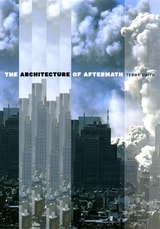
The September 11 terrorist attacks targeted, in Osama bin Laden’s words, “America’s icons of military and economic power.” In The Architecture of Aftermath, Terry Smith argues that it was no accident that these targets were buildings: architecture has long served as a symbol of proud, defiant power—and never more so than in the late twentieth century.

But after September 11, Smith asserts, late modern architecture suddenly seemed an indulgence. With close readings of key buildings—including Jørn Utzon’s Sydney Opera House, Minoru Yamasaki’s World Trade Center, Frank Gehry’s Guggenheim Museum Bilbao, and Richard Meier’s Getty Center—Smith traces the growth of the spectacular architecture of modernity and then charts its aftermath in the conditions of contemporaneity. Indeed, Smith focuses on the very culture of aftermath itself, exploring how global politics, clashing cultures, and symbolic warfare have changed the way we experience destination architecture. 

Like other artists everywhere, architects are responding to the idea of aftermath by questioning the viability of their forms and the validity of their purposes. With his richly illustrated The Architecture of Aftermath, Smith has done so as well.
[more]
cover of What Is Contemporary Art?

What Is Contemporary Art?

Terry Smith

University of Chicago Press, 2009

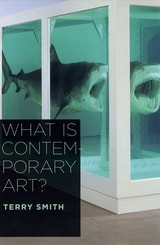
Who gets to say what counts as contemporary art? Artists, critics, curators, gallerists, auctioneers, collectors, or the public? Revealing how all of these groups have shaped today’s multifaceted definition, Terry Smith brilliantly shows that an historical approach offers the best answer to the question: What is Contemporary Art?

Smith argues that the most recognizable kind is characterized by a return to mainstream modernism in the work of such artists as Richard Serra and Gerhard Richter, as well as the retro-sensationalism of figures like Damien Hirst and Takashi Murakami. At the same time, Smith reveals, postcolonial artists are engaged in a different kind of practice: one that builds on local concerns and tackles questions of identity, history, and globalization. A younger generation embodies yet a third approach to contemporaneity by investigating time, place, mediation, and ethics through small-scale, closely connective art making. Inviting readers into these diverse yet overlapping art worlds, Smith offers a behind-the-scenes introduction to the institutions, the personalities, the biennials, and of course the works that together are defining the contemporary. The resulting map of where art is now illuminates not only where it has been but also where it is going.

[more]