Results by title
8 books match the query 'Smoking'
Cigarettes Are Sublime
Richard Klein
Duke University Press, 1993
Combating Teen Smoking
Research and Policy StrategiesPeter D. Jacobson, Paula M. Lantz, Kenneth E. Warner, Jeffrey Wasserman, Harold A. Pollack, and Alexis K. Ahlstrom
University of Michigan Press, 2001
Learning to Smoke
Tobacco Use in the WestJason Hughes
University of Chicago Press, 2002
Hughes traces the transformations of tobacco and its use over time, from its role as a hallucinogen in Native American shamanistic ritual to its use as a prophylactic against the plague and a cure for cancer by early Europeans, and finally to the current view of smoking as a global pandemic. He then analyzes tobacco from the perspective of the individual user, exploring how its consumption relates to issues of identity and life changes. Comparing sociocultural and personal experiences, Hughes ultimately asks what the patterns of tobacco use mean for the clinical treatment of smokers and for public policy on smoking. Pointing the way, then, to a more learned and sophisticated understanding of tobacco use, this study will prove to be essential reading for anyone interested in the history of smoking and the sociology of addiction.
No Smoking
The Ethical IssuesRobert E. Goodin
University of Chicago Press, 1990
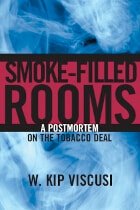
Smoke-Filled Rooms
A Postmortem on the Tobacco DealW. Kip Viscusi
University of Chicago Press, 2002
With Smoke-Filled Rooms,W. Kip Viscusi provides unexpected answers to these questions, drawing on an impressive range of data on several topics central to the smoking policy debate. Based on surveys of smokers in the United States and Spain, for instance, he demonstrates that smokers actually overestimate the dangers of smoking, indicating that they are well aware of the risks involved in their choice to smoke. And while smoking does increase medical costs to the states, Viscusi finds that these costs are more than financially balanced by the premature mortality of smokers, which reduces their demands on state pension and health programs, so that, on average, smoking either pays for itself or generates revenues for the states.
Viscusi's eye-opening assessment of the tobacco lawsuits also includes policy recommendations that could frame these debates in a more productive way, such as his suggestion that the FDA should develop a rating system for cigarettes and other tobacco products based on their relative safety, thus providing an incentive for tobacco manufacturers to compete among themselves to produce safer cigarettes. Viscusi's hard look at the facts of smoking and its costs runs against conventional thinking. But it is also necessary for an informed and realistic debate about the legal, financial, and social consequences of the tobacco lawsuits.
People making $50,000 or more pay .08 percent of their income in cigarette taxes, but people with incomes of less than $10,000 pay 1.62 percenttwenty times as much. The maintenance crew at the Capitol will bear more of the "sin tax" levied on cigarettes than will members of Congress who voted to boost it.
Cigarettes are not a financial drain to the U.S. In fact, they are self-financing, as a consequence of smokers' premature mortality.
The general public estimates that 47 out of 100 smokers will die from lung cancer because they smoke. Smokers believe that 40 out of 100 will die of the disease. Scientists estimate the actual number of 100 smokers who will die from lung cancer to be between 7 and 13.
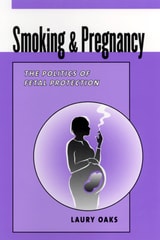
Smoking and Pregnancy
The Politics of Fetal ProtectionOaks, Laury
Rutgers University Press, 2001
The 1966 edition of the leading medical textbook states that pregnant women can safely smoke half a pack of cigarettes a day. Yet today, women who smoke during pregnancy are among the most vilified figures in public health campaigns. Laury Oaks argues this shift is not due solely to medical findings indicating that cigarette smoking may harm the fetus. Also responsible are a variety of social factors that converged more than a decade ago to construct the demonized category of the “pregnant smoker.”
This book charts the emergence of smoking during pregnancy as a public health concern and social problem. Oaks looks at the emphasis public health educators place on individual responsibility, the current legal and social assertion of fetal personhood, the changing expectations of pregnant and prepregnant women, and the advent of antismoking campaigns. She explores how public health educators discuss “the problem” with one another, how they communicate with pregnant smokers, and how these women themselves understand the “risk” of fetal harm. Finally, Oaks discusses the various meanings of “objective” statistics on the effects of smoking on the fetus, exploring the significance of cultural context in assessing the relative importance of those numbers. She argues that rather than bombarding pregnant women with statistics, health educators should consider the daily lives of these women and their socioeconomic status to understand why some women choose to smoke during pregnancy. Without downplaying the seriousness of the health risks that smoking poses to women and their babies, the book supports new efforts that challenge the moral policing of pregnant smokers.
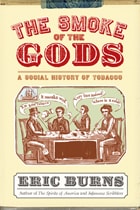
The Smoke of the Gods
A Social History of TobaccoEric Burns
Temple University Press, 2006

The Smoking Book
Lesley Stern
University of Chicago Press, 1999
Stern writes of addictions and passionate attachments, of the body and bodily pleasure, of autobiography and cultural history. Smoking is Stern's seductive pretext, her way of entering unknown and mysterious regions. The Smoking Book begins with intimate and vivid accounts of growing up on a tobacco farm in colonial Rhodesia, reminiscences that permeate subsequent excursions into precolonial tobacco production and postcolonial life in Zimbabwe, as well as dramatic vignettes set in Australia, the United States, Scotland, Italy, Japan, and South America. Stern has written a book, at once intensely personal and kaleidoscopically international, that weaves the intimate act of a solitary person smoking a cigarette into a broad cultural picture of desire, exchange, fulfillment, and the acts that bind people together, either in lasting ways or through ephemeral encounters.
The Smoking Book is for anyone who has ever smoked or loved a smoker (against their better judgment); it is for those who have never smoked or for those who mourn the loss of cigarettes as they would grieve for a lost friend. But mostly, The Smoking Book is for all those who are smoldering still.