Results by title
14 books match the query 'Social change in literature'
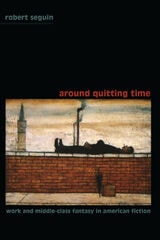
Around Quitting Time
Work and Middle-Class Fantasy in American FictionRobert Seguin
Duke University Press, 2001
Tracing connections between the reconstruction of the labor process and the aesthetic dilemmas of modernism, between the emergence of the modern state and the structure of narrative, Seguin analyzes the work of Nathanael West, Ernest Hemingway, Willa Cather, John Barth, and others. These fictional narratives serve to demonstrate for Seguin the pattern of social sites and cultural phenomenon that have emerged where work and leisure, production and consumption, and activity and passivity coincide. He reveals how, by creating pathways between these seemingly opposed domains, the middle-class imaginary at once captures and suspends the dynamics of social class and opens out onto a political and cultural terrain where class is both omnipresent and invisible.
Around Quitting Time will interest critics and historians of modern U.S. culture, literary scholars, and those who explore the interaction between economic and cultural forms.
At the Pivot of East and West
Ethnographic, Literary, and Filmic ArtsMichael M. J. Fischer
Duke University Press, 2023

Bridging
How Gloria Anzaldúa's Life and Work Transformed Our OwnEdited by AnaLouise Keating and Gloria González-López
University of Texas Press, 2011
The inspirational writings of cultural theorist and social justice activist Gloria Anzaldúa have empowered generations of women and men throughout the world. Charting the multiplicity of Anzaldúa's impact within and beyond academic disciplines, community trenches, and international borders, Bridging presents more than thirty reflections on her work and her life, examining vibrant facets in surprising new ways and inviting readers to engage with these intimate, heartfelt contributions.
Bridging is divided into five sections: The New Mestizas: "transitions and transformations"; Exposing the Wounds: "You gave me permission to fly in the dark"; Border Crossings: Inner Struggles, Outer Change; Bridging Theories: Intellectual Activism with/in Borders; and "Todas somos nos/otras": Toward a "politics of openness." Contributors, who include Norma Elia Cantú, Elisa Facio, Shelley Fisher Fishkin, Aída Hurtado, Andrea Lunsford, Denise Segura, Gloria Steinem, and Mohammad Tamdgidi, represent a broad range of generations, professions, academic disciplines, and national backgrounds. Critically engaging with Anzaldúa's theories and building on her work, they use virtual diaries, transformational theory, poetry, empirical research, autobiographical narrative, and other genres to creatively explore and boldly enact future directions for Anzaldúan studies.
A book whose form and content reflect Anzaldúa's diverse audience, Bridging perpetuates Anzaldúa's spirit through groundbreaking praxis and visionary insights into culture, gender, sexuality, religion, aesthetics, and politics. This is a collection whose span is as broad and dazzling as Anzaldúa herself.
Error, Misuse, Failure
Object Lessons From The English RenaissanceJulian Yates
University of Minnesota Press, 2002
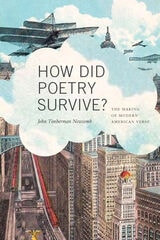
How Did Poetry Survive?
The Making of Modern American VerseJohn Timberman Newcomb
University of Illinois Press, 2013
This book traces the emergence of modern American poetry at the turn of the nineteenth century. With a particular focus on four "little magazines"--Poetry, The Masses, Others, and The Seven Arts--John Timberman Newcomb shows how each advanced ambitious agendas combining urban subjects, stylistic experimentation, and progressive social ideals. While subsequent literary history has favored the poets whose work made them distinct--individuals singled out usually on the basis of a novel technique--Newcomb provides a denser, richer view of the history that hundreds of poets made.
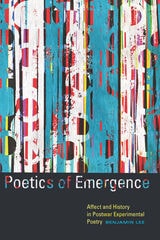
Poetics of Emergence
Affect and History in Postwar Experimental PoetryBenjamin Lee
University of Iowa Press, 2020
Experimental poetry responded to historical change in the decades after World War II, with an attitude of such casual and reckless originality that its insights have often been overlooked. However, as Benjamin Lee argues, to ignore the scenes of self and the historical occasions captured by experimental poets during the 1950s and 1960s is to overlook a rich and instructive resource for our own complicated transition into the twenty-first century.
Frank O’Hara and fellow experimental poets like Amiri Baraka, Diane di Prima, and Allen Ginsberg offer us a set of perceptive responses to Cold War culture, lyric meditations on consequential changes in U.S. social life and politics, including the decline of the Old Left, the rise of white-collar workers, and the emergence of vernacular practices like hipsterism and camp. At the same time, they offer us opportunities to anatomize our own desire for historical significance and belonging, a desire we may well see reflected and reconfigured in the work of these poets.
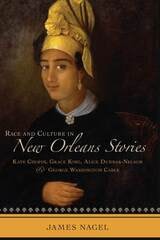
Race and Culture in New Orleans Stories
Kate Chopin, Grace King, Alice Dunbar-Nelson, and George Washington CableJames Nagel
University of Alabama Press, 2013
Race and Culture in New Orleans Stories is a study of four volumes of interrelated short stories set in New Orleans and the surrounding Louisiana bayous: Kate Chopin’s Bayou Folk; George Washington Cable’s Old Creole Days; Grace King’s Balcony Stories; and Alice Dunbar-Nelson’s The Goodness of St. Rocque and Other Stories. James Nagel argues that the conflicts and themes in these stories cannot be understood without a knowledge of the unique historical context of the founding of Louisiana, its four decades of rule by the Spanish, the Louisiana Purchase and the resulting cultural transformations across the region, Napoleonic law, the Code Noir, the plaçage tradition, the immigration of various ethnic and natural groups into the city, and the effects of the Civil War and Reconstruction. All of these historical factors energize and enrich the fiction of this important region.
The literary context of these volumes is also central to understanding their place in literary history. They are short-story cycles—collections of short fiction that contain unifying settings, recurring characters or character types, and central themes and motifs. They are also examples of the “local color” tradition in fiction, a movement that has been much misunderstood. Nagel maintains that regional literature was meant to be the highest form of American writing, not the lowest, and its objective was to capture the locations, folkways, values, dialects, conflicts, and ways of life in the various regions of the country in order to show that the lives of common citizens were sufficiently important to be the subject of serious literature.
Finally, Nagel shows that New Orleans provided a profoundly rich and complex setting for the literary exploration of some of the most crucial social problems in America, including racial stratification, social caste, economic exploitation, and gender roles, all of which were undergoing rapid transformation at the end of the nineteenth century and the beginning of the twentieth.
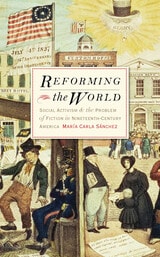
Reforming the World
Social Activism and the Problem of Fiction in Nineteenth-Century AmericaMaria Carla Sanchez
University of Iowa Press, 2009
In her informed and innovative work, Sánchez considers those authors both familiar (Lydia Maria Child, Harriet Jacobs, and Harriet Beecher Stowe) and those all but lost to history (Timothy Shay Arthur). Along the way, she refers to some of the most notable American writers in the period (Emerson, Thoreau, and Poe). Illuminating the intersection of reform and fiction, Reforming the World visits important questions about the very purpose of literature, telling the story of “a revolution that never quite took place," one that had no grandiose or even catchy name. But it did have numerous settings and participants: from the slums of New York, where prostitutes and the intemperate made their homes, to the offices of lawyers who charted the downward paths of broken men, to the tents for revival meetings, where land and souls alike were “burned over” by the grace of God.
Rhetoric and Resistance
The Literary Arts of Dissent in Nineteenth-Century BritainMaeve Adams
Ohio University Press, 2025
A fresh perspective on the enduring relationship between literature, democracy, and dissent
Rhetoric and Resistance explores the transformative role of nineteenth-century literature in shaping modern concepts and practices of democratic dissent. By examining the works of Romantic and Victorian novelists, poets, and journalists, Maeve Adams identifies origins of modern theories and practices of resistance in nineteenth-century literary forms. Offering a literary history of dissent, the book recovers the intertwined development of democracy and aesthetics, revealing how narrative form became a potent tool for challenging authority.
Tracing the lineage of dissent from the radical fiction and journalism of the 1800s to contemporary movements like #MeToo, Adams offers a genealogy that highlights how literary texts experimented with political power, granting new and consequential voices to working-class individuals, women, colonized peoples, and other marginalized groups.
Adams takes an interdisciplinary approach, weaving together close readings of works by Thomas De Quincey, Walter Scott, Elizabeth Gaskell, and H. G. Wells, as well as lesser-known journalists, with insights from modern moral and political philosophy. Drawing on theories of democratic ethics and justice from scholars such as Miranda Fricker, Sharon Krause, Martha Nussbaum, and Philip Pettit, the book bridges literary history and contemporary debates about political agency and expression.
Risk Culture
Performance and Danger in Early AmericaJoseph Fichtelberg
University of Michigan Press, 2010
---David Shields, University of South Carolina

Room for Maneuver
Reading (the) Oppositional (in) NarrativeRoss Chambers
University of Chicago Press, 1991
The Novel in the Age of Disintegration
Dostoevsky and the Problem of Genre in the 1870sKate Holland
Northwestern University Press, 2013
Scholars have long been fascinated by the creative struggles with genre manifested throughout Dostoevsky’s career. In The Novel in the Age of Disintegration, Kate Holland brings historical context to bear, showing that Dostoevsky wanted to use the form of the novel as a means of depicting disintegration brought on by various crises in Russian society in the 1860s. This required him to reinvent the genre. At the same time he sought to infuse his novels with the capacity to inspire belief in social and spiritual reintegration, so he returned to some older conventions of a society that was already becoming outmoded.
In thoughtful readings of Demons, The Adolescent, A Writer’s Diary, and The Brothers Karamazov, Holland delineates Dostoevsky’s struggle to adapt a genre to the reality of the present, with all its upheavals, while maintaining a utopian vision of Russia’s future mission.
Walt Whitman and Nineteenth-Century Women Reformers
Sherry Ceniza
University of Alabama Press, 1999
WINNER OF THE ELIZABETH AGEE PRIZE IN AMERICAN LITERATURE
Examining Whitman’s poetic development through the documented influence of nineteenth‑century women reformers.
Walt Whitman and 19th-Century Women Reformers documents Whitman's friendships with women during the 1850s, the decade of Whitman's most creative period. The book reveals startling connections between the first three editions of Leaves of Grass and the texts generated by the women he knew during this period, many of whom were radical activists in the women's rights movement.
Sherry Ceniza argues that Whitman's editions of Leaves became progressively more radically 'feminist' as he followed the women's rights movement during the 1850s and that he was influenced by what he called the 'true woman of the new aggressive type . . . woman under the new dispensation.' Ceniza documents the progression of the National Woman's Rights movement through the lives and writings of three of its leaders- Abby Hills Price, Paulina Wright Davis, and Ernestine L. Rose. By juxtaposing the texts written by these women with Leaves, Ceniza shows that Whitman used many of the same arguments and rhetorical gestures as his female activist friends.
The book also discusses the influence of women engaged in women's rights outside the National Woman's Rights organization. And Ceniza's opening chapter is devoted to a fresh interpretation of the life and thought of another strong-minded woman who influenced the poet's writing-Louisa Van Velsor Whitman, Walt Whitman's mother.
Where the World Is Not
Cultural Authority and Democratic Desire in Modern American LiteratureKim Savelson
The Ohio State University Press, 2009