71 books match the query 'Social networks' and 4 start with a
cover of A Confluence of Transatlantic Networks: Elites, Capitalism, and Confederate Migration to Brazil

A Confluence of Transatlantic Networks

Elites, Capitalism, and Confederate Migration to Brazil

Laura Jarnagin

University of Alabama Press, 2013

Examines the qualitative nature of capitalism’s processes through the lens of social networks

A Confluence of Transatlantic Network demonstrates how portions of interconnected trust-based kinship, business, and ideational transatlantic networks evolved over roughly a century and a half and eventually converged to engender, promote, and facilitate the migration of southern elites to Brazil in the post–Civil War era. Placing that migration in the context of the Atlantic world sharpens our understanding of the transborder dynamic of such mainstream nineteenth-century historical currents as international commerce, liberalism, Protestantism, and Freemasonry. The manifestation of these transatlantic forces as found in Brazil at midcentury provided disaffected Confederates with a propitious environment in which to try to re-create a cherished lifestyle.

[more]
cover of Affective Circuits: African Migrations to Europe and the Pursuit of Social Regeneration

Affective Circuits

African Migrations to Europe and the Pursuit of Social Regeneration

Edited by Jennifer Cole and Christian Groes

University of Chicago Press, 2016

The influx of African migrants into Europe in recent years has raised important issues about changing labor economies, new technologies of border control, and the effects of armed conflict. But attention to such broad questions often obscures a fundamental fact of migration: its effects on ordinary life. Affective Circuits brings together essays by an international group of well-known anthropologists to place the migrant family front and center. Moving between Africa and Europe, the book explores the many ways migrants sustain and rework family ties and intimate relationships at home and abroad. It demonstrates how their quotidian efforts—on such a mass scale—contribute to a broader process of social regeneration.
           
The contributors point to the intersecting streams of goods, people, ideas, and money as they circulate between African migrants and their kin who remain back home. They also show the complex ways that emotions become entangled in these exchanges. Examining how these circuits operate in domains of social life ranging from child fosterage to binational marriages, from coming-of-age to healing and religious rituals, the book also registers the tremendous impact of state officials, laws, and policies on migrant experience. Together these essays paint an especially vivid portrait of new forms of kinship at a time of both intense mobility and ever-tightening borders.
 
[more]
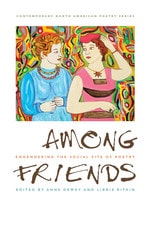
cover of Among Friends: Engendering the Social Site of Poetry

Among Friends

Engendering the Social Site of Poetry

Anne Dewey and Libbie Rifkin

University of Iowa Press, 2013
Philosophers and theorists have long recognized both the subversive and the transformative possibilities of friendship, the intimacy of which can transcend the impersonality of such identity categories as race, class, or gender. Unlike familial relations, friendships are chosen, opening a space of relative freedom in which to create and explore new identities. This process has been particularly valuable to poets marginalized by gender or sexuality since the second half of the twentieth century, as friendship provides both a buffer against and a wedge into predominantly male homosocial poetic communities.


Among Friends presents a richly theorized evocation of friendship as a fluid, critical social space, one that offers a vantage point from which to explore the gendering of poetic institutions and practices from the postwar period to the present. With friendship as an optic, the essays in this volume offer important new insights into the gender politics of the poetic avant-garde, since poetry as an institution has continued to be transformed by dramatic changes wrought by second-wave feminism, sexual liberation, and gay rights. These essays reveal the intimate social negotiations that fight, fracture, and queer the conventions of authority and community that have long constrained women poets and the gendering of poetic subjectivities.


From this shared perspective, the essays collected here investigate a historically and aesthetically wide-ranging array of subjects: from Joanne Kyger and Philip Whalen’s trans-Pacific friendship, to Patti Smith’s grounding of her punk persona in the tension between her romantic friendships with male artists and her more professional connections to the poets of the St. Mark’s scene, and from the gender dynamics of the Language School to the Flarf network’s reconception of poetic community in the digital age and the Black Took Collective’s creation of an intimate poetics of performance. Together, these explorations of poetic friendship open up new avenues for interrogating contemporary American poetry. 

Contributors: Maria Damon, Andrew Epstein, Ross Hair, Duriel E. Harris, Daniel Kane, Dawn Lundy Martin, Peter Middleton, Linda Russo, Lytle Shaw, Ann Vickery, Barrett Watten, Ronaldo V. Wilson
[more]
cover of Angel De Cora, Karen Thronson, and the Art of Place: How Two Midwestern Women Used Art to Negotiate Migration and Dispossession

Angel De Cora, Karen Thronson, and the Art of Place

How Two Midwestern Women Used Art to Negotiate Migration and Dispossession

Elizabeth Sutton

University of Iowa Press, 2020

Angel De Cora (c. 1870–1919) was a Native Ho-Chunk artist who received relative acclaim during her lifetime. Karen Thronson (1850–1929) was a Norwegian settler housewife who created crafts and folk art in obscurity along with the other women of her small immigrant community. The immigration of Thronson and her family literally maps over the De Cora family’s forced migration across Wisconsin, Iowa, and onto the plains of Nebraska and Kansas. Tracing the parallel lives of these two women artists at the turn of the twentieth century, art historian Elizabeth Sutton reveals how their stories intersected and diverged in the American Midwest.

By examining the creations of these two artists, Sutton shows how each woman produced art or handicrafts that linked her new home to her homeland. Both women had to navigate and negotiate between asserting their authentic self and the expectations placed on them by others in their new locations. The result is a fascinating story of two women that speaks to universal themes of Native displacement, settler conquest, and the connection between art and place.

[more]