Results by title
4 books match the query 'Solomon'
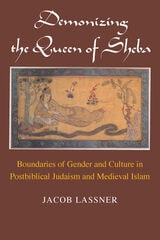
Demonizing the Queen of Sheba
Boundaries of Gender and Culture in Postbiblical Judaism and Medieval IslamJacob Lassner
University of Chicago Press, 1993
The Bible presents the Queen of Sheba's encounter with King Solomon as a diplomatic mission: the queen comes "to test him with hard questions," all of which he answers to her satisfaction; she then praises him and, after an exchange of gifts, returns to her own land. By the Middle Ages, Lassner demonstrates, the focus of the queen's visit had shifted from international to sexual politics. The queen was now portrayed as acting in open defiance of nature's equilibrium and God's design. In these retellings, the authors humbled the queen and thereby restored the world to its proper condition.
Lassner also examines the Islamization of Jewish themes, using the dramatic accounts of Solomon and his female antagonist as a test case of how Jewish lore penetrated the literary imagination of Muslims. Demonizing the Queen of Sheba thus addresses not only specialists in Jewish and Islamic studies, but also those concerned with issues of cultural transmission and the role of gender in history.
Hidden Critique of Solomon in the Hebrew Bible
Pekka Särkiö
SBL Press, 2025
The Psalms of Solomon
Language, History, TheologyEberhard Bons
SBL Press, 2015
A fresh analysis of that sheds new light on the Psalms of Solomon
Researchers whose work focuses on the Psalms of Solomon, experts on the Septuagint, and scholars of Jewish Hellenistic literature take a fresh look at debates surrounding the text. Authors engage linguistic, historical, and theological issues including the original language of the psalms, their historical setting, and their theological intentions with the goal of expanding our understanding of first-century BCE Jewish theology.
Features:
- New methods applied to open questions of authorship and historical context
- Focusd scholarly attention on a work of theological and literary importance
- Revised essays originally presented at the First International Meeting on the Psalms of Solomon
The Psalms of Solomon
Texts, Contexts, and IntertextsPatrick Pouchelle
SBL Press, 2021
Explore new approaches to the Psalms of Solomon
The Psalms of Solomon: Texts, Contexts, and Intertexts explores a unique pseudepigraphal document that bears witness to the 63 BCE Roman conquest of Jerusalem. Essays address a variety of themes, notably their political, social, religious, and historical contexts, through the lens of anthropology of religion, cognitive science, socioeconomic theory, and more. Contributors include Kenneth Atkinson, Eberhard Bons, Johanna Erzberger, Angela Kim Harkins, G. Anthony Keddie, Patrick Pouchelle, Stefan Schreiber, Shani Tzoref, and Rodney A. Werline.