Results by title
5 books match the query 'Some'

(some of) The Adventures of Carlyle, My Imaginary Friend
Dainis Hazners
University of Iowa Press, 2004
“Carlyle is spore, and mild. / He is swoon & sherbet.” Endearing and kind, if not actually cruel, he is also cold and strange. He shapeshifts, transforming into Magician and Jester, Surgeon and Scientist, Cloud; he studies fire and mirrors and bores holes in his own skull, looking for heaven. Throughout his many adventures, which range from the ludicrous to the life-threatening, he flies into the light and carries the reader with him on his perplexing and fanciful journey.

Jazz Matters
Reflections on the Music & Some of Its MakersDoug Ramsey
University of Arkansas Press, 1989
Rich in anecdote and insight, Jazz Matters is a collection of essays, profiles, and reviews by Doug Ramsey, and observer and chronicler of jazz and its musicians for more than thirty years. It stirs the reader to discover or rediscover the music and performers Ramsey describes. His accounts of recording sessions and live performances enhance this excellent review of the history, variety, and artistic depth that make jazz so profound an element in modern culture.
Jazz Matters gives the reader a basis for understanding jazz improvisation Ramsey’s sensitive, straightforward, and entertaining pieces promote appreciation of the accomplishment of artists from Louis Armstrong to John Coltrane and Ornette Coleman.

Some of Us
Chinese Women Growing Up in the Mao EraZhong, Xueping
Rutgers University Press, 2001
What does it mean to have grown up female in the Mao era? How can the remembered details of everyday life help shed light upon those turbulent times?
Some of Us is a collection of memoirs by nine Chinese women who grew up during the Mao era. All hail from urban backgrounds and all have obtained their Ph.D.s in the United States; thus, their memories are informed by intellectual training and insights that only distance can allow. Each of the chapters—arranged by the age of the author—is crafted by a writer who reflects back to that time in a more nuanced manner than has been possible for Western observers. The authors attend to gender in a way that male writers have barely noticed and reflect on their lives in the United States.
The issues explored here are as varied as these women’s lives: The burgeoning rebellion of a young girl in northeast China. A girl’s struggles to obtain for herself the education her parents inspired her to attain. An exploration of gender and identity as experienced by two sisters.
Some of Us offers insight into a place and time when life was much more complex than Westerners have allowed. These eloquent writings shatter our stereotypes of persecution, repression, victims, and victimizers. Together, these multi-faceted memoirs offer the reader new perspectives as they daringly explore difficult—and fascinating—issues.
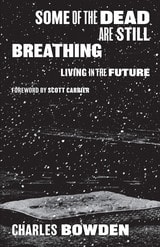
Some of the Dead Are Still Breathing
Living in the FutureBy Charles Bowden
University of Texas Press, 2018
The third book in Charles Bowden’s “accidental trilogy” that began with Blood Orchid and Blues for Cannibals, Some of the Dead Are Still Breathing attempts to resolve the overarching question: “How can a person live a moral life in a culture of death?” As humanity moves further into the twenty-first century, Bowden continues to interrogate our roles in creating the ravaged landscapes and accumulated death that still surround us, as well as his own childhood isolation, his lust for alcohol and women, and his waning hope for a future. We witness post-Katrina New Orleans and terrorist-bombed Bali; we encounter our shared actions with the animal world and the desirous need for consumption; we see the clash and erosion of our physical and figurative borders, the savagery of our own civilization. A man of his time and out of time, Bowden seeks acceptance and a will to endure what may lie ahead.

Some of the People Who Ate My Barbecue Didn't Vote for Me
The Life of Georgia Governor Marvin GriffinScott E. Buchanan
Vanderbilt University Press, 2011
.
In "Some of the People Who Ate My Barbecue Didn't Vote for Me," Scott Buchanan portrays Marvin Griffin as a Yellow Dog Democrat struggling against inevitable change. Griffin was viewed by many as a charismatic voice of resistance in the Georgia and the South in the wake of Brown v. Board of Education. He combined a staunch segregationist approach with economically progressive policies, assisting in Georgia's transformation from an agrarian economy to a more industrialized one.
Ironically, it was these efforts and the larger shift in politics that doomed Griffin's career, ensuring his administration would last only one term. In many ways, Griffin stands as a clear dividing line between the Old South and the New.