Results by title
4 books match the query 'Sommer, Jason'
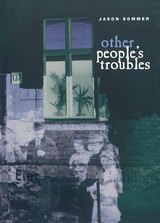
Other People's Troubles
Jason Sommer
University of Chicago Press, 1997
Son of a Holocaust survivor, Jason Sommer writes of troubles that unfold at the intersection of history made and personality in making, of self and other, of wakefulness and sleep. His world is post-Holocaust, and the poetic voice in this book is one which emerges from that calamity, telling the stories of those who have finally begun to speak to him, and now through him. As a survivor's child, Sommer must consider how to live in the wake of history, among those who are indelibly marked by it.
[more]
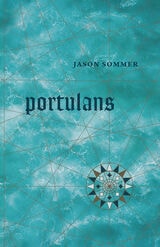
Portulans
Jason Sommer
University of Chicago Press, 2021
Taking inspiration from medieval sea charts—portulans—the poems in Jason Sommer’s collection bring a fresh variation to the ancient metaphor of life as a journey. Creating a coordinate system charting paths between ports and the dangers that surrounded them, portulans offered webs of routes and images through which sailors could navigate. These maps—both accurate and beautifully illustrated—guided mariners from port to port weaving paths at the threshold of the open sea. Similarly, the course of these poems navigates familiar mysteries and perennial questions through times of unbelief, asking whether consciousness is anchored in the transcendent, if inward travel can descend past the self, and if the universe can be accounted for by physics alone.
Through this collection, Sommer takes us to the ocean floor, into the basement, out the front door, through multiverses, and in and out of dreams. Along the way, he considers whether art—the beauty of the map—can provide momentary meaning against a backdrop of oblivion. Drawing on history and myth, the voices in these poems consider what can and cannot be known of the self and the other, of our values, and of what we insist has permanence. These are poems of searching. Like ancient cartographers who lent lavish decoration to their maps, the poems in Portulans illuminate possibilities of beauty in each journey.
Is there more to the story that you remember and hesitate
to say? Your eyes, though, scanning upward in their sockets,
do seem to search memory, but for what may be gone already,
gone to where it goes—wherever it came from—gone as can be imagined,
down into things, in past flesh and bark, marrow and pith, and down,
down into molecule, atom, particle, vanishing into theory.
Through this collection, Sommer takes us to the ocean floor, into the basement, out the front door, through multiverses, and in and out of dreams. Along the way, he considers whether art—the beauty of the map—can provide momentary meaning against a backdrop of oblivion. Drawing on history and myth, the voices in these poems consider what can and cannot be known of the self and the other, of our values, and of what we insist has permanence. These are poems of searching. Like ancient cartographers who lent lavish decoration to their maps, the poems in Portulans illuminate possibilities of beauty in each journey.
[more]
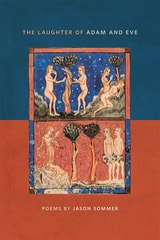
The Laughter of Adam and Eve
Jason Sommer
Southern Illinois University Press, 2013
Near the beginning, just after the fall, was laughter—at least as Jason Sommer imagines it. In the title poem, Eve catches Adam’s hilarity over what passes for a tree outside of Eden, their laughter a heady combination of longing, defiance, and perhaps even relief, through which they find they now possess “a knowledge of evil that is good,” an understanding that will carry them through life after paradise. Through settings mythical, historical and biblical, through characters that range from Gunga Din to St. Kevin of Glendalough, the poems in this book often search out meaning in the tracing of origins: of a bird’s song, of laughter, of a word, of language itself. Poems explore the source of the word brouhaha, the song of the “resignation bird,” and the dangerous way a poem of Anna Akhmatova enters the world, under the eyes and ears of Stalin’s secret police, escaping the house arrest its author must endure.
In The Laughter of Adam and Eve, Sommer speaks from a multitude of voices and perspectives, in short, formal lyrics as well as longer free-verse narratives. From the archetypal parents of us all, down through anonymous voices, throughout these pages, women and men speak to—and of—each other, in many roles and relations—as lover and beloved, as child and parent, as dreamer and dreamt of. The poems attempt to travel beyond the traditional binary in search of the common thread that binds us to one another. Perhaps chief among them is story: whether recasting myth so that Pygmalion and Narcissus become a single figure or using an Appalachian tale retold as a message, lover to lover, these poems narrate, while engaging deeply with those special properties that poetry can bring to story.
[more]
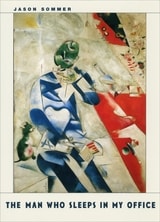
The Man Who Sleeps in My Office
Jason Sommer
University of Chicago Press, 2004
With grace and style, Jason Sommer considers how to live in the wake of history among those who are indelibly marked by it. On the surface a book of poems composed in the shadow of the Holocaust, The Man Who Sleeps in My Office offers more than a poetic chronicle of suffering and loss. Instead, Sommer—the son of a survivor—has discovered a delicate balance that allows him to be in and of history without succumbing to it. In these works, both the seen and the unseen—the failed or rejected vision—alter the seer, as the limit of one thing becomes the verge of something else. Whether about the Holocaust, the dog he'll never own, or love between a husband and wife or parent and child, these poems savor the mysterious instant when alternatives of vision unfold. While these moments may also conjure loss, the losses are made good, as when, in "Legion," someone forgets why he has walked into a room but salvages from the lapse not the purpose of the errand but a sense of the ultimate worth of a life. These finely crafted narrative poems tell the story of these unanticipated perceptions, when the ordinary opens to the very human story of failed understanding and quiet epiphany.
[more]