Results by title
4 books match the query 'Song dynasty, 960-1279'
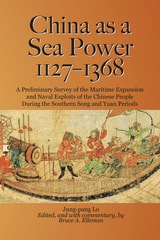
China as a Sea Power, 1127–1368
A Preliminary Survey of the Maritime Expansion and Naval Exploits of the Chinese People During the Southern Song and Yuan PeriodsLo Jung-pang
National University of Singapore Press, 2012
Lo Jung-pang argues that during each of the three periods when imperial China embarked on maritime enterprises (the Qin and Han dynasties, the Sui and early Tang dynasties, and Song, Yuan, and early Ming dynasties), coastal states took the initiative at a time when China was divided, maritime trade and exploration subsequently peaked when China was strong and unified, and declined as Chinese power weakened. At such times, China's people became absorbed by internal affairs, and state policy focused on threats from the north and the west. These cycles of maritime activity, each lasting roughly five hundred years, corresponded with cycles of cohesion and division, strength and weakness, prosperity and impoverishment, expansion and contraction.
In the early 21st century, a strong and outward looking China is again building up its navy and seeking maritime dominance, with important implications for trade, diplomacy and naval affairs. Events will not necessarily follow the same course as in the past, but Lo Jung-pang's analysis suggests useful questions for the study of events as they unfold and decades to come.
In the early 21st century, a strong and outward looking China is again building up its navy and seeking maritime dominance, with important implications for trade, diplomacy and naval affairs. Events will not necessarily follow the same course as in the past, but Lo Jung-pang's analysis suggests useful questions for the study of events as they unfold and decades to come.
[more]
Commerce and Society in Sung China
Shiba Yoshinobu; Translated by Mark Elvin
University of Michigan Press, 1969
The full dimensions of the medieval Chinese economic revolution are still almost unknown to economic historians in the Western world, and the manifold problems that it raises for accepted theories of economic development have hardly begun to be systematically considered. Japanese scholars have been the pioneers in opening up this field, and Professor Shiba’s Commerce and Society in Sung China is among the most recent and most impressive fruits of their labors. For the first time it is possible to be relatively confident, as the result of the author’s systematic exploitation of an enormous range of source materials, about the parts played by transport, trade, business organization and urbanization in this revolution. It is hardly necessary to labor the significance of the advance. China’s was beyond any reasonable doubt the most developed economy in the medieval world, and the investigation both of the causes that made this possible and of those that subsequently prevented a take-off into sustained growth is among the most pressing tasks waiting to be accomplished before any general theory of economic development, solidly grounded in comparative historical analysis, becomes possible.
[more]
Salt and State
An Annotated Translation of the <em>Songshi</em> Salt Monopoly TreatiseCecilia Lee-fang Chien
University of Michigan Press, 2004
Salt and State is an annotated translation of a treatise on salt from Song China. From its inception in the Han dynasty (206 B.C.–220 A.D.), the salt monopoly was a key component in the Chinese government's financial toolkit. Salt, with its highly localized and large-scale production, was an ideal target for bureaucratic management.
In the Song dynasty (960–1279), fiscal pressures on the government had intensified with increased centralization and bureaucratization. A bloated administration and an enormous standing army maintained against incursions by aggressive steppe neighbors placed tremendous strain on Song finances. Developing the salt monopoly seemed a logical and indeed urgent strategy, but each actor in this plan—the emperor, local officials, monopoly administrators, producers, merchants, and consumers—had his own interests to protect and advance. Thus attempts to maximize the effectiveness of the monopoly meant frequent policy swings and led to levels of corruption that would ultimately undo the Song.
Unlike other contemporary sources, the Songshi treatise organizes its subject into an intelligible and detailed narrative, elucidating special terminology, the bureaucracy and its processes, and debates relating to Chinese finance and politics, as well as the salt industry itself. Professor Chien's extensive annotation relies on parallel histories that corroborate and supplement the Songshi account, together providing a comprehensive study of this important institution in China's premodern political economy.
[more]
Village and Bureaucracy in Southern Sung China
Brian E. McKnight
University of Chicago Press, 1983
In imperial China, workers drawn from the local populace performed many of the basic functions of local administration. Standing between the rulers and the ruled, these men mediated in both directions. McKnight's study concentrates on the nature of this village-level subbureaucratic activity in the Sung period; it sheds new light on the emergence of early Chinese society while providing a background against which to assess social changes during later dynasties.
[more]