87 books match the query 'Sound' and 9 start with a
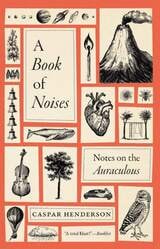
cover of A Book of Noises: Notes on the Auraculous

A Book of Noises

Notes on the Auraculous

Caspar Henderson

University of Chicago Press, 2023

A wide-ranging exploration of the sounds that shape our world in invisible yet significant ways.

The crackling of a campfire. The scratch, hiss, and pop of a vinyl record. The first glug of wine as it is poured from a bottle. These are just a few of writer Caspar Henderson’s favorite sounds. In A Book of Noises, Henderson invites readers to use their ears a little better—to tune in to the world in all its surprising noisiness.
 
Describing sounds from around the natural and human world, the forty-eight essays that make up A Book of Noises are a celebration of all things “auraculous.” Henderson calls on his characteristic curiosity to explore sounds related to humans (anthropophony), other life (biophony), the planet (geophony), and space (cosmophony). Henderson finds the beauty in everyday sounds, like the ringing of a bell, the buzz of a bee, or the “earworm” songs that get stuck in our heads. A Book of Noises also explores the marvelous, miraculous sounds we may never get the chance to hear, like the deep boom of a volcano or the quiet, rustling sound of the Northern Lights.
 
A Book of Noises will teach readers to really listen to the sounds of the world around them, to broaden and deepen their appreciation of the humans, animals, rocks, and trees simultaneously broadcasting across the whole spectrum of sentience.
[more]
cover of A Resonant Ecology

A Resonant Ecology

Max Ritts

Duke University Press, 2024
In A Resonant Ecology, Max Ritts traces how sound’s integration into the environmental politics of Canada’s North Coast has paved the way for massive industrial expansion. While conservationists hope that the dissemination of whale songs and other nature sounds will showcase the beauty of local wildlife for people around the world, Ritts reveals how colonial capitalism can co-opt sonic efforts to protect the coast. He demonstrates how digital technologies allow industry to sonically map new shipping lanes and facilitate new ways of experiencing sound—premised not on listening, but on sound’s exploitable status as a data resource. By outlining how sound can both perpetuate and refuse capitalist colonialism, Ritts challenges the idea that the sonic realm is inherently liberatory and reveals sound to be a powerfully uncertain object. Through a situated geographical approach, he makes the case that only a decolonial and multigenerational environmental politics can counter the false promise of “sustainable marine development” held up by industry and the state.
[more]
cover of Acoustic Colonialism: Acts of Mapuche Interference

Acoustic Colonialism

Acts of Mapuche Interference

Luis E. Cárcamo-Huechante

Duke University Press, 2025
In Acoustic Colonialism, Luis E. Cárcamo-Huechante examines the role of sound in Chilean and Mapuche cultural production over the last two centuries. Cárcamo-Huechante theorizes sound as a territory of racial, patriarchal, and colonial hegemony as well as of Mapuche struggle, agency, and response to what he calls "acoustic colonialism." From the mid-nineteenth century to the present, Chilean literature, radio, and other media have exerted a historic role in disseminating distorted visual and sonic representations of the Mapuche. The enduring effects of what Cárcamo-Huechante defines as the colonial ear—the entry point for these misrepresentations—reflect the logic of the Chilean settler nation-state. In response to these aural and sonorous figurations, contemporary Mapuche writers, artists, and activists have produced their own literary, radiophonic, vocal, and musical expressions. The voices, sounds, and discourses of these Mapuche productions contest and disrupt the acoustic colonialism that has dominated the soundscape of the territory designated in present-day cartography as central and southern Chile. 
[more]
cover of Alive in the Sound: Black Music as Counterhistory

Alive in the Sound

Black Music as Counterhistory

Ronald Radano

Duke University Press, 2025
In Alive in the Sound, Ronald Radano proposes a new understanding of US Black music by focusing on the key matter of value, manifested musically in its seemingly embodied qualities—spirit, soul, and groove. While acknowledging these qualities are always embedded in Black music, Radano shows they developed not simply from performance but from musicians’ status as laborers inhabiting an enduring racial-economic contradiction: Black music originated publicly as an exchangeable property owned by people whose subhuman status granted them—as “natural” musicians—indelible properties of sound. As a contradiction of the rules of ownership, wherein enslaved property was forbidden the right to own, modern Black music emerges after emancipation as a primary possession, moving dialectically into commercial markets and counterhistorically back into Black worlds. Slavery’s seminal contests of ownership underlie modern musical sensations of aliveness, which become the chief measure of value in popular music. By reconceiving US Black music history as a history of value, Radano rethinks the music’s place in US and global culture.
[more]
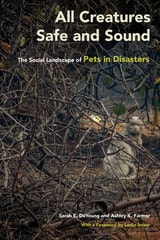
cover of All Creatures Safe and Sound: The Social Landscape of Pets in Disasters

All Creatures Safe and Sound

The Social Landscape of Pets in Disasters

Sarah E. DeYoung and Ashley K. Farmer

Temple University Press, 2021

Some of the most striking news stories from natural disasters are of animals tied to trees or cats swimming through murky flood waters. Although the issue of evacuating pets has gained more attention in recent disasters, there are still many failures throughout local and national systems of managing pets and accommodating animals in emergencies.

All Creatures Safe and Sound is a comprehensive study of what goes wrong in our disaster response that shows how people can better manage pets in emergencies—from the household level to the large-scale, national level. Authors Sarah DeYoung and Ashley Farmer offer practical disaster preparedness tips while they address the social complexities that affect disaster management and animal rescue. They track the developments in the management of pets since Hurricane Katrina, including an analysis of the 2006 PETS Act, which dictates that animals should be included in hazard and disaster planning. Other chapters focus on policies in place for sheltering and evacuation, coalitions for animal welfare and the prevention of animal cruelty, organizational coordination, decision-making, preparedness, the role of social media in animal rescue and response, and how privilege and power shape disaster experiences and outcomes.  

Using data they collected from seven major recent American disasters, ranging from Hurricanes Harvey, Irma, and Florence to the Camp, Tubbs, and Carr Fires in California and the Hawaii Lava Flow, the authors provide insights about the successes and failures of animal care. All Creatures Safe and Sound also outlines what still needs to change to best prepare for the safety and welfare of pets, livestock, and other companion animals in times of crisis.
[more]
cover of Amplifications of Black Sound from Colonial Mexico: Vocality and Beyond

Amplifications of Black Sound from Colonial Mexico

Vocality and Beyond

Sarah Finley

Vanderbilt University Press, 2024

Thinkers like W. E. B. Du Bois and Paul Gilroy have long championed sound as an affective register of Black subjectivity, particularly in the African Atlantic. Prior studies in this vein focus on Anglophone or Caribbean contexts, a tendency that furthers Mexico’s marginalization within narratives of the Black and African diaspora and mutes Afro-descendant traditions that date back to the sixteenth century. Indeed, the New Spanish archive contains whispers of the region’s Black sound cultures, including monetary records for the voices of enslaved singers and representations of Black music in casta paintings. Despite such evidence, it is difficult to attend fully to these subaltern voices, for the cultural filters of the lettered elite often mute or misinterpret non-European sounds.

Amplifications of Black Sound from Colonial Mexico is the first extensive study of Afro-descendant sonorities in New Spain or elsewhere in colonial Latin America. In this context, it attends to Black sounds through a framework that remixes Jacques Derrida’s reading of the ear’s anatomy with theories like Gilroy’s lower frequencies or Fred Moten’s phonic materiality. Sarah Finley’s aim is to unsettle the divide between self and other so the auditory archive might emerge as a polyphonic record that exceeds dichotomies of sounding object / listening subject. Through sampling the Afro-descendant sounds of this archive, this book recovers and rearticulates Black voices and auditory practices in New Spain.
[more]
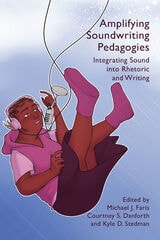
cover of Amplifying Soundwriting Pedagogies: Integrating Sound into Rhetoric and Writing

Amplifying Soundwriting Pedagogies

Integrating Sound into Rhetoric and Writing

Michael J. Faris

University Press of Colorado, 2022
While sonic rhetoric is still a growing subfield of writing studies, attention to pedagogy remains an underattended but increasingly important conversation. Amplifying Soundwriting Pedagogies addresses this gap by offering a broad range of assignments to support university instructors who seek to integrate the use of digital audio into their writing and rhetoric curricula. Each of the 25 chapters in this edited collection provides a written introduction to an adaptable soundwriting activity or sequence of assignments; a transcribed audio reflection from the instructor discussing the assignment’s purpose, strengths, and weaknesses; student-oriented documents such as assignment prompts, and rubrics) that readers can adapt in their own teaching; and examples of student work (audio with transcriptions) hosted on the book’s website.
[more]
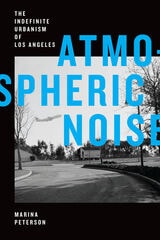
cover of Atmospheric Noise: The Indefinite Urbanism of Los Angeles

Atmospheric Noise

The Indefinite Urbanism of Los Angeles

Marina Peterson

Duke University Press, 2021
In Atmospheric Noise, Marina Peterson traces entanglements of environmental noise, atmosphere, sense, and matter that cohere in and through encounters with airport noise since the 1960s. Exploring spaces shaped by noise around Los Angeles International Airport (LAX), she shows how noise is a way of attuning toward the atmospheric: through noise we learn to listen to the sky and imagine the permeability of bodies and matter, sensing and conceiving that which is diffuse, indefinite, vague, and unformed. In her account, the “atmospheric” encompasses the physicality of the ephemeral, dynamic assemblages of matter as well as a logic of indeterminacy. It is audible as well as visible, heard as much as breathed. Peterson develops a theory of “indefinite urbanism” to refer to marginalized spaces of the city where concrete meets sky, windows resonate with the whine of departing planes, and endangered butterflies live under flight paths. Offering a conceptualization of sound as immanent and non-objectified, she demonstrates ways in which noise is central to how we know, feel, and think atmospherically.
[more]
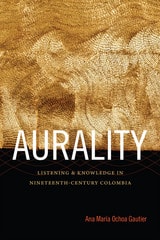
cover of Aurality: Listening and Knowledge in Nineteenth-Century Colombia

Aurality

Listening and Knowledge in Nineteenth-Century Colombia

Ana María Ochoa Gautier

Duke University Press, 2014

In this audacious book, Ana María Ochoa Gautier explores how listening has been central to the production of notions of language, music, voice, and sound that determine the politics of life. Drawing primarily from nineteenth-century Colombian sources, Ochoa Gautier locates sounds produced by different living entities at the juncture of the human and nonhuman. Her "acoustically tuned" analysis of a wide array of texts reveals multiple debates on the nature of the aural. These discussions were central to a politics of the voice harnessed in the service of the production of different notions of personhood and belonging. In Ochoa Gautier's groundbreaking work, Latin America and the Caribbean emerge as a historical site where the politics of life and the politics of expression inextricably entangle the musical and the linguistic, knowledge and the sensorial.
[more]