Results by title
5 books match the query 'Spary, E. C.'
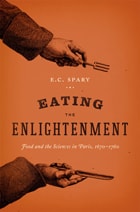
Eating the Enlightenment
Food and the Sciences in Paris, 1670-1760E. C. Spary
University of Chicago Press, 2012
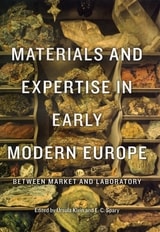
Materials and Expertise in Early Modern Europe
Between Market and LaboratoryEdited by Ursula Klein and E. C. Spary
University of Chicago Press, 2010
It is often assumed that natural philosophy was the forerunner of early modern natural sciences. But where did these sciences’ systematic observation and experimentation get their starts? In Materials and Expertise in Early Modern Europe, the laboratories, workshops, and marketplaces emerge as arenas where hands-on experience united with higher learning. In an age when chemistry, mineralogy, geology, and botany intersected with mining, metallurgy, pharmacy, and gardening, materials were objects that crossed disciplines.
Here, the contributors tell the stories of metals, clay, gunpowder, pigments, and foods, and thereby demonstrate the innovative practices of technical experts, the development of the consumer market, and the formation of the observational and experimental sciences in the early modern period. Materials and Expertise in Early Modern Europe showcases a broad variety of forms of knowledge, from ineffable bodily skills and technical competence to articulated know-how and connoisseurship, from methods of measuring, data gathering, and classification to analytical and theoretical knowledge. By exploring the hybrid expertise involved in the making, consumption, and promotion of various materials, and the fluid boundaries they traversed, the book offers an original perspective on important issues in the history of science, medicine, and technology.
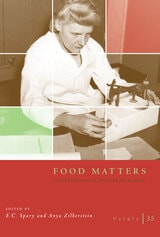
Osiris, Volume 35
Food Matters: Critical Histories of Food and the SciencesEdited by E. C. Spary and Anya Zilberstein
University of Chicago Press Journals, 2020
The essays delve into a range of topics, from early modern dietetics and debates about cannibalism to modern ready-to-eat rations and Ayurvedic recipes, from analyses of hungry model organisms to the dining rituals of Silicon Valley entrepreneurs and their patrons. As Food Matters shows, the history of knowledge about food has always raised debates about the shifting definition and boundaries of expertise: between traditional recipes and experimental protocols; between domestic craft skill and laboratory procedure; between the management and redistribution of resources for the social body on the one hand, and the subjective experiences of individual bodies on the other. At a moment when the authority of science is being questioned by a variety of publics, Food Matters is a timely reminder that such tensions, always present in food-related domains, reflect broader historical developments through which science became a prevalent force in shaping all aspects of public and private life.

Taking Drugs in the Sun King’s Reign
E. C. Spary
University of Chicago Press, 2027
The first full-length history of drugs during the first French Empire.
Taking Drugs in the Sun King’s Reign is the story of how the French came to know and consume new non-European plants between 1660 and 1730, a period during which many exotic substances—like coffee, tea, cinchona bark, chocolate, and ipecacuanha—became everyday commodities. E. C. Spary treats the trajectories of these drugs as fragile complexes, made and remade by every exchange. Her book addresses well-known cases, but also drugs that never became popular in France, such as betel.
Taking Drugs is divided into three parts. The first offers a rich depiction of the world of drug-taking and drug-selling in Paris and Versailles at the outset of Louis XIV’s personal reign. The second explores features of monarchical power which explain the “drugs rush” of this period. Finally, the third offers an in-depth look at how priorities for the capture of exotic plant drugs changed within the royal naval administration. It asks how, under the conditions of early modern empires, information about drugs could be made or made trustworthy, who made it, and how it traveled. Spary shows how, over time, drugs transitioned from being natural bodies imbued with mysterious virtues to becoming calculable, replicable sources of profit. Her approach allows for new insights into how political and economic power transformed between the reigns of Louis XIV and his successor, Louis XV.
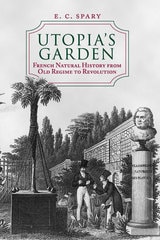
Utopia's Garden
French Natural History from Old Regime to RevolutionE. C. Spary
University of Chicago Press, 2000
E. C. Spary traces the scientific, administrative, and political strategies that enabled the foundation of the Muséum, arguing that agriculture and animal breeding rank alongside classification and collections in explaining why natural history was important for French rulers. But the Muséum's success was also a consequence of its employees' Revolutionary rhetoric: by displaying the natural order, they suggested, the institution could assist in fashioning a self-educating, self-policing Republican people. Natural history was presented as an indispensable source of national prosperity and individual virtue.
Spary's fascinating account opens a new chapter in the history of France, science, and the Enlightenment.