Results by title
5 books match the query 'Spiritual warfare'

Born Again
The Christian Right GlobalizedJennifer S. Butler
Pluto Press, 2006
The Christian Right wields massive political power in the United States and beyond. This is the first book to reveal the growing influence of the Christian Right within the United Nations.
This book reveals how Christian conservative groups are able to shape policy in every corner of the world. Drawing on interviews with religious leaders, it reveals how today's most powerful Christian Right organisations are building interfaith coalitions, connecting Catholic, Mormon and Muslim allies to advance a conservative agenda.
The US under Bush Jr. has given them a significant voice in shaping US policy on issues including women's rights, reproductive health, human cloning, children's rights and AIDS.
In short, the Christian Right is globalising -- a phenomenon that promises to challenge progressive social policy on a world-wide scale - as well as transform the Christian Right itself.
[more]
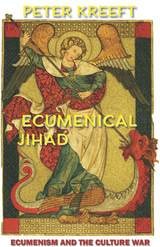
Ecumenical Jihad
Ecumenism and the Culture WarPeter Kreeft
St. Augustine's Press, 2015
Juxtaposing “ecumenism” and “jihad,” two words that many would consider strange and at odds with one another, Peter Kreeft argues that we need to change our current categories and alignments. We need to realize that we are at war and that the sides have changed radically. Documenting the spiritual and moral decay that has taken hold of modern society, Kreeft issues a wake-up call to all God-fearing Christians, Jews, and Muslims to unite together in a “religious war” against the common enemy of godless secular humanism, materialism, and immorality.
Aware of the deep theological differences of these monotheistic faiths, Kreeft calls for a moratorium on our polemics against one another so that we can form an alliance to fight together to save Western civilization.
Aware of the deep theological differences of these monotheistic faiths, Kreeft calls for a moratorium on our polemics against one another so that we can form an alliance to fight together to save Western civilization.
[more]
Imagining Persecution
Why American Christians Believe There Is a Global War against Their FaithJason Bruner
Rutgers University Press, 2021
Many American Christians have come to understand their relationship to other Christian denominations and traditions through the lens of religious persecution. This book provides a historical account of these developments, showing the global, theological, and political changes that made it possible for contemporary Christians to claim that there is a global war on Christians. This book, however, does not advocate on behalf of particular repressed Christian communities, nor does it argue for the genuineness (or lack thereof) of certain Christians’ claims of persecution. Instead, this book is the first to examine the idea that there is a “global war on Christians” and its analytical implications. It does so by giving a concise history of the categories (like “martyrs”), evidence (statistics and metrics), and theologies that have come together to produce a global Christian imagination premised upon the notion of shared suffering for one’s faith. The purpose in doing so is not to deny certain instances of suffering or death; rather, it is to reflect upon the consequences for thinking about religious violence and Christianity worldwide using terms such as a “global war on Christians.”
[more]
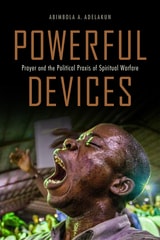
Powerful Devices
Prayer and the Political Praxis of Spiritual WarfareAbimbola Adunni Adelakun
Rutgers University Press, 2023
Powerful Devices studies spiritual warfare performances as an apparatus for disestablishing structures of power and knowledge, and establishing righteousness in their stead. Drawing on performance studies’ emphasis on radicality and breaking of social norms as devices of social transformation, the book demonstrates how Christian groups with dominant cultural power but who perceive themselves as embattled wield the ideas of performance activism. Combining religious studies with ethnography, Powerful Devices explores Nigerian Pentecostals and US Evangelicals’ praxis of transnational spiritual warfare. By closely studying spiritual warfare prayers as a “device,” Powerful Devices shows how the rituals of prayer enable an apprehension of time, paradigms of self-enhancement, and the subversion of politics and authority. A critical intervention, Powerful Devices explores charismatic Christianity’s relationship to science and secular authority, technology and temporality, neoliberalism, and reactionary ideology.
[more]
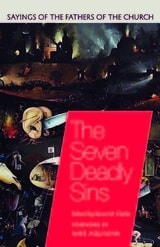
The Seven Deadly Sins
Sayings of the Fathers of the ChurchKevin M. Clarke
Catholic University of America Press, 2018
The Seven Deadly Sins: Sayings of the Fathers of the Church is the inaugural volume in a new series from the Catholic University of America Press. This series will feature a wide range of scholars compiling material from the Fathers of the Church series to focus on a specific area of theology. Forthcoming titles will focus on Death, Judgement, Heaven and Hell, and Angels and Demons, with others to be announced shortly.
Sacred Scripture did not neatly list the seven deadly sins, so where did this tradition come from? Unsurprisingly, it can be traced back to the Church Fathers. But were there eight or seven? In a sense, the answer is “both.” The tradition of the capital sins has a rich development in the patristic era, not only in the presentation of the list of vices but in the preaching and teaching of the early shepherds of the Church. So how do the capital sins spawn other vices in the soul? How does one cultivate the virtues that heal the soul from those vices? How are gluttony and lust related? Is sadness really a vice? How is vainglory different from pride? What role does almsgiving have in soothing the passion of anger? The Fathers of the Church answer these questions and more in this volume.
The capital vices are the gateway drugs to countless sins. The path of the book descends through the vices, culminating with their queen ruler, pride. The words of the Fathers will assist the reader in being more realistic about the attacks upon the soul. The text should also be edifying and medicinal. Since each chapter begins with vice and ends with virtue, one’s path through the chapters represents a sort of ascent out of vice and into the freedom of the virtues. The text gives special attention throughout to the thought of Augustine of Hippo, Evagrius of Pontus, John Cassian, Gregory the Great, and Maximus the Confessor.
[more]