Results by title
112 books match the query 'Spirituality' and 7 start with a
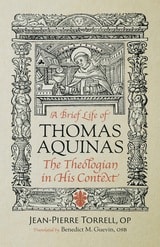
A Brief Life of Aquinas
The Theologian in His ContextJean-Pierre Torrell
Catholic University of America Press, 2024
Jean-Pierre Torrell, OP, who has already written the most highly-regarded contemporary two-volume introduction to the life and works of Saint Thomas, has composed a shorter book that captures the essence of the career of the Angelic Doctor for a more general audience. Torrell follows a biographical outline of the saint, although he also includes brief accounts of what the author takes to be the most important features of Aquinas's teachings.
Part biography, part travelogue, part theology, Jean-Pierre Torrell, OP’s A Brief Life of Thomas Aquinas is a multi-faceted look at the life and the writings of Saint Thomas Aquinas. Torrell’s hope is that his biography of the doctor communis intertwined with his theological examination of Aquinas’s writings will enable the reader to understand the person behind the writer and the writer behind the person. Aquinas’s life, Torrell claims, can shed light on his work with respect not only to their number, or to the varied topics he writes about, but to their content as well. It would be inaccurate to view Aquinas hiding behind a mountain of books in the cells he occupied in the various houses he inhabited around the Dominican world. He taught, he preached, he debated, he faced a number of conflicts of ideas that were not of his own making, but out of which would come some of his best-known writings. Torrell’s unique approach makes accessible one of the greatest minds of our tradition and the richness of the legacy he left the Church.
[more]
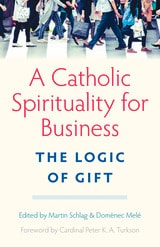
A Catholic Spirituality for Business
Martin Schlag
Catholic University of America Press, 2019
Spirituality and gift are notions that are en vogue. Topics such as spirituality at the workplace, spirituality management, spirituality in leadership, organizational spirituality and other related topics are trending in management literature. The “logic of gift” is also appearing more frequently, especially in attempts to rethink the way our economy works in order to include the marginalized.
<
The expression “logic of gift” was introduced into official Catholic social teaching by Pope Benedict XVI, who presented it in association with the principle of gratuitousness, which in turn is an expression of fraternity. However, before Caritas in Veritate and ever since Marcel Mauss’s groundbreaking work The Gift, the importance of gift for human relationships and for the cohesion of society had been increasingly recognized. Alain Caillé and Jacques T. Godbout further fleshed out the implication of gift for contemporary society in the context of secular social sciences, striving to overcome utilitarianism. It was the “civil economy” movement, however, that exercised greatest influence on Benedict XVI’s encyclical Caritas in Veritate
This present volume reflects on the general scope of these notions for business and society. This is done by structuring the book in two parts, each dedicated to one of the two concepts. Each part has two general chapters and two that apply the notions to business and to business education. The authors are a mix of well-known emeritus professors and younger talented emerging scholars. We have also been careful to combine European with American authors.
A Catholic Spirituality for Business: The Logic of Gift does not seek to provide a definitive answer to all social challenges, but to make a contribution to a better understanding of Christian spirituality and gift in connection with business organizations. The authors in this book are convinced that markets can be ethical and social, that moral change towards ethical capitalism is possible.
[more]

A God in the House
Poets Talk About FaithEdited by Ilya Kaminsky and Katherine Towler
Tupelo Press, 2012
Editors Ilya Kaminsky and Katherine Towler have gathered conversations with nineteen of America’s leading poets, reflecting upon their diverse experiences with spirituality and the craft of writing. Bringing together poets who are Christian, Buddhist, Jewish, Muslim, Pagan, Native American, Wiccan, agnostic, and otherwise, this book offers frank and thoughtful consideration of themes too often polarized and politicized in our society. Participants include Li-Young Lee, Jane Hirshfield, Carolyn Forché, Gerald Stern, Christian Wiman, Joy Harjo, and Gregory Orr, and others, all wrestling with difficult questions of human existence and the sources of art.
[more]

A View from Life's Edge
Discovering What Really Matters with Older Women Across the GlobeCorinne G. Dempsey
Rutgers University Press, 2026
In today’s death-denying, success-driven society, older women’s countercultural voices call for our attention. Recounting emotionally charged conversations from across the world, A View from Life’s Edge reflects on women’s comfort with impending death, gratitude forged by catastrophe, and humility that makes way for wonder.
Speaking with nearly one hundred women over the age of eighty in four locations—northern Iceland, south India, a retirement community in California, and a convent in upstate New York—Corinne G. Dempsey finds that, as we near life’s end, we gain clarity about what really matters in life. Women’s stories and reflections, in which sorrow and loss are central to a life well lived, help to expand our sense of what it means to be human.
Drawing on the paradoxical wisdom of world religions and mystical traditions to frame late-life tendencies across cultures, Dempsey portrays these accounts as a corrective to mainstream values that defeat and diminish us. Dempsey encourages us to turn away from ageist fears rather than denying life’s inevitable end. Learning from older women’s perspectives, we might move their edge-of-life views closer to the center.
[more]
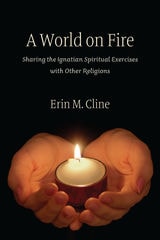
A World On Fire
Sharing the Ignatian Spiritual Exercises with Other ReligionsErin M. Cline
Catholic University of America Press, 2018
The Spiritual Exercises of St. Ignatius of Loyola give shape to the spiritual lives of Jesuits and many other Christians. But might these different ways of praying, meditating, and reading scripture be helpful to members of other faiths as well? In response to the call of Fr. Adolfo Nicolas, SJ, the thirtieth Superior General of the Jesuits (2008-2016) to explore how the Ignatian Spiritual Exercises can be fruitfully appropriated by non-Christians, A World on Fire analyzes the prospects for adapting the Spiritual Exercises in order to make them accessible to members of other faith traditions while still maintaining their core meaning and integrity.
Erin Cline examines why this ought to be done, for whom, and what the aims of such an adaptation would be, including the different theological justifications for this practice. She concludes that there are compelling reasons for sharing the Exercises with members of other religions and that doing so coheres with the central mission of the Jesuits. A World on Fire goes on to examine the question of how the Exercises can be faithfully adapted for members of other religions. In outlining adaptations for the Hindu, Buddhist, and Confucian traditions that draw upon the traditional content of the Exercises supplemented by the texts of these religious traditions, Cline shows how Ignatian spirituality can help point the way to a different kind of inter-religious dialogue – one that is not bound up in technical terminology or confined to conversations between theologians and religious leaders. Rather, in making the Spriitual Exercises accessible to members of other faith traditions, we are as Pope Francis puts it, “living on a frontier, one in which the Gospel meets the needs of the people to whom it should be proclaimed in an understandable and meaningful way.”
A World on Fire will be of interest to comparative theologians and scholars working on inter-religious dialogue, religious pluralism, contemplative studies, and spirituality, as well as Jesuit priests and other practitioners who employ the Spiritual Exercises in their ministry.
[more]
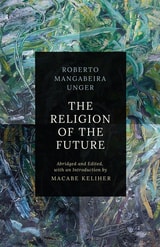
Abridgment of The Religion of the Future
Roberto Mangabeira Unger
Bridwell Press, 2014
Roberto Mangabeira Unger's The Religion of the Future is a secular project for spiritual and political revolution. It offers a comprehensive vision of humanity and a program for the refashioning of self and society that will enable each man and woman to live a greater life. Unger exhorts us to embrace the life we have now by recognizing what makes us human rather than attempt to suppress or overcome — as do existing religions — our existential and spiritual limitations. His program involves both political measures to reform the structure of society and a moral component to engage an individual's conduct of life. Unger's vision of the religion of the future offers us more life here and now so that we can become more human by becoming more godlike. This abridgment represents an edited rendition of the original that, although reduced in size, is complete in argument. It contains an extensive introduction to the argument and the author.
[more]
Aztec Philosophy
Understanding a World in MotionJames Maffie
University Press of Colorado, 2014
In Aztec Philosophy, James Maffie shows the Aztecs advanced a highly sophisticated and internally coherent systematic philosophy worthy of consideration alongside other philosophies from around the world. Bringing together the fields of comparative world philosophy and Mesoamerican studies, Maffie excavates the distinctly philosophical aspects of Aztec thought.
Aztec Philosophy focuses on the ways Aztec metaphysics—the Aztecs’ understanding of the nature, structure and constitution of reality—underpinned Aztec thinking about wisdom, ethics, politics,\ and aesthetics, and served as a backdrop for Aztec religious practices as well as everyday activities such as weaving, farming, and warfare. Aztec metaphysicians conceived reality and cosmos as a grand, ongoing process of weaving—theirs was a world in motion. Drawing upon linguistic, ethnohistorical, archaeological, historical, and contemporary ethnographic evidence, Maffie argues that Aztec metaphysics maintained a processive, transformational, and non-hierarchical view of reality, time, and existence along with a pantheistic theology.
Aztec Philosophy will be of great interest to Mesoamericanists, philosophers, religionists, folklorists, and Latin Americanists as well as students of indigenous philosophy, religion, and art of the Americas.
[more]