Results by title
10 books match the query 'Sports and state'
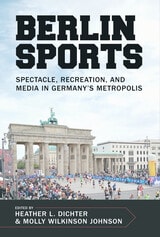
Berlin Sports
Spectacle, Recreation, and Media in Germany’s MetropolisHeather L. Dichter
University of Arkansas Press, 2024
This book begins with a long-distance equestrian race in the 1890s and continues with the role of media in spectacle, celebrity, urban life, and gender from the 1890s to the 1920s.It then turns to grassroots sport participation and spectatorship as well as sport diplomacy at the elite international level during the postwar period and the years of German division. Next, it explores recreational sport associations within the context of immigration and youth counterculture. It concludes with the 2015 European Maccabi Games, an international Jewish sports festival through which Berlin sought to grapple with the infamous 1936 Olympics and showcase Berlin as a cosmopolitan and multicultural city. Taken together, the book’s scholarly essays on all of these sporting endeavors reveal the rich and varied sporting culture in Berlin and yield fresh insights into spectacle, recreation, and media in the city.

Beyond A Boundary
C. L. R. James
Duke University Press, 1993
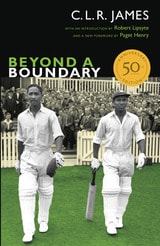
Beyond a Boundary
50th Anniversary EditionC. L .R. James
Duke University Press, 2013
Named one of the Top 50 Sports Books of All Time by Sports Illustrated
"Beyond a Boundary . . . should find its place on the team with Izaak Walton, Ivan Turgenev, A. J. Liebling, and Ernest Hemingway."—Derek Walcott, The New York Times Book Review
"As a player, James the writer was able to see in cricket a metaphor for art and politics, the collective experience providing a focus for group effort and individual performance. . . . [In] his scintillating memoir of his life in cricket, Beyond a Boundary (1963), James devoted some of his finest pages to this theme."—Edward Said, The Washington Post
"A work of double reverence—for the resilient, elegant ritualism of cricket and for the black people of the world."—Whitney Balliett, The New Yorker
"Beyond a Boundary is a book of remarkable richness and force, which vastly expands our understanding of sports as an element of popular culture in the Western and colonial world."—Mark Naison, The Nation
"Everything James has done has had the mark of originality, of his own flexible, sensitive, and deeply cultured intelligence. He conveys not a rigid doctrine but a delight and curiosity in all the manifestations of life, and the clue to everything lies in his proper appreciation of the game of cricket."—E. P. Thompson, author of The Making of the English Working Class
"Beyond a Boundary is . . . first and foremost an autobiography of a living legend—probably the greatest social theorist of our times."—Manning Marable, Journal of Sport & Social Issues
"The great triumph of Beyond a Boundary is its ability to rise above genre and in its very form explore the complex nature of colonial West Indian society."—Caryl Phillips, The New Republic
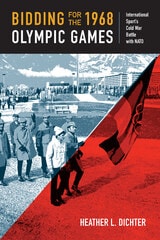
Bidding for the 1968 Olympic Games
International Sport's Cold War Battle with NATOHeather L. Dichter
University of Massachusetts Press, 2021
During the Cold War, political tensions associated with the division of Germany came to influence the world of competitive sport. In the 1950s, West Germany and its NATO allies refused to recognize the communist East German state and barred its national teams from sporting competitions. The construction of the Berlin Wall in 1961 further exacerbated these pressures, with East German teams denied travel to several world championships. These tensions would only intensify in the run-up to the 1968 Olympics.
In Bidding for the 1968 Olympic Games, Heather L. Dichter considers how NATO and its member states used sport as a diplomatic arena during the height of the Cold War, and how international sport responded to political interference. Drawing on archival materials from NATO, foreign ministries, domestic and international sport functionaries, and newspapers, Dichter examines controversies surrounding the 1968 Summer and Winter Olympic Games, particularly the bidding process between countries to host the events. As she demonstrates, during the Cold War sport and politics became so intertwined that they had the power to fundamentally transform each other.
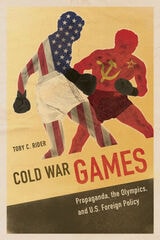
Cold War Games
Propaganda, the Olympics, and U.S. Foreign PolicyToby C Rider
University of Illinois Press, 2016
Drawing on newly declassified materials and archives, Toby C. Rider chronicles how the U.S. government used the Olympics to promote democracy and its own policy aims during the tense early phase of the Cold War. Rider shows how the government, though constrained by traditions against interference in the Games, eluded detection by cooperating with private groups, including secretly funded émigré organizations bent on liberating their home countries from Soviet control. At the same time, the United States utilized Olympic host cities as launching pads for hyping the American economic and political system. Behind the scenes, meanwhile, the government attempted clandestine manipulation of the International Olympic Committee. Rider also details the campaigns that sent propaganda materials around the globe as the United States mobilized culture in general, and sports in particular, to fight the communist threat.
Deeply researched and boldly argued, Cold War Games recovers an essential chapter in Olympic and postwar history.
Marxism, Colonialism, and Cricket
C. L. R. James's Beyond a BoundaryDavid Featherstone, Christopher Gair, Christian Høgsbjerg and Andrew Smith, editors
Duke University Press, 2018
Contributors. Anima Adjepong, David Austin, Hilary McD. Beckles, Michael Brearley, Selwyn R. Cudjoe, David Featherstone, Christopher Gair, Paget Henry, Christian Høgsbjerg, C. L. R. James, Selma James, Roy McCree, Minkah Makalani, Clem Seecharan, Andrew Smith, Neil Washbourne, Claire Westall
Sport and Neoliberalism
Politics, Consumption, and CultureDavid L. Andrews
Temple University Press, 2012
Offering new approaches to thinking about sports and political ideologies, Sport and Neoliberalism explores the structures, formations, and mechanics of neoliberalism. The editors and contributors to this original and timely volume examine the intersection of sport as a national pastime and also an engine for urban policy—e.g., stadium building—as well as a powerful force for influencing our understanding of the relationship between culture, politics, and identity.
Sport and Neoliberalism examines the ways the neoliberal project creates priorities for civic society and how, in effect, it turns many aspects of sport into a vehicle of public governance. From the relationship between sport and the neo-liberal state, through the environmental dimensions of neo-liberal sport, to the political biopolitics of obesity, the essays in this volume explore the ways in which the “logics” of neoliberalism are manifest as powerful public pedagogies through the realm of popular culture.
Contributors include: Michael Atkinson, Ted Butryn, C. L. Cole, Norman Denzin, Grant Farred, Jessica Francombe, Caroline Fusco, Michael D. Giardina, Mick Green, Leslie Heywood, Samantha King, Lisa McDermott, Mary G. McDonald, Toby Miller, Mark Montgomery, Joshua I. Newman, Jay Scherer, Kimberly S. Schimmel, and Brian Wilson
In the series Sporting, edited by Amy Bass
Sport and Political Ideology
By John M. Hoberman
University of Texas Press, 1984
Across the modern political spectrum, left-wing and right-wing political theorists have invested sport with ideological significance. That significance, however, varies distinctively and characteristically with the ideology—a phenomenon John Hoberman terms "ideological differentiation." Taking this phenomenon as its point of departure, this provocative work interprets the major sport ideologies of the twentieth century as distinct expressions of political doctrine.
Hoberman argues that a political ideology's interpretation of sport is shaped in part by the value it assigns to work and play as modes of experience; the political anthropologies of right and left can be distinguished by examining their resistance to—or affinity for—sportive imagery of their leaders and of the state itself; there exists a fascist temperament that shows an affinity to athleticism and the sphere of the body that is not shared by the left.
Tracing modern sport ideology back to its premodern antecedents, Hoberman examines the interpretations of sport that have been promulgated by European political intellectuals, such as cultural conservatives and contemporary neo-Marxists, and by the official ideologists of Nazi Germany, the Soviet Union, the German Democratic Republic, and China before and after Mao.
As a form of mass theater, sport can advertise any ideology. But the deeper relationship between sport and political ideology has never before been explored wth such vigor. Presenting the first general theory of sport and political ideology to appear in any language, Hoberman's groundbreaking work is a unique and invaluable contribution to the intellectual and political history of sport in the twentieth century.
The Nazi Olympics
Richard D. Mandell
University of Illinois Press, 1987
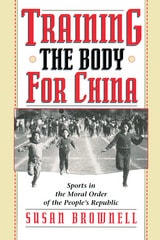
Training the Body for China
Sports in the Moral Order of the People's RepublicSusan Brownell
University of Chicago Press, 1995
Training the Body for China is the first book on Chinese sports based on extended fieldwork by a Westerner. Brownell introduces the notion of "body culture" to analyze Olympic sports as one element in a whole set of Chinese body practices: the "old people's disco dancing" craze, the new popularity of bodybuilding (following reluctant official acceptance of the bikini), mass calisthenics, martial arts, military discipline, and more.
Translating official and dissident materials into English for the first time and drawing on performance theory and histories of the body, Brownell uses the culture of the body as a focal point to explore the tensions between local and global organizations, the traditional and the modern, men and women. Her intimate knowledge of Chinese social and cultural life and her wide range of historic examples make Training the Body for China a unique illustration of how gender, the body, and the nation are interlinked in Chinese culture.