Results by title
14 books match the query 'St . Louis'
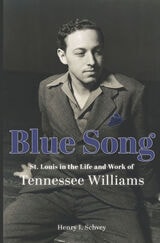
Blue Song
St. Louis in the Life and Work of Tennessee WilliamsHenry I. Schvey
University of Missouri Press, 2022
The question of this paradox lies at the heart of this book, an attempt not so much to correct the record about Williams’s well-chronicled dislike of the city, but rather to reveal how the city was absolutely indispensable to his formation and development both as a person and artist. Unlike the prevailing scholarly narrative that suggests that Williams discovered himself artistically and sexually in the deep South and New Orleans, Blue Song reveals that Williams remained emotionally tethered to St. Louis for a host of reasons for the rest of his life.
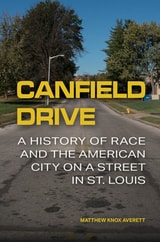
Canfield Drive
A History of Race and the American City on a Street in St. LouisMatthew Knox Averett
University of Missouri Press, 2027
Winner of the 2026 Missouri Conference on History Book Award; the 2026 Missouri History Book Award; and shortlisted for the 2026 ASU Humanities Book Award
On August 9, 2014, Michael Brown and a friend were walking down Canfield Drive, a residential street in the St. Louis suburb of Ferguson. There, they encountered Ferguson Police Officer Darren Wilson. Moments later, Brown was dead on the street—shot by Wilson at least six times. That evening, a memorial appeared on the pavement where he had fallen. In the days that followed, vigils turned into protests, and protests into an Uprising, as police in riot gear faced off with a grieving, outraged community. For nearly two weeks, Ferguson commanded the nation’s attention. The killing of Michael Brown was an outrage and it should not have happened. But Canfield Drive was primed for tragedy long before that fatal encounter because the street was already a place of racial conflict. This was no accident.
Canfield Drive: A History of Race and the American City on a Street in St. Louis uncovers the deeper history behind the street where Brown died, tracing how race and the built environment have long intersected in St. Louis—from the city’s founding to the Ferguson Uprising. The book follows the story of Black space across two centuries: from early Black communities, to the birth of the St. Louis Blues, to the Halcyon days of The Ville, to the destruction of Mill Creek Valley, to the tragedy of Pruitt-Igoe, and to the construction of Canfield Drive. Though Canfield Drive is the first comprehensive history of St. Louis’s Black urban landscape, it is more than just St. Louis's story. Canfield Drive details the racial engineering of the American city. Here is the machinery of American segregation laid bare: occupancy covenants, court decisions, racial steering, white flight, public housing, voucher systems, and predatory policing that combine to transform neighborhoods into traps. Here too are the people who fought back, building community against staggering odds and securing civil rights reforms that transformed America's understanding of government's obligations to its citizens.
Canfield Drive provides a powerful lens on the national story of race and the American city and reveals how Michael Brown's death was not just one officer's deadly decision, but the inevitable outcome of America's built environment—a tragedy centuries in the making, on a street designed for violence. This is how a place becomes a powder keg. This is how history erupts into headlines. This is the story behind the story that America couldn't look away from. This is the story of how a street came to matter, and how it came to stand for something far greater than itself.
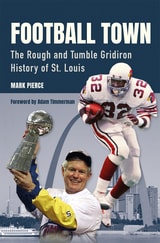
Football Town
The Rough and Tumble Gridiron History of St. LouisMark Pierce
University of Missouri Press, 2027
For 49 years St. Louis was home to two NFL football franchises comprising many colorful and even great players, but ever since the Rams moved back to Los Angeles in 2016, the Gateway City has secured a solid reputation as an NFL ghost town. In Football Town:The Rough and Tumble Gridiron History of St. Louis, the first scholarly treatment of the history of all professional football in St. Louis, Mark Pierce challenges the standard narrative, chronicling the city’s rich yet largely forgotten history of pro football, celebrating its more successful moments on the gridiron, and proving that St. Louis has long been and still is far more than a “Baseball Town.”
Pierce begins with St. Louis’s efforts to compete in the burgeoning NFL in 1923 and 1934-1936, yet the city’s pro football history begins in earnest with the arrival of the Cardinals from Chicago in 1960. The author chronicles the team’s entire 28-season stay in St. Louis, including its most successful period under head coach Don Coryell, from 1973 to 1977, and the inconsistency that prevailed after his tenure. Eventually, revenue concerns, failed stadium negotiations, and other issues culminated in the owner of the franchise’s decision to move the team to Phoenix after the 1987 season, despite offers of better terms at Busch Stadium and the promise of the construction of a new downtown stadium by city and state government leaders.
Even after the loss of the Cardinals, a craving for pro football persisted in St. Louis, and the search for a new team commenced almost immediately thereafter. Pierce documents the tumultuous process of securing the Rams’ 1995 move from their native Los Angeles to St. Louis, a deal concluded through high-stakes negotiations despite efforts by NFL insiders to prevent the move entirely. Nevertheless, by April that year, St. Louis fans could once again emotionally invest in the NFL—and they did so in earnest. In addition to detailing the ups and downs of the Ram’s subsequent twenty years in the city, Pierce closely examines the “poison pill” made in its original lease agreement with the St. Louis Convention and Visitors Commission, which would ultimately lead to disaster.
Football Town is built on a foundation of 25 interviews the author personally conducted with former players, coaches, and broadcasters, including Pro Football Hall of Famers Dick Vermeil and Jackie Smith; Baseball Hall of Fame broadcaster Joe Buck; Cardinals greats Jim Hart, Mel Gray, O.J. Anderson, and Roy Green; and Rams’ Super Bowl champions Mike Martz, Trent Green, Adam Timmerman, Keith Lyle, and Adam Timmerman.
Accompanied by dozens of photos not seen in decades, Football Town allows those who played the game in St. Louis to tell their stories and share their thoughts on the city’s rich and colorful football history.
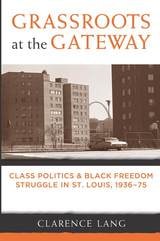
Grassroots at the Gateway
Class Politics and Black Freedom Struggle in St. Louis, 1936-75Clarence Lang
University of Michigan Press, 2010
"This is a theoretically sophisticated and thoroughly documented historical case study of the movements for African American liberation in St. Louis. Through detailed analysis of black working class mobilization from the depression years to the advent of Black Power, award-winning historian Clarence Lang describes how the advances made in earlier decades were undermined by a black middle class agenda that focused on the narrow aims of black capitalists and politicians. The book is a major contribution to our understanding of the black working class insurgency that underpinned the civil rights and Black Power campaigns of the twentieth century."
---V. P. Franklin, University of California, Riverside
"A major work of scholarship that will transform historical understanding of the pivotal role that class politics played in both civil rights and Black Power activism in the United States. Clarence Lang's insightful, engagingly written, and well-researched study will prove indispensable to scholars and students of postwar American history."
---Peniel Joseph, Brandeis University
Breaking new ground in the field of Black Freedom Studies, Grassroots at the Gateway reveals how urban black working-class communities, cultures, and institutions propelled the major African American social movements in the period between the Great Depression and the end of the Great Society. Using the city of St. Louis in the border state of Missouri as a case study, author Clarence Lang undermines the notion that a unified "black community" engaged in the push for equality, justice, and respect. Instead, black social movements of the working class were distinct from---and at times in conflict with---those of the middle class. This richly researched book delves into African American oral histories, records of activist individuals and organizations, archives of the black advocacy press, and even the records of the St. Louis' economic power brokers whom local black freedom fighters challenged. Grassroots at the Gateway charts the development of this race-class divide, offering an uncommon reading of not only the civil rights movement but also the emergence and consolidation of a black working class.
Clarence Lang is Assistant Professor in African American Studies and History at the University of Illinois at Urbana-Champaign.
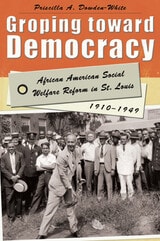
Photo courtesy Western Historical Manuscript Collection, University of Missouri, St. Louis
Groping toward Democracy
African American Social Welfare Reform in St. Louis, 1910-1949Priscilla A. Dowden-White
University of Missouri Press, 2011
In Groping toward Democracy: African American Social Welfare Reform in St. Louis, 1910–1949, historian Priscilla A. Dowden-White presents an on-the-ground view of local institution building and community organizing campaigns initiated by African American social welfare reformers. Through extensive research, the author places African American social welfare reform efforts within the vanguard of interwar community and neighborhood organization, reaching beyond the “racial uplift” and “behavior” models of the studies preceding hers. She explores one of the era’s chief organizing principles, the “community as a whole” idea, and deliberates on its relationship to segregation and the St. Louis black community’s methods of reform. Groping toward Democracy depicts the dilemmas organizers faced in this segregated time, explaining how they pursued the goal of full, uncontested black citizenship while still seeking to maximize the benefits available to African Americans in segregated institutions. The book’s nuanced mapping of the terrain of social welfare offers an unparalleled view of the progress brought forth by the early-twentieth-century crusade for democracy and equality.
By delving into interrelated developments in health care, education, labor, and city planning, Dowden-White deftly examines St. Louis’s African American interwar history. Her in-depth archival research fills a void in the scholarship of St. Louis’s social development, and her compelling arguments will be of great interest to scholars and teachers of American urban studies and social welfare history.
Meet Me in St. Louis
Sally Benson
University of Chicago Press, 2026
Sally Benson’s charming slice-of-life story is back in print for a new generation of readers.
Originally published as World War II raged overseas, Meet Me in St. Louis is Sally Benson’s semi-autobiographical account of the intergenerational Smith family during the twelve months leading up to the 1904 World’s Fair in St. Louis, Missouri. With warmth and tenderness, Benson chronicles the Smiths’ lives as they navigate sibling rivalries, first loves, financial hardship, jealousy, and heartaches in a poignant ode to the bonds of family.
Benson's novel is infused with wit as she details the lighthearted, pleasant existence of the Smith family’s five children—one rife with chaste crushes, victimless pranks, and other childhood escapades. Yet, the novel’s episodic, squeaky-clean veneer belies a dark comedic brilliance that transcends the ages and speaks, even today, to the universal experience of growing up.
Long out of print, this new edition of Benson’s timeless work includes a foreword by bestselling author Benjamin Dreyer, who comments both on the book's origins and its afterlife in popular culture as the source material for Judy Garland’s beloved musical of the same name. An effervescent midcentury novel waiting to be rediscovered, Meet Me in St. Louis is ready to meet its new generation of readers.
Mound City
The Place of the Indigenous Past and Present in St. LouisPatricia Cleary
University of Missouri Press, 2025
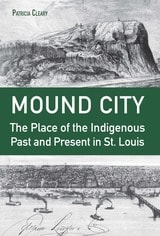
Nearly one thousand years ago, Native peoples built a satellite suburb of America's great metropolis on the site that later became St. Louis. At its height, as many as 30,000 people lived in and around present-day Cahokia, Illinois. While the mounds around Cahokia survive today (as part of a state historic site and UNESCO world heritage site), the monumental earthworks that stood on the western shore of the Mississippi were razed in the 1800s. But before and after they fell, the mounds held an important place in St. Louis history, earning it the nickname “Mound City.” For decades, the city had an Indigenous reputation. Tourists came to marvel at the mounds and to see tribal delegations in town for trade and diplomacy. As the city grew, St. Louisans repurposed the mounds—for a reservoir, a restaurant, and railroad landfill—in the process destroying cultural artifacts and sacred burial sites. Despite evidence to the contrary, some white Americans declared the mounds natural features, not built ones, and cheered their leveling. Others espoused far-fetched theories about a lost race of Mound Builders killed by the ancestors of contemporary tribes. Ignoring Indigenous people's connections to the mounds, white Americans positioned themselves as the legitimate inheritors of the land and asserted that modern Native peoples were destined to vanish. Such views underpinned coerced treaties and forced removals, and—when Indigenous peoples resisted—military action. The idea of the “Vanishing Indian” also fueled the erasure of Indigenous peoples’ histories, a practice that continued in the 1900s in civic celebrations that featured white St. Louisans “playing Indian” and heritage groups claiming the mounds as part of their own history. Yet Native peoples endured and in recent years, have successfully begun to reclaim the sole monumental mound remaining within city limits.
Drawing on a wide range of sources, Patricia Cleary explores the layers of St. Louis’s Indigenous history. Along with the first in-depth overview of the life, death, and afterlife of the mounds, Mound City offers a gripping account of how Indigenous histories have shaped the city’s growth, landscape, and civic culture.
St. Louis and Empire
250 Years of Imperial Quest and Urban CrisisHenry W. Berger
Southern Illinois University Press, 2015
Berger uses a biographical approach to explore the individuals and institutions that played a leading role in St. Louis’s expansionist reach. He shows how St. Louis business leaders, entrepreneurs, politicians, and investors—often driven by personal and ideological motives, as well as the potential betterment of the city and its people—looked to the west, southwest, Latin America, Europe, Asia, and the Pacific to form economic or political partnerships. Among the people and companies Berger profiles are Thomas Hart Benton, who envisioned a western democratic capitalist empire hosted by St. Louis; cotton exporters James Paramore and William Senter, who were involved in empire building in the southwest and Mexico; St. Louis oil tycoon and railroad investor Henry Clay Pierce, who became deeply involved in political intrigue and intervention in Mexican affairs; entrepreneur and politician David R. Francis, who promoted personal and St. Louis interests in Russia; and McDonnell-Douglas and its founder, James S. McDonnell Jr., who were part of the transformation of St. Louis’s political economy during the Cold War.
Many of these attempted imperial activities failed, but even when they succeeded, Berger explains, the economy and the people of St. Louis did not usually benefit. The vision of a democratic capitalist empire embraced by its exponents proved to be both an illusion and a contradiction. By shifting the focus of foreign relations history from the traditional confines of nation-state conduct to city and regional behavior, this innovative study highlights the domestic foundations and content of foreign policy, opening new avenues for study in the field of foreign relations.
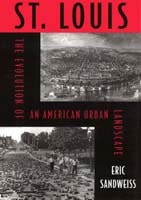
St. Louis
Evolution Of American Urban LandscapeERIC SANDWEISS
Temple University Press, 2001
In this book, Eric Sandweiss scrutinizes the everyday landscape -- streets, houses, neighborhoods, and public buildings -- as it evolved in a classic American city. Bringing to life the spaces that most of us pass without noticing, he reveals how the processes of dividing, trading, improving, and dwelling upon land are acts that reflect and shape social relations. From its origins as a French colonial settlement in the eighteenth century to the present day, St. Louis offers a story not just about how our past is diagrammed in brick and asphalt, but also about the American city's continuing viability as a place where the balance of individual rights and collective responsibilities can be debated, demonstrated and adjusted for generations to come.
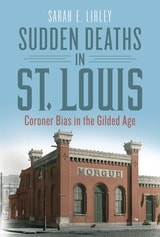
Sudden Deaths in St. Louis
Coroner Bias in the Gilded AgeSarah E. Lirley
Southern Illinois University Press, 2024
Honorable Mention, 2025 Society of Midland Authors Award in History!
A social history of death investigations in the urban Midwest
The scene of myriad grisly deaths, late nineteenth-century St. Louis was a hotbed for homicide, suicide, alcoholism, abortion, and workplace accidents. The role of the city’s Gilded Age coroners has not been fully examined, contextualized, or interrogated until now. Sarah E. Lirley investigates the process in which these outcomes were determined, finding coroners’ rulings were not uniform, but rather varied by who was conducting the inquest. These fascinating case studies explore the lives of the deceased, as well as their families, communities, press coverage of the events, and the coroners themselves.
Sudden Deaths in St. Louis is a study of 120 coroners’ inquests conducted between 1875 and 1885. Each chapter analyzes the typical versus the atypical in verdicts of death. At the time, inaccurate findings and cursory investigations fueled criticisms of coroner’s offices for employing poorly trained laymen. The coroners featured in this book had the power to shape public perception of the deceased, and they often relied on preexisting reputations to determine cause of death. For instance, women who worked as prostitutes were likely to be ruled as suicides, whether or not that was actually the case, and women who were respected members of their communities, particularly mothers, frequently received rulings of suicide caused by insanity. Verdicts also depended in part on availability of witnesses, including family members, to determine whether another person could be held liable for the death. Lirley’s book highlights the stories of ordinary men and women whose lives were tragically cut short, and the injustice they received even after death.
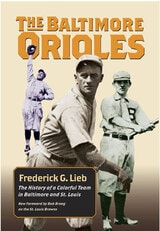
The Baltimore Orioles
The History of a Colorful Team in Baltimore and St. LouisFrederick G. Lieb Foreword by Bob Broeg
Southern Illinois University Press, 2005
With a legacy that spans two fiercely loyal baseball towns a half-nation apart, the Baltimore Orioles—originally the St. Louis Browns—rank among baseball’s most storied teams. One of the fifteen celebrated team histories commissioned by G. P. Putnam’s Sons in the 1940s and 1950s, The Baltimore Orioles: The History of a Colorful Team in Baltimore and St. Louis chronicles the club’s early history and is reissued on the fiftieth anniversary of their first season in Baltimore.
Hall of Fame sportswriter Frederick G. Lieb begins with the history of baseball in Baltimore from its pre-Civil War beginnings and its major-league debut as the Lord Baltimores in 1872 to the championship seasons of the National League Orioles in 1894, ’95, and ’96 when the roster included Willie Keeler, Joe Kelley, Kid Gleason, Roger Bresnahan, Joe McGinnity, and John McGraw. After the turn of the century, Baltimore was briefly home to the Orioles of the American League in 1901-02, then, after losing its franchise to New York, had to settle for the AAA International League Orioles until 1954. Under the leadership of Jack Dunn, the minor-league Orioles, while developing the talents of Babe Ruth, Lefty Grove, and other future major-league stars, won seven straight International League pennants from 1919 to 1926.
Here, too, is the colorful history of the precursors to the current Orioles, the lovable and luckless St. Louis Browns, augmented for this edition with a new foreword from St. Louis sportswriter Bob Broeg on the escapades of the Brownies. Though they lost more than a thousand games and captured only a single pennant in fifty-three seasons, the Browns remain a legendary part of national lore. Taking their lead in different eras from larger-than-life figures such as Branch Rickey, Rogers Hornsby, Urban Shocker, and the Barnum of Baseball, Bill Veeck, the Browns “boasted a one-armed outfielder, a hired hypnotist, the mighty midget [Eddie Gaedel] and—even the best ballplayer in the land—George Sisler,” as Broeg recalls in his foreword. In 1944, the Browns also played in the only all-St. Louis World Series, losing to the Cardinals.
Originally published in 1955 and featuring twenty-two photographs, The Baltimore Orioles history concludes with the new American League team’s first season in Baltimore, finishing seventh in the league but garnering the lasting adoration of their new hometown.
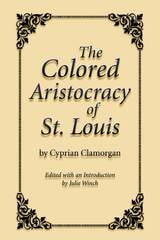
The Colored Aristocracy of St. Louis
Cyprian Clamorgan, Edited & Intro by Julie Winch
University of Missouri Press, 2018
In 1858, Cyprian Clamorgan wrote a brief but immensely readable book entitled The Colored Aristocracy of St. Louis. The grandson of a white voyageur and a mulatto woman, he was himself a member of the "colored aristocracy." In a setting where the vast majority of African Americans were slaves, and where those who were free generally lived in abject poverty, Clamorgan's "aristocrats" were exceptional people. Wealthy, educated, and articulate, these men and women occupied a "middle ground." Their material advantages removed them from the mass of African Americans, but their race barred them from membership in white society.
The Colored Aristocracy of St. Louis is both a serious analysis of the social and legal disabilities under which African Americans of all classes labored and a settling of old scores. Somewhat malicious, Clamorgan enjoyed pointing out the foibles of his friends and enemies, but his book had a serious message as well. "He endeavored to convince white Americans that race was not an absolute, that the black community was not a monolith, that class, education, and especially wealth, should count for something."
Despite its fascinating insights into antebellum St. Louis, Clamorgan's book has been virtually ignored since its initial publication. Using deeds, church records, court cases, and other primary sources, Winch reacquaints readers with this important book and establishes its place in the context of African American history. This annotated edition of The Colored Aristocracy of St. Louis includes an introductory essay on African Americans in St. Louis before the Civil War, as well as an account of the lives of the author and the members of his remarkable family—a family that was truly at the heart of the city's "colored aristocracy" for four generations.
A witty and perceptive commentary on race and class, The Colored Aristocracy of St. Louis is a remarkable story about a largely forgotten segment of nineteenth-century society. Scholars and general readers alike will appreciate Clamorgan's insights into one of antebellum America's most important communities.
The Dead End Kids of St. Louis
Homeless Boys and the People Who Tried to Save ThemBonnie Stepenoff
University of Missouri Press, 2021
The Great Heart of the Republic
St. Louis and the Cultural Civil WarAdam Arenson
University of Missouri Press, 2011
The Civil War revealed what united as well as what divided Americans in the nineteenth century—not only in its deadly military conflict, but also in the broader battle of ideas, dueling moral systems, and competing national visions. Adam Arenson focuses this cultural civil war in St. Louis, the largest city along the border of slavery and freedom. From this vantage point, the Civil War era looks less like a fight between North and South over slavery or the West as a prize, and more like a messy struggle between northerners, southerners, and westerners, a clash among three incompatible regional visions, whose leaders argued about the definition and importance of Manifest Destiny and slavery politics. Arenson weaves this political history with analyses of paintings, architecture, and other cultural products, paying particular attention to institutions such as universities and railroads. The result is a vibrant history of the Civil War era from the heart of the Republic that enriches our understanding of America at a crossroads.