Results by title
4 books match the query 'Staudt, R. Jared'
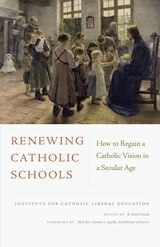
Renewing Catholic Schools
How to Regain a Catholic Vision for a Secular AgeR. Jared Staudt
Catholic University of America Press, 2020
Catholic education remains one of the most compelling expressions of the Church’s mission to form disciples. Despite decades of decline in the number of schools and students, many Catholic schools have been experiencing renewal by returning to the great legacy of the Catholic tradition. Renewing Catholic Schools offers an overview of the reasons behind this renewal and practical suggestions for administrators, clergy, teachers, and parents on how to begin the process of reinvigoration.
The book begins by situating Catholic education within the Church’s mission. Fidelity to Catholic mission and identity, including a commitment to the fulness of truth, provides the fundamental mark for the true success of Catholic education. The Catholic intellectual tradition, in particular, established by figures such as Augustine, Boethius, and Aquinas, can continue to direct Catholic schools, providing a depth of vision to overcome today’s educational crisis.
To transcend the now dominate secular model of education, Catholic schools can align their curriculum more closely to the Catholic tradition. One touchpoint comes from Archbishop Michael Miller’s The Holy See’s Teaching on Catholic Schools, which the book explores as a source for practical guidance. It also offers a Catholic vision for curriculum, examining the full range of subjects from gymnasium, the fine arts, the liberal arts, literature, history, and catechesis, all of which lead to a well-formed graduate, inspired by beauty, attune to truth, and ordered toward the good.
Finally, the book provides a practical vision for renewing the school through the formation of teachers, creation of a school community, and by offering suggestions for implementation of a stronger Catholic mission and philosophy of education. The teacher, ultimately, should strive to teach like Jesus, while the community should joyfully embody the school’s mission, making it a lived reality. The book concludes with examples of Catholic schools that have successfully undergone renewal.
[more]
The Adeodatus Handbook on Catholic Education and Culture
Volume 1: From Jesus the Teacher to St. John Henry NewmanAlex E. Lessard
Catholic University of America Press, 2025
Catholic education stands in need of renewal, for it too has experienced the consequences of the rupture of faith and reason in the modern period. Secularism affects Catholic schools as well as public ones when faith remains confined solely to a religion class or the celebration of the Mass. Our past provides a model of integration: the unity of divine revelations and the liberal arts and a life of wisdom that pursues what is truly highest. Modern people too often settle for less—little comforts and distractions—while the theologians, philosophers, and educators of the past spur us on to stop at nothing less than God’s invitation to enter his divine life.
This first volume of the Adeodatus Handbook seeks to provide inspiration to return to the central vision of Catholic education: an integrated approach to the liberal arts that flows from God’s initiative toward us and is ordered toward eternal union with him. The essays of this volume unfold the narrative offered in this introduction in more detail. We consider them to be the most essential figures who have established the Catholic approach to education. Two of them, Plato and Aristotle, were pagan authors who formed the philosophical basis of the Catholic approach. The others, flowing from the Incarnation of the Son of God, appropriated the truths of nature contemplated by philosophy and drew them into a sacramental synthesis with the truths of divine revelation. There can be no genuine Christian education that does help the student to contemplate the whole of reality and to live a life of wisdom, rooted in the virtues that perfect human nature while ultimately receptive of the gifts and fruits of the Holy Spirit.
The majority of the figures addressed in this volume are canonized saints, pointing us to the priority of holiness in Catholic education. Education serves the ultimate aim of human life: our perfect happiness in the beatific vision. To reach this, we need the support of mentors and friends. This requires the concrete embodiment of Christian community within the home and school. It can also, however, flow from our communion with the great sainted educators of our heritage. We have inherited their legacy, and with their prayers and support, we have been tasked with continuing in our own age. We will not be able to replicate their efforts, but with the grace and inspiration of the Holy Spirit, we can make our contribution in educating the youth, young adults, seminarians, and lay people of the Church of God.
[more]
The Dividing of Christendom
Christopher Dawson
Catholic University of America Press, 2026
Christopher Dawson, the renowned historian of culture, offered an overarching narrative in two volumes of the rise and fall of Christian unity within Western Civilization in lectures he delivered at Harvard University between 1958 and 1962. Volume 1, The Formation of Christendom, laid out Dawson’s anthropological approach to culture in general and to the formation of Christian culture in particular. Volume 2, The Dividing of Christendom, examines the forces that led to the dissolution of European unity and the rise of a new secular vision of humanity with its hopes set on material progress.
Dawson begins the tale of dissolution in the Middle Ages, examining its spiritual, intellectual, and social causes. A Church in desperate need of reform, divided in its allegiance during the Great Western Schism, could not muster the collective will to overcome laxity and corruption. Nominalism and voluntarism unraveled the great intellectual synthesis of scholasticism. Political and economic forces, burdened by feudal restraints, needed only a catalyst to overturn the old order.
The Dividing of Christendom highlights the social and cultural forces that shaped the Age of Reformations and its aftermath. While not neglecting the importance of theological claims, Dawson explains how political ambition and consolidation of power played a role just as significant. Furthermore, the distinct theological vision of the different reformations of the sixteenth century created a new culture, focused much more on the individual and an emphasis on industry. The mystical extravagance of the Baroque period, which characterized the Catholic renewal of southern Europe and spread throughout the world, eventually gave way to the more utilitarian values of the ascendant European north.
Religious wars resulted in a secularism that prioritized science and economics in the shaping of modern culture. The Enlightenment, in particular, initiated a campaign against throne and altar that paved the way for political revolutions. Successful movements of religious revival occurred simultaneously, as Dawson traces their influence on the American colonies, particularly Puritanism and Methodism. Nevertheless, those bent on material progress as a kind of new religion undermined the spiritual foundations of Christian culture so completely that we must seek to rediscover a new source of internal vigor and unity to overcome our cultural crisis.
[more]
Words Made Flesh
The Sacramental Mission of Catholic EducationR. Jared Staudt
Catholic University of America Press, 2024
Forming souls and building culture together form the sacramental mission of Catholic education. These profoundly related goals are laid out by the Church for education, following the general sacramental principle that permeates the whole of Catholic life. This approach seeks conformity to the Logos, the divine mind, that shapes the way disciples think, imagine, and pray. Guided by this approach, the student will be able to contemplate the truth of reality in a holistic and integrated fashion. As sacramental, it also leads to a concrete embodiment in the life of the Christian community and the daily actions of the disciple. A sacramental approach to education draws together the inner and outer life: mind and body, soul and culture, prayer and work, salvation and mission, the individual and community. For the future of society and renewal within the Church, we need nothing less than a reintegration of the person and our communities through the renewal of education, forming students deeply rooted in our heritage and prepared to hand it on in creative ways.
[more]