Results by title
7 books match the query 'Steam'
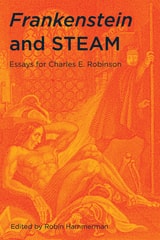
Frankenstein and STEAM
Essays for Charles E. RobinsonRobin Hammerman
University of Delaware Press, 2022
Charles E. Robinson, Professor Emeritus of English at The University of Delaware, definitively transformed study of the novel Frankenstein with his foundational volume The Frankenstein Notebooks and, in nineteenth century studies more broadly, brought heightened attention to the nuances of writing and editing. Frankenstein and STEAM consolidates the generative legacy of his later work on the novel's broad relation to topics in science, technology, engineering, arts, and mathematics (STEAM). Seven chapters written by leading and emerging scholars pay homage to Robinson's later perspectives of the novel and a concluding postscript contains remembrances by his colleagues and students. This volume not only makes explicit the question of what it means to be human, a question Robinson invited students and colleagues to examine throughout his career, but it also illustrates the depth of the field and diversity of those who have been inspired by Robinson's work. Frankenstein and STEAM offers direction for continuing scholarship on the intersections of literature, science, and technology.
Published by the University of Delaware Press. Distributed worldwide by Rutgers University Press.
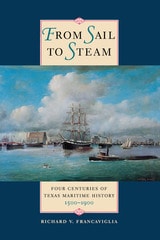
From Sail to Steam
Four Centuries of Texas Maritime History, 1500-1900By Richard V. Francaviglia
University of Texas Press, 1998
Second Place, Presidio La Bahia Award, Sons of the Republic of Texas
The Gulf Coast has been a principal place of entry into Texas ever since Alonso Alvarez de Pineda explored these shores in 1519. Yet, nearly five hundred years later, the maritime history of Texas remains largely untold. In this book, Richard V. Francaviglia offers a comprehensive overview of Texas' merchant and military marine history, drawn from his own extensive collection of maritime history materials, as well as from research in libraries and museums around the country.
Based on recent discoveries in nautical archaeology, Francaviglia tells the stories of the Spanish flotilla that wrecked off Padre Island in 1554 and of La Salle's flagship Belle, which sank in 1687. He explores the role of the Texas Navy in the Texas Revolution of 1835-1836 and during the years of the Texas Republic and also describes the Civil War battles at Galveston and Sabine Pass. Finally, he recounts major developments of the nineteenth century, concluding with the disastrous Galveston Hurricane in 1900. More than one hundred illustrations, many never before published, complement the text.

Railroads in the Heartland
Steam and Traction in the Golden Age of PostcardsH. Roger Grant
University of Iowa Press, 1997
Historians of midwestern railroading during the early part of the twentieth century have generally focused on the production of railroad company histories while ignoring the regional view. Fortunately for railway historians and buffs, coincidentally with the zenith of the Railway Age, the national fad for producing and mailing postcards was at its height. Millions of cards, including "real-photo" images, were produced between 1905 and 1915. Roger Grant has selected more than a hundred representative picture postcards to visualize the principal themes and characteristics that gave this dynamic industry its distinctive regional features.
By the turn of the century, the railroad map of the Midwest was unequaled. Anyone who examined it carefully sensed that this was the vital center of America's massive network of steel rails. Depots erected in the western prairie environment were spartan, with only minor decoration, but those in the Midwest usually mirrored more ornate New England styles. These features are often reflected in the images in this heavily illustrated book, which depicts the spare but strong pioneering spirit of the enterprise.
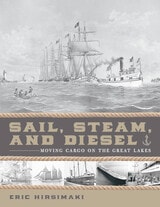
Sail, Steam, and Diesel
Moving Cargo on the Great LakesEric Hirsimaki
Michigan State University Press, 2024
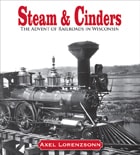
Steam & Cinders
The Advent of Railroads in WisconsinAxel Lorenzsonn
Wisconsin Historical Society Press, 2009
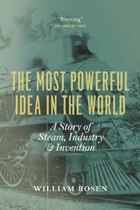
The Most Powerful Idea in the World
A Story of Steam, Industry, and InventionWilliam Rosen
University of Chicago Press, 2012
This bracing history uses the earth-shaking development of the steam engine to show how the very idea of intellectual property was essential to the entire Industrial Revolution.
Hardly a week passes without some high-profile court case that features intellectual property at its center. But how did the belief that one could own an idea come about? And how did that belief change the way humankind lives and works?
William Rosen, author of Justinian's Flea, seeks to answer these questions and more with The Most Powerful Idea in the World. A lively and passionate study of the engineering and scientific breakthroughs that led to the steam engine, this book argues that the very notion of intellectual property drove not only the invention of the steam engine but also the entire Industrial Revolution: history’s first sustained era of economic improvement. To do so, Rosen conjures up an eccentric cast of characters, including the legal philosophers who enabled most the inventive society in millennia, and the scientists and inventors—Thomas Newcomen, Robert Boyle, and James Watt—who helped to create and perfect the steam engine over the centuries. With wit and wide-ranging curiosity, Rosen explores the power of creativity, capital, and collaboration in the brilliant engineering of the steam engine and how this power source, which fueled factories, ships, and railroads, changed human history.
Deeply informative and never dull, Rosen's account of one of the most important inventions made by humans is a rollicking ride through history, with careful scholarship and fast-paced prose in equal measure.
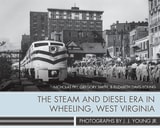
The Steam and Diesel Era in Wheeling, West Virginia
Photographs by J. J. Young Jr.Nicholas Fry
West Virginia University Press, 2016
For nearly seventy years, John J. Young Jr. photographed railroads. With unparalleled scope and span, he documented the impact and beauty of railways in American life from 1936 to 2004.
As a child during the Great Depression, J. J. Young Jr. began to photograph railroads in Wheeling, West Virginia. This book collects over one hundred fifty of those images—some unpublished until now—documenting the railroads of Wheeling and the surrounding area from the 1930s until the 1960s.
The photographs within this book highlight the major railroads of Wheeling: the Baltimore & Ohio, the Pennsylvania, the Wheeling & Lake Erie, the Pittsburgh & West Virginia, the New York Central, and the industrial and interurban rail lines that crisscrossed the region. These images capture the routine activities of trains that carried passengers and freight to and from the city and its industries, as well as more unusual traffic, such as a circus-advertising car, the General Motors Train of Tomorrow, and the 1947 American Freedom Train.