Results by title

12 books match the query 'Stewart, Susan'
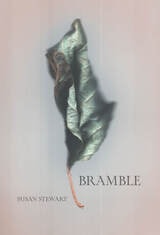
cover of Bramble

Bramble

Susan Stewart

University of Chicago Press, 2026

A finalist for the 2026 National Book Award for Poetry, this seventh collection by acclaimed poet Susan Stewart offers a meditation on difficulty and the powers of nature.
 
In the biblical book of Judges, the bramble is a figure of destructive leadership, thwarting the lives of trees. In ballads and fairy tales, roses grow “‘round the briar” in tragic contrast to heroines who are enveloped by the thorns. One of the oldest English words and an even older symbol, “bramble” reminds us of the entangled and unending struggle that comes with living in time and searching beyond appearances. The rough thicket presents impediments, yet it also bears fruit and delicate flowers.
 
With Bramble, Susan Stewart has composed a book of many forms, including satires, elegies, meditations, and songs. Bramble is also an exploration of the act of making such forms. The book’s three sections—“Mirror,” “Briar,” and “Channel”—link lyric time to our lives as they are situated in history and nature. Reflecting upon illness, grief, and change, the poems follow the progress of day and night, the movement of the seasons, and the path of water from springs to the sea.
 

[more]
cover of Columbarium

Columbarium

Susan Stewart

University of Chicago Press, 2003

Winner of the 2003 National Book Critics Circle Award in the category of poetry.

In her long-awaited fourth book of poetry, Susan Stewart gives us a series of splendid, numinous poems about truths learned with the mind but set free through the senses. Modeled on the seventeenth-century practice of century forms, or books of one hundred pages, Columbarium expresses the bond between the living and the dead in voices of parent to child, lover to beloved, and mortal to the gods. The book arrives as a meditative gift from one of our most respected poet-critics.

Stewart frames her Columbarium with four poems paying homage to the elements-to their destructive and creative aspects and to their roles in the human and more than human worlds. Both nest and crypt, the book's center holds an alphabet of "shadow georgics," poems of instruction and doubt that link knowledge and the unconscious. Questions of mortality, of goodness and suffering, and of the fragility and power of memory animate these poems. In one poem an apple calls the narrator back from the dead to savor the echoes of its varieties in myth and literature. In another, the seeds of a pear tree reveal the essential unity that makes the diversity of existence possible.

Stewart's Columbarium is both a memorial to the dead and a testament to life.
[more]
cover of Crimes of Writing: Problems in the Containment of Representation

Crimes of Writing

Problems in the Containment of Representation

Susan Stewart

Duke University Press, 1994
From the origins of modern copyright in early eighteenth-century culture to the efforts to represent nature and death in postmodern fiction, this book explores a series of problems regarding the containment of representation. Stewart focuses on specific cases of "crimes of writing"—the forgeries of George Psalmanazar; the production of "fakelore"; the "ballad scandals" of the eighteenth and nineteenth centuries; the imposture of Thomas Chatterton; and contemporary legislation regarding graffiti and pornography. She emphasizes the issues that arise once language is seen as a matter of property, and authorship is viewed as a matter of originality. Finally, Stewart demonstrates that crimes of writing are delineated by the law because they specifically undermine the status of the law itself: the crimes illuminate the irreducible fact that law is written and therefore subject to temporality and interpretation. This valuable and pioneering work, originally published in 1991 (Oxford University Press), will be of interest to literary and legal theorists, folklorists, anthropologists, and scholars of eighteenth-century and postmodern culture.
[more]
cover of On Longing: Narratives of the Miniature, the Gigantic, the Souvenir, the Collection

On Longing

Narratives of the Miniature, the Gigantic, the Souvenir, the Collection

Susan Stewart

Duke University Press, 1993
Miniature books, eighteenth-century novels, Tom Thumb weddings, tall tales, and objects of tourism and nostalgia: this diverse group of cultural forms is the subject of On Longing, a fascinating analysis of the ways in which everyday objects are narrated to animate or realize certain versions of the world. Originally published in 1984 (Johns Hopkins University Press), and now available in paperback for the first time, this highly original book draws on insights from semiotics and from psychoanalytic, feminist, and Marxist criticism. Addressing the relations of language to experience, the body to scale, and narratives to objects, Susan Stewart looks at the "miniature" as a metaphor for interiority and at the "gigantic" as an exaggeration of aspects of the exterior. In the final part of her essay Stewart examines the ways in which the "souvenir" and the "collection" are objects mediating experience in time and space.
[more]
cover of Poetry and the Fate of the Senses

Poetry and the Fate of the Senses

Susan Stewart

University of Chicago Press, 2001

What is the role of the senses in the creation and reception of poetry? How does poetry carry on the long tradition of making experience and suffering understood by others? With Poetry and the Fate of the Senses, Susan Stewart traces the path of the aesthetic in search of an explanation for the role of poetry in our culture. The task of poetry, she tells us, is to counter the loneliness of the mind, or to help it glean, out of the darkness of solitude, the outline of others. Poetry, she contends, makes tangible, visible, and audible the contours of our shared humanity. It sustains and transforms the threshold between individual and social existence.

Herself an acclaimed poet, Stewart not only brings the intelligence of a critic to the question of poetry, but the insight of a practitioner as well. Her new study draws on reading from the ancient Greeks to the postmoderns to explain how poetry creates meanings between persons. Poetry and the Fate of the Senses includes close discussions of poems by Stevens, Hopkins, Keats, Hardy, Bishop, and Traherne, of the sense of vertigo in Baroque and Romantic works, and of the rich tradition of nocturnes in visual, musical, and verbal art. Ultimately, Stewart explores the pivotal role of poetry in contemporary culture. She argues that poetry can counter the denigration of the senses and can expand our imagination of the range of human expression.

Poetry and the Fate of the Senses won the 2004 Truman Capote Award for Literary Criticism in Memory of Newton Arvin, administered for the Truman Capote Estate by the University of Iowa Writers' Workshop. It also won the Phi Beta Kappa Society's 2002 Christian Gauss Award for Literary Criticism.
[more]
cover of Red Rover

Red Rover

Susan Stewart

University of Chicago Press, 2008

Red Rover is both the name of a children’s game and a formless spirit, a god of release and permission, called upon in the course of that game. The “red rover” is also a thread of desire, and a clue to the forces of love and antipathy that shape our fate. In her most innovative work to date, award-winning poet and critic Susan Stewart remembers the antithetical forces—falling and rising, coming and going, circling and centering—revealed in such games and traces them out to many other cycles. Ranging among traditional, open, and newly-invented forms, and including a series of free translations of medieval dream visions and love poems, Red Rover begins as a historical meditation on our fall and grows into a song of praise for the green and turning world.

[more]
cover of The Forest

The Forest

Susan Stewart

University of Chicago Press, 1995
Susan Stewart plumbs human history in an attempt to articulate the way language, memory, and art join in evoking consciousness. The Forest is about violence and memory: the violence we do to our surroundings and to ourselves; and the propensity of the human mind to exploit and rationalize in its longing for truth.
[more]
cover of The Open Studio: Essays on Art and Aesthetics

The Open Studio

Essays on Art and Aesthetics

Susan Stewart

University of Chicago Press, 2004

Poets often have responded vitally to the art of their time, and ever since Susan Stewart began writing about art in the early 1980s, her work has resonated with practicing artists, curators, art historians, and art critics. Rooted in a broad and learned range of references, Stewart's fresh and independent essays bridge the fields of literature, aesthetics, and contemporary art.

Gathering most of Stewart's writing on contemporary art—long and short pieces first published in small magazines, museum and gallery publications, and edited collections—The Open Studio illuminates work ranging from the installation art of Ann Hamilton to the sculptures and watercolors of Thomas Schütte, the prints and animations of William Kentridge to the films of Tacita Dean. Stewart's essays are often the record of studio conversations with living artists and curators, and of the afterlife of those experiences in the solitude of her own study. Considering a wide variety of art forms, Stewart finds pathbreaking ways to explore them. Whether she is following central traditions of painting, drawing, sculpture, film, photography, and printmaking or exploring the less well-known realms of portrait miniatures, collecting practices, doll-making, music boxes, and gardening, Stewart speaks to the creative process in general and to the relation between art and ethics.

The Open Studio will be read eagerly by scholars of art, poetry, and visual theory; by historians interested in the links between contemporary and classic literature and art; and by teachers, students, and practitioners of the visual arts.
[more]
cover of The Poet's Freedom: A Notebook on Making

The Poet's Freedom

A Notebook on Making

Susan Stewart

University of Chicago Press, 2011

Why do we need new art? How free is the artist in making? And why is the artist, and particularly the poet, a figure of freedom in Western culture? The MacArthur Award–winning poet and critic Susan Stewart ponders these questions in The Poet’s Freedom. Through a series of evocative essays, she not only argues that freedom is necessary to making and is itself something made, but also shows how artists give rules to their practices and model a self-determination that might serve in other spheres of work.
Stewart traces the ideas of freedom and making through insightful readings of an array of Western philosophers and poets—Plato, Homer, Marx, Heidegger, Arendt, Dante, and Coleridge are among her key sources. She begins by considering the theme of making in the Hebrew Scriptures, examining their accountof a god who creates the world and leaves humans free to rearrange and reform the materials of nature. She goes on to follow the force of moods, sounds, rhythms, images, metrical rules, rhetorical traditions, the traps of the passions, and the nature of language in the cycle of making and remaking. Throughout the book she weaves the insight that the freedom to reverse any act of artistic making is as essential as the freedom to create.
 
A book about the pleasures of making and thinking as means of life, The Poet’s Freedom explores and celebrates the freedom of artists who, working under finite conditions, make considered choices and shape surprising consequences. This engaging and beautifully written notebook on making will attract anyone interested in the creation of art and literature.
[more]
cover of The Reprisal: A Novel

The Reprisal

A Novel

Laudomia Bonanni

University of Chicago Press, 2013

In the bitterly cold winter of 1943, the Italian countryside is torn apart by violence as partisans wage a guerilla war against the occupying German army and their local fascist allies. In the midst of this conflict, a ragtag group of fascist supporters captures a woman in the late stages of pregnancy. Suspecting her of being in league with the partisans, they hastily put her on “trial” by improvising a war tribunal one night in the choir stalls of the abandoned monastery that serves as their hide-out. This sham court convicts the woman and sentences her to die—but not until her child has been born. When a young seminarian visits the monastery and tries to dissuade the fascist band from executing their sentence, the absurd tragedy of the woman’s fate is cast in stark relief. The child’s birth approaches, an unnerving anticipation unfolds, and tension mounts ominously among the characters and within their individual psyches.          

Based on a number of incidents that took place in Abruzzo during the war, Laudomia Bonanni’s compact and tragic novel explores the overwhelming conflicts between ideology and community, justice and vengeance. The story is embedded in the cruel reality of Italian fascism, but its themes of revenge, sacrifice, and violence emerge as universal, delivered in prose that is at once lyrical and brutal.
In her native Italy, Bonanni, a writer of journalism and critical prose as well as fiction, is hailed as one of the strongest proponents of post-war realism, and this is the first of her novels to be made available to Anglophone readers. Translators Susan Stewart and Sara Teardo render Bonanni’s singular style—both sparse and emotive, frank and poetic—into readable, evocative English.

[more]
cover of The Ruins Lesson: Meaning and Material in Western Culture

The Ruins Lesson

Meaning and Material in Western Culture

Susan Stewart

University of Chicago Press, 2019

How have ruins become so valued in Western culture and so central to our art and literature? Covering a vast chronological and geographical range, from ancient Egyptian inscriptions to twentieth-century memorials, Susan Stewart seeks to answer this question as she traces the appeal of ruins and ruins images, and the lessons that writers and artists have drawn from their haunting forms.

Stewart takes us on a sweeping journey through founding legends of broken covenants and original sin, the Christian appropriation of the classical past, and images of decay in early modern allegory. Stewart looks in depth at the works of Goethe, Piranesi, Blake, and Wordsworth, each of whom found in ruins a means of reinventing his art. Lively and engaging, The Ruins Lesson ultimately asks what can resist ruination—and finds in the self-transforming, ever-fleeting practices of language and thought a clue to what might truly endure.
[more]
cover of Theme of Farewell and After-Poems: A Bilingual Edition

Theme of Farewell and After-Poems

A Bilingual Edition

Milo de Angelis

University of Chicago Press, 2013

Milo De Angelis, born in 1951, is one of the most important living Italian poets. With this volume, Susan Stewart and Patrizio Ceccagnoli bring to English readers for the first time a facing-page edition of his most recent work: his book-length elegy, Theme of Farewell, and the subsequent poems of That Wandering in the Darkness of Courtyards. These two books form a sequence narrating the illness and premature death, in 2003, of the poet’s wife, the writer Giovanna Sicari, a celebrated poet in her own right; they also trace De Angelis’s turn from grief, through time, back to the world. Immediate, perceptive, and woven from the fabric of everyday life in contemporary Milan, the poems never depart from universal human emotions of despair and awakening. Throughout his long career, De Angelis has renewed lyric poetry with the sheer intensity of his forms and insights, and the volumes offered here have won some of the most important Italian literary awards, including the coveted Premio Viareggio.
           
These inexorable and beautifully crafted translations will be of interest to scholars of contemporary Italian literature, students of contemporary poetry and literary translation, and those who work in comparative literature. Above all, they are bound to speak to any reader in search of a poet writing at the height of his powers of expression.
[more]