Results by title
7 books match the query 'Stoics'
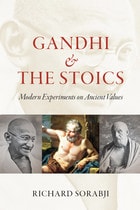
Gandhi and the Stoics
Modern Experiments on Ancient ValuesRichard Sorabji
University of Chicago Press, 2012
“Was Gandhi a philosopher? Yes.” So begins this remarkable investigation of the guiding principles that motivated the transformative public acts of one of the top historical figures of the twentieth century. Richard Sorabji, continuing his exploration of the many connections between South Asian thought and ancient Greek and Roman philosophy, brings together in this volume the unlikely pairing of Mahatma Gandhi and the Stoics, uncovering a host of parallels that suggests a deep affinity spanning the two millennia between them.
While scholars have long known Gandhi’s direct Western influences to be Platonic and Christian, Sorabji shows how a look at Gandhi’s convergence with the Stoics works mutually, throwing light on both of them. Both emphasized emotional detachment, which provided a necessary freedom, a suspicion of universal rules of conduct that led to a focus not on human rights but human duties—the personally determined paths each individual must make for his or her self. By being indifferent, paradoxically, both the Stoics and Gandhi could love manifoldly. In drawing these links to the fore, Sorabji demonstrates the comparative consistency of Gandhi’s philosophical ideas, isolating the specific ideological strengths that were required to support some of the most consequential political acts and experiments in how to live.
[more]
Seneca
Fifty Letters of a Roman StoicLucius Annaeus Seneca
University of Chicago Press, 2021
A selection of Seneca’s most significant letters that illuminate his philosophical and personal life.
“There is only one course of action that can make you happy. . . . rejoice in what is yours. What is it that is yours? Yourself; the best part of you.”
In the year 62, citing health issues, the Roman philosopher Seneca withdrew from public service and devoted his time to writing. His letters from this period offer a window onto his experience as a landowner, a traveler, and a man coping with the onset of old age. They share his ideas on everything from the treatment of enslaved people to the perils of seafaring, and they provide lucid explanations for many key points of Stoic philosophy.
This selection of fifty letters brings out the essentials of Seneca’s thought, with much that speaks directly to the modern reader. Above all, they explore the inner life of the individual who proceeds through philosophical inquiry from a state of emotional turmoil to true friendship, self-determination, and personal excellence.
[more]
Stoic Theology
Proof for the Existence of the Cosmic God and of the Traditional GodsP. A. Meijer
Eburon Academic Publishers, 2008
The ancient Stoics constructed an elaborate set of proofs for the existence of the Greek gods which proved highly influential for later theological and philosophical proofs. P. A. Meijer’s Stoic Theology, the first book on the subject in almost thirty years,analyzes these proofs from a fresh perspective. This valuable resource features a thorough examination of pre-Christian theological argumentation as well as new insights on the relationship between God and the deities in ancient Greek thought, in a book sure to interest scholars of philosophy and religion.
[more]
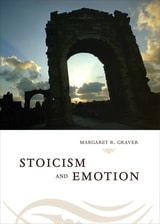
Stoicism and Emotion
Margaret Graver
University of Chicago Press, 2007
On the surface, stoicism and emotion seem like contradictory terms. Yet the Stoic philosophers of ancient Greece and Rome were deeply interested in the emotions, which they understood as complex judgments about what we regard as valuable in our surroundings. Stoicism and Emotion shows that they did not simply advocate an across-the-board suppression of feeling, as stoicism implies in today’s English, but instead conducted a searching examination of these powerful psychological responses, seeking to understand what attitude toward them expresses the deepest respect for human potential.
In this elegant and clearly written work, Margaret Graver gives a compelling new interpretation of the Stoic position. Drawing on a vast range of ancient sources, she argues that the chief demand of Stoic ethics is not that we should suppress or deny our feelings, but that we should perfect the rational mind at the core of every human being. Like all our judgments, the Stoics believed, our affective responses can be either true or false and right or wrong, and we must assume responsibility for them. Without glossing over the difficulties, Graver also shows how the Stoics dealt with those questions that seem to present problems for their theory: the physiological basis of affective responses, the phenomenon of being carried away by one’s emotions, the occurrence of involuntary feelings and the disordered behaviors of mental illness. Ultimately revealing the deeper motivations of Stoic philosophy, Stoicism and Emotion uncovers the sources of its broad appeal in the ancient world and illuminates its surprising relevance to our own.
In this elegant and clearly written work, Margaret Graver gives a compelling new interpretation of the Stoic position. Drawing on a vast range of ancient sources, she argues that the chief demand of Stoic ethics is not that we should suppress or deny our feelings, but that we should perfect the rational mind at the core of every human being. Like all our judgments, the Stoics believed, our affective responses can be either true or false and right or wrong, and we must assume responsibility for them. Without glossing over the difficulties, Graver also shows how the Stoics dealt with those questions that seem to present problems for their theory: the physiological basis of affective responses, the phenomenon of being carried away by one’s emotions, the occurrence of involuntary feelings and the disordered behaviors of mental illness. Ultimately revealing the deeper motivations of Stoic philosophy, Stoicism and Emotion uncovers the sources of its broad appeal in the ancient world and illuminates its surprising relevance to our own.
[more]
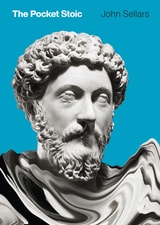
The Pocket Stoic
John Sellars
University of Chicago Press, 2020
To counter the daily anxieties, stress, and emotional swings caused by the barrage of stimuli that plagues modern life, many people have been finding unexpected solace in a philosophy from a very different and distant time: Stoicism. Today, more than 100,000 people are members of online communities for modern Stoics, and there are annual conferences, meet-ups, and workshops for those aspiring to walk the Stoic path. But what is Stoicism, and what makes it resonate so powerfully today?
As John Sellars shows in The Pocket Stoic, the popular image of the isolated and unfeeling Stoic hardly does justice to the rich vein of thought that we find in the work of Seneca, Epictetus, and Marcus Aurelius, the three great Roman Stoics. Their works are recognized classics, and for good reason—they speak to some of the perennial issues that face anyone trying to navigate their way through life. These writings, fundamentally, are about how to live—how to understand your place in the world, how to cope when things don’t go well, how to manage your emotions, how to behave toward others, and finally, how to live a good life. To be a Stoic is to recognize that much of the suffering in your life is due to the way you think about things, and that you have the ability to train your mind to look at the world in a new way—to recognize what you can and cannot control and to turn adversity into opportunity.
Concise and accessible, The Pocket Stoic provides a welcome introduction to the lives and thought of the key Stoics. It is also a perfect guide to help you start incorporating the practice of Stoicism into your everyday approach to life.
[more]
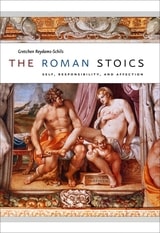
The Roman Stoics
Self, Responsibility, and AffectionGretchen Reydams-Schils
University of Chicago Press, 2005
Roman Stoic thinkers in the imperial period adapted Greek doctrine to create a model of the self that served to connect philosophical ideals with traditional societal values. The Roman Stoics-the most prominent being Marcus Aurelius-engaged in rigorous self-examination that enabled them to integrate philosophy into the practice of living. Gretchen Reydams-Schils's innovative new book shows how these Romans applied their distinct brand of social ethics to everyday relations and responsibilities.
The Roman Stoics reexamines the philosophical basis that instructed social practice in friendship, marriage, parenting, and community. From this analysis emerge Stoics who were neither cold nor detached, as the stereotype has it, but all too aware of their human weaknesses. In a valuable contribution to current discussions in the humanities on identity, autonomy, and altruism, Reydams-Schils ultimately conveys the wisdom of Stoics to the citizens of modern society.
The Roman Stoics reexamines the philosophical basis that instructed social practice in friendship, marriage, parenting, and community. From this analysis emerge Stoics who were neither cold nor detached, as the stereotype has it, but all too aware of their human weaknesses. In a valuable contribution to current discussions in the humanities on identity, autonomy, and altruism, Reydams-Schils ultimately conveys the wisdom of Stoics to the citizens of modern society.
[more]
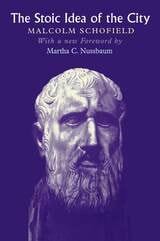
The Stoic Idea of the City
Malcolm Schofield
University of Chicago Press, 1999
The Stoic Idea of the City offers the first systematic analysis of the Stoic school, concentrating on Zeno's Republic. Renowned classical scholar Malcolm Schofield brings together scattered and underused textual evidence, examining the Stoic ideals that initiated the natural law tradition of Western political thought. A new foreword by Martha Nussbaum and a new epilogue written by the author further secure this text as the standard work on the Stoics.
"The account emerges from a jigsaw-puzzle of items from a wide range of authorities, painstakingly pieced together and then annotated in a series of appendixes, the whole executed with fine scholarship, clarity, and good humor."—Times Literary Supplement
"The account emerges from a jigsaw-puzzle of items from a wide range of authorities, painstakingly pieced together and then annotated in a series of appendixes, the whole executed with fine scholarship, clarity, and good humor."—Times Literary Supplement
[more]