Results by title
34 books match the query 'Stone'
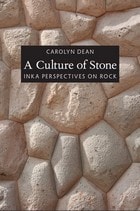
A Culture of Stone
Inka Perspectives on RockCarolyn Dean
Duke University Press, 2010
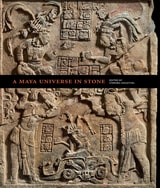
A Maya Universe in Stone
Stephen Houston
J. Paul Getty Trust, The, 2021
In 1950, Dana Lamb, an explorer of some notoriety, stumbled on a Maya ruin in the tropical forests of northern Guatemala. Lamb failed to record the location of the site he called Laxtunich, turning his find into the mystery at the center of this book. The lintels he discovered there, long since looted, are probably of a set with two others that are among the masterworks of Maya sculpture from the Classic period. Using fieldwork, physical evidence, and Lamb’s expedition notes, the authors identify a small area with archaeological sites where the carvings were likely produced.
Remarkably, the vividly colored lintels, replete with dynastic and cosmic information, can be assigned to a carver, Mayuy, who sculpted his name on two of them. To an extent nearly unique in ancient America, Mayuy can be studied over time as his style developed and his artistic ambition grew. An in-depth analysis of Laxtunich Lintel 1 examines how Mayuy grafted celestial, seasonal, and divine identities onto a local magnate and his overlord from the kingdom of Yaxchilan, Mexico. This volume contextualizes the lintels and points the way to their reprovenancing and, as an ultimate aim, repatriation to Guatemala.
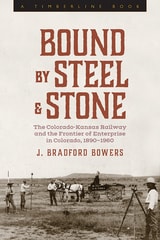
Bound by Steel and Stone
The Colorado-Kansas Railway and the Frontier of Enterprise in Colorado, 1890-1960J. Bradford Bowers
University Press of Colorado, 2022
Offering the Colorado-Kansas Railway as an example of how shortline railroads helped to integrate the rural landscape with the larger urban and economic world, Bowers reveals the constant adaptations driven by changing economic forces and conditions. He puts the railway in context of the wider environmental and political landscapes, the growing quarrying and mining business, the expansion of agriculture and irrigation, Progressive-era political reforms, and land development. In the new frontier of enterprise in the early twentieth-century American West, the railroad highlights the successes and failures of the men inspired to pursue these new opportunities as well as the story of one woman who held these fragile industries together well into the second half of the twentieth century.
Bound by Steel and Stone is an insightful addition to the history of industrialization and economic development in Colorado and the American West.
Daughters of Stone and Tide
Loss and Resilience in a Fisherman's FamilyWritten by Maria "Mia" Millefoglie. Read by Maria Marquis.
University of Massachusetts Press, 2026
A powerful family memoir about inheritance, identity, and the pull of the sea
Surrendered as an infant in America, Maria “Mia” was taken in by Sicilian immigrants in Gloucester, Massachusetts—a gritty working-class town steeped in salt and tradition. She inherits a name that traces back to 19th-century Sicily, where her great-grandfather was abandoned as a newborn on la ruota dei proietti, the “wheel of the castoffs.” Christened Millefoglie, “a thousand leaves, a thousand pages,” he crossed the bold Atlantic to America’s shores, carrying with him a legacy of endurance and exile.
For generations, the Millefoglie men went to sea: dorymen who rose before dawn to cast their nets along jagged coastlines, captains of eastern-rig draggers navigating storms that could split a vessel in half, stowaways chasing the promise of a life they could scarcely imagine. They lived by tides, currents, and the unspoken rules of the ocean; their courage and skill tested daily by wind and water. The women, left on shore, learned a different kind of survival, keeping households, raising children, and enduring the constant absence of fathers, brothers, and husbands.
Into this world of fishermen and keepers of the shore, Mia was adopted, learning early that bloodlines dictate identity and tradition shapes fate. College is forbidden; marriages are arranged, and no one abandons the family. By nineteen, trapped in a fish-packing job and lost in a haze of drugs, Mia does the unthinkable: she leaves. Decades later, drawn back to Gloucester’s weathered harbor to care for her aging parents, Mia begins to unearth her family’s buried stories, tracing the lineage from a Sicilian orphanage to a New England fishing port and the invisible inheritance that shaped them all.
Both intimate and historical, Daughters of Stone and Tide is a meditation on identity, abandonment, and belonging—a fisherman’s daughter’s search to understand the forces that bind and break a family across generations and seas.
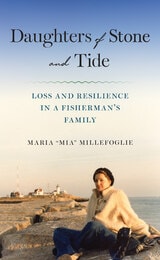
Daughters of Stone and Tide
Loss and Resilience in a Fisherman’s FamilyMaria "Mia" Millefoglie
University of Massachusetts Press, 2026
A powerful family memoir about inheritance, identity, and the pull of the sea
Surrendered as an infant in America, Maria “Mia” was taken in by Sicilian immigrants in Gloucester, Massachusetts—a gritty working-class town steeped in salt and tradition. She inherits a name that traces back to 19th-century Sicily, where her great-grandfather was abandoned as a newborn on la ruota dei proietti, the “wheel of the castoffs.” Christened Millefoglie, “a thousand leaves, a thousand pages,” he crossed the bold Atlantic to America’s shores, carrying with him a legacy of endurance and exile.
For generations, the Millefoglie men went to sea: dorymen who rose before dawn to cast their nets along jagged coastlines, captains of eastern-rig draggers navigating storms that could split a vessel in half, stowaways chasing the promise of a life they could scarcely imagine. They lived by tides, currents, and the unspoken rules of the ocean; their courage and skill tested daily by wind and water. The women, left on shore, learned a different kind of survival, keeping households, raising children, and enduring the constant absence of fathers, brothers, and husbands.
Into this world of fishermen and keepers of the shore, Mia was adopted, learning early that bloodlines dictate identity and tradition shapes fate. College is forbidden; marriages are arranged, and no one abandons the family. By nineteen, trapped in a fish-packing job and lost in a haze of drugs, Mia does the unthinkable: she leaves. Decades later, drawn back to Gloucester’s weathered harbor to care for her aging parents, Mia begins to unearth her family’s buried stories, tracing the lineage from a Sicilian orphanage to a New England fishing port and the invisible inheritance that shaped them all.
Both intimate and historical, Daughters of Stone and Tide is a meditation on identity, abandonment, and belonging—a fisherman’s daughter’s search to understand the forces that bind and break a family across generations and seas.
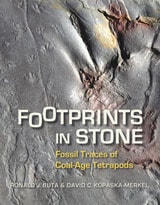
Footprints in Stone
Fossil Traces of Coal-Age TetrapodsRonald J. Buta and David C. Kopaska-Merkel
University of Alabama Press, 2016
Where ancient creatures walked—science uncovers their lasting impressions.
The Steven C. Minkin (Union Chapel) Paleozoic Footprint Site ranks among the most important fossil sites in the world today, and Footprints in Stone recounts the accidental revelation of its existence and detailed findings about its fossil record.
Currently 2,500 miles from the equator and more than 250 miles north of the Gulf of Mexico, the Minkin site was a swampy tropical forest adjacent to a tidal flat during the Coal Age or Carboniferous Period more than 300 million years ago. That fecund strand of sand and mud at the ocean’s edge teemed with the earth’s earliest reptiles as well as amphibians, fish, horseshoe crabs, spiders, jumping insects, and other fascinating organisms. Unlike dinosaurs and other large animals whose sturdy bodies left hard fossil records, most of these small, soft-bodied creatures left no concrete remains. But they did leave something else. Preserved in the site’s coal beds along with insect wings and beautifully textured patterns of primeval plants are their footprints, fossilized animal tracks from which modern paleontologists can glean many valuable insights about their physical anatomies and behaviors.
The paleontological examination of fossil tracks is now the cutting-edge of contemporary scholarship, and the Minkin site is the first and largest site of its kind in eastern North America. Discovered by a local high school science teacher, the site provides both professional and amateur paleontologists around the world with a wealth of fossil track samples along with an inspirational story for amateur explorers and collectors.
Authoritative and extensively illustrated, Footprints in Stone brings together the contributions of many geologists and paleontologists who photographed, documented, and analyzed the Minkin site’s fossil trackways. An engrossing tale of its serendipitous discovery and a detailed study of its fossil records, Footprints in Stone is a landmark publication in the history of paleontology.
From Stone to Flesh
A Short History of the BuddhaDonald S. Lopez Jr.
University of Chicago Press, 2013
House of Sugar, House of Stone
Emily Pérez
University Press of Colorado, 2016
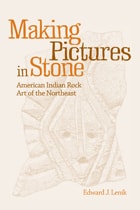
Making Pictures in Stone
American Indian Rock Art of the NortheastEdward J. Lenik
University of Alabama Press, 2008
A full range of rock art appearances, including dendroglyphs, pictographs, and a selection of portable rock objects
The Indians of northeastern North America are known to us primarily through reports and descriptions written by European explorers, clergy, and settlers, and through archaeological evidence. An additional invaluable source of information is the interpretation of rock art images and their relationship to native peoples for recording practical matters or information, as expressions of their legends and spiritual traditions, or as simple doodling or graffiti. The images in this book connect us directly to the Indian peoples of the Northeast, mainly Algonkian tribes inhabiting eastern Pennsylvania, Maryland and the lower Potomac River Valley, New York, New Jersey, the six New EnglandStates, and Atlantic Canada. Lenik provides a full range of rock art appearances in the study area, including some dendroglyphs, pictographs, and a selection of portable rock objects. By providing a full analysis and synthesis of the data, including the types and distribution of the glyphs, and interpretations of their meaning to the native peoples, Lenik reveals a wealth of new information on the culture and lifeways of the Indians of the Northeast.
No Walls of Stone
An Anthology of Literature by Deaf and Hard of Hearing WritersJill Jepson
Gallaudet University Press, 1992
Oblivion and Stone
A Selection of Bolivian Poetry and FictionSandra Reyes
University of Arkansas Press, 1998
In a literature where recognition is hard earned, this anthology demonstrates what distinguishes contemporary Bolivian fiction and poetry from the rest of Latin American writing and shows clearly how Bolivian writers relate to that tradition.
Bolivia is a landlocked nation of mountains and high, arid plains, a place native writer Jesús Urzagasti calls the “Land of Silence.” This crucible of indigenous and European influences has contributed to the creation of a writing style that is always down-to-earth, often grittily realistic.
From this fundamental base, Bolivian writers express provincial customs and values, decry political oppression, and sound universal themes of isolation, even resignation; but, more often, they show the will to move forward as a people. This rich thematic mix encourages what critic Edgar Lora has called the “dynamic and vigorous social dis course” and the resulting “subversive, militant, and revolutionary” qualities of Bolivian literature.
Editor Sandra Reyes has gathered a panoramic sampling of twenty two poets and eighteen fiction writers. Focusing predominantly on living, practicing writers, this anthology defines the current literary voice of Bolivia and gives us a distillation of the contemporary Bolivian consciousness.
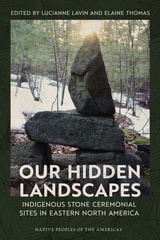
Our Hidden Landscapes
Indigenous Stone Ceremonial Sites in Eastern North AmericaLucianne Lavin
University of Arizona Press, 2023
This volume introduces readers to eastern North America’s Indigenous ceremonial stone landscapes (CSLs)—sacred sites whose principal identifying characteristics are built stone structures that cluster within specific physical landscapes. Our Hidden Landscapes presents these often unrecognized sites as significant cultural landscapes in need of protection and preservation.
In this book, Native American authors provide perspectives on the cultural meaning and significance of CSLs and their characteristics, while professional archaeologists and anthropologists provide a variety of approaches for better understanding, protecting, and preserving them. The chapters present overwhelming evidence in the form of oral tradition, historic documentation, ethnographies, and archaeological research that these important sites created and used by Indigenous peoples are deserving of protection.
This work enables archaeologists, historians, conservationists, foresters, and members of the general public to recognize these important ritual sites.
Contributors
Nohham Rolf Cachat-Schilling
Robert DeFosses
James Gage
Mary Gage
Doug Harris
Julia A. King
Lucianne Lavin
Johannes (Jannie) H. N. Loubser
Frederick W. Martin
Norman Muller
Charity Moore Norton
Paul A. Robinson
Laurie W. Rush
Scott M. Strickland
Elaine Thomas
Kathleen Patricia Thrane
Matthew Victor Weiss
Rainbows of Stone
Ralph Salisbury
University of Arizona Press, 2000
Son of a Cherokee-English father and an Irish mother, Ralph Salisbury grew up among storytellers and has shared his family's tales and experiences in seven previous books of prose and poetry. Now in Rainbows of Stone he returns with a striking collection of poems that interweaves family tales with personal and tribal history.
Salisbury conjures images that define his life, from the vanishing farming and hunting traditions with which he was raised to his experiences in World War II as a member of a bomber crew. He writes of himself and of Indian people as Vanishing Americans—vanishing into the mingling of races—and sees himself as a pacifistic patriot concerned that we not continue the destructive reliance on war that marks our history.
Writing as one who is "not part Indian, part white, but wholly both," Salisbury has produced a haunting, powerful work that expresses his devotion to the Cherokee religion, its fidelity to its forebears, and its harmony with the forces of Nature. For all concerned with ecology, social justice, and peace, Rainbows of Stone conveys a growing awareness of the world and a sense of how each individual connects with the universal and timeless realities of every other human being.

Rendered in Bits and Stone
Studies in (In)Tangible Digital HeritageEdited by Maciej Stasiowski
Intellect Books, 2026
As digital technologies increasingly shape how we preserve, interpret, and experience the past, the field of digital heritage has undergone rapid and transformative growth. This book offers a timely and critical exploration of how tools such as 3D modelling, augmented reality, and mobile applications are redefining the landscape of heritage conservation and storytelling.
Bringing together contributions from international scholars across disciplines, including architectural conservation, archaeology, urban studies, tourism, photography, museology, and game studies, this volume engages with the complex politics, practices, and potentials of digital heritage. The chapters are organized around three thematic strands: the digital politics of conservation, technology as a medium for narrative and interpretation, and the creation of virtual reconstructions of the past.
By critically examining the limitations of traditional preservation methods and the innovative opportunities offered by digital tools, this collection not only reflects the current state of the field but also contributes to its future directions. Featuring culturally and geographically diverse case studies and blending theoretical insight with practical application, the book is essential reading for students, researchers, and professionals in heritage studies, conservation, architecture, archaeology, and cultural tourism.
Reset in Stone
Memory and Reuse in Ancient AthensSarah A. Rous
University of Wisconsin Press, 2019
Sarah Rous develops the concept of upcycling to refer to this meaningful reclamation, the intentionality of reemploying each particular object for its specific new context. The upcycling approach drives innovative reinterpretations of diverse cases, including column drums built into fortification walls, recut inscriptions, monument renovations, and the wholesale relocation of buildings. Using archaeological, literary, and epigraphic evidence from more than eight centuries of Athenian history, Rous's investigation connects seemingly disparate instances of the reuse of building materials. She focuses on agency, offering an alternative to the traditional discourse on spolia. Reset in Stone illuminates a vital practice through which Athenians shaped social memory in the physical realm, literally building their past into their city.
Rite, Flesh, and Stone
The Matter of Death in Contemporary Spanish CultureAntonio Córdoba
Vanderbilt University Press, 2021
Materials analyzed here—ranging from cinematic and literary fictions, to historical archives and anthropological and ethnographic sources—make explicit a dynamic scenario where actors embody a variety of positions toward death and dying, the political production of mortality, and the commemoration of the dead. Ultimately, the goal of this volume is to chart the complex network in which the disenchantment of death and its reenchantment coexist, and biopolitical control over secularized bodies overlaps with new avatars of the religious and non-theistic desires for memorialization and transcendence.
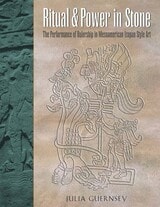
Ritual and Power in Stone
The Performance of Rulership in Mesoamerican Izapan Style ArtBy Julia Guernsey
University of Texas Press, 2006
The ancient Mesoamerican city of Izapa in Chiapas, Mexico, is renowned for its extensive collection of elaborate stone stelae and altars, which were carved during the Late Preclassic period (300 BC-AD 250). Many of these monuments depict kings garbed in the costume and persona of a bird, a well-known avian deity who had great significance for the Maya and other cultures in adjacent regions. This Izapan style of carving and kingly representation appears at numerous sites across the Pacific slope and piedmont of Mexico and Guatemala, making it possible to trace political and economic corridors of communication during the Late Preclassic period.
In this book, Julia Guernsey offers a masterful art historical analysis of the Izapan style monuments and their integral role in developing and communicating the institution of divine kingship. She looks specifically at how rulers expressed political authority by erecting monuments that recorded their performance of rituals in which they communicated with the supernatural realm in the persona of the avian deity. She also considers how rulers used the monuments to structure their built environment and create spaces for ritual and politically charged performances. Setting her discussion in a broader context, Guernsey also considers how the Izapan style monuments helped to motivate and structure some of the dramatic, pan-regional developments of the Late Preclassic period, including the forging of a codified language of divine kingship. This pioneering investigation, which links monumental art to the matrices of political, economic, and supernatural exchange, offers an important new understanding of a region, time period, and group of monuments that played a key role in the history of Mesoamerica and continue to intrigue scholars within the field of Mesoamerican studies.
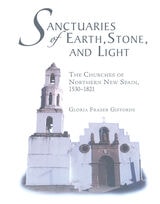
Sanctuaries of Earth, Stone, and Light
The Churches of Northern New Spain, 1530-1821Gloria Fraser Giffords
University of Arizona Press, 2007
Giffords has a remarkable eye for detail and for images both grand and diminutive. Because so many of the buildings she examines have been destroyed, she sleuthed through historical records in several countries, and she discovered that the architecture and material culture of northern New Spain reveal the influences of five continents. As she examines objects as large as churches or as small as ornamental ceramic tile she illuminates the sometimes subtle, sometimes striking influences of the religious, social, and artistic traditions of Europe (from the beginning of the Christian era through the nineteenth century), of the Muslim countries ringing the Mediterranean (from the seventh through the fifteenth centuries), and of Northern New Spain’s indigenous peoples (whose art influenced the designs of occupying Europeans).
Sanctuaries of Earth, Stone, and Light is a pathbreaking book, featuring 200 stunning photographs and over 300 illustrations ranging from ceremonial garments to detailed floor plans of the churches.
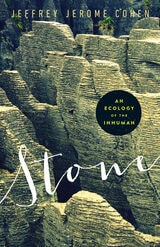
Stone
An Ecology of the InhumanJeffrey Jerome Cohen
University of Minnesota Press, 2015
Stone maps the force, vivacity, and stories within our most mundane matter, stone. For too long stone has served as an unexamined metaphor for the “really real”: blunt factuality, nature’s curt rebuke. Yet, medieval writers knew that stones drop with fire from the sky, emerge through the subterranean lovemaking of the elements, tumble along riverbeds from Eden, partner with the masons who build worlds with them. Such motion suggests an ecological enmeshment and an almost creaturely mineral life.
Although geological time can leave us reeling, Jeffrey Jerome Cohen argues that stone’s endurance is also an invitation to apprehend the world in other than human terms. Never truly inert, stone poses a profound challenge to modernity’s disenchantments. Its agency undermines the human desire to be separate from the environment, a bifurcation that renders nature “out there,” a mere resource for recreation, consumption, and exploitation.
Written with great verve and elegance, this pioneering work is notable not only for interweaving the medieval and the modern but also as a major contribution to ecotheory. Comprising chapters organized by concept —“Geophilia,” “Time,” “Force,” and “Soul”—Cohen seamlessly brings together a wide range of topics including stone’s potential to transport humans into nonanthropocentric scales of place and time, the “petrification” of certain cultures, the messages fossils bear, the architecture of Bordeaux and Montparnasse, Yucca Mountain and nuclear waste disposal, the ability of stone to communicate across millennia in structures like Stonehenge, and debates over whether stones reproduce and have souls.
Showing that what is often assumed to be the most lifeless of substances is, in its own time, restless and forever in motion, Stone fittingly concludes by taking us to Iceland⎯a land that, writes the author, “reminds us that stone like water is alive, that stone like water is transient.”
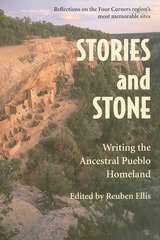
Stories and Stone
Writing the Ancestral Pueblo HomelandReuben Ellis
University of Arizona Press, 1997
Collected here are more than fifty selections from a striking body of literature about the prehistoric Southwest: essays, stories, travelers' reports, and poems spanning more than four centuries of visitation. They include timeless writings such as John Wesley Powell's The Exploration of the Colorado River and Its Tributaries and Frank Hamilton Cushing's "Life at Zuni," plus contemporary classics ranging from Colin Fletcher's The Man Who Walked Through Time to Wallace Stegner's Beyond the Hundredth Meridian to Edward Abbey's "The Great American Desert." Reuben Ellis's introduction brings contemporary insight and continuity to the collection, and a section on "reading in place" invites readers to experience these great works amidst the landscapes that inspired them. For anyone who loves to roam ancient lands steeped in mystery, Stories and Stone is an incomparable companion that will enhance their enjoyment.
Stories in Stone
The Enchanted Gem Carvings of Vasily KonovalenkoStephen E. Nash
University Press of Colorado, 2016
Part art catalogue and part life history, Stories in Stone tells the tale of Konovalenko’s impressive works, explaining their conception, creation, and symbolism. Each handcrafted figure depicts a scene from life in the Soviet Union—a bowman hunting snow geese, a woman reposing in a hot spring surrounded by ice, peasants spinning wool, a pair of gulag prisoners sawing lumber—painstakingly rendered in precious stones and metals. The materials used to make the figurines are worth millions of dollars, but as cultural artifacts, the sculptures are priceless. Author Stephen Nash draws upon oral history and archival research to detail the life of their creator, revealing a rags-to-riches and life-imitates-art narrative full of Cold War intrigue, Communist persecution, and capitalist exploitation.
Augmented by Richard M. Wicker’s exquisite and revelatory photographs of sixty-five Konovalenko sculptures from museums, state agencies, and private collections around the world, Stories in Stone is a visually stunning glimpse into a unique corner of Russian art and cultural history, the craft and science of gem carving, and the life of a Russian artist and immigrant who loved people everywhere.
Co-published with the Denver Museum of Nature & Science, home to the most significant collection of Russian gem-carving sculptures by Vasily Konovalenko in the world.
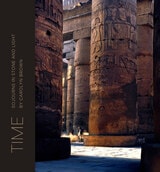
TIME
Sojourns in Stone and LightCarolyn Brown
Bridwell Press, 2026
TIME: Sojourns in Stone and Light continues Carolyn Brown’s lifelong exploration of how light, memory, and architecture converge—revealing places not simply as monuments, but as living witnesses to history.
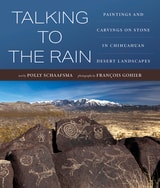
Talking to the Rain
Paintings and Carvings on Stone in Chihuahuan Desert LandscapesPolly Schaafsma, photographs by François Gohier
University of Utah Press, 2025
In this visually stunning volume, Polly Schaafsma, leading authority on pre-Hispanic Indian rock imagery and kiva murals of the greater American Southwest, provides an insightful journey into the petroglyphs and rock paintings of the Jornada Mogollon farmers in southern New Mexico's lower Chihuahuan Desert.
Talking to the Rain defines the Rio Grande Tradition, emphasizing the foundational Jornada Style as exemplified by its Mimbres-like imagery as well as its diverse and complex rain-making symbolism. By examining visual metaphors of cosmology and place-making, the book reveals an ancient dialogue between farmers and the cosmos that places rain for crops as its central concern. Exceptional color photographs by François Gohier invite readers to experience the landscapes and locations selected for creating these images. Both scholarly and accessible, Talking to the Rain offers a fresh perspective on cultural landscapes and the profound connections between people, art, and environment, making it essential for understanding Southwest cultural history.
The Chinese Garden as Lyric Enclave
A Generic Study of <em>The Story of the Stone</em>Chi Xiao
University of Michigan Press, 2012
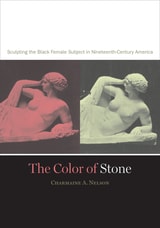
The Color of Stone
Sculpting the Black Female Subject in Nineteenth-Century AmericaCharmaine A. Nelson
University of Minnesota Press, 2007
Nineteenth-century neoclassical sculpture was a highly politicized international movement. Based in Rome, many expatriate American sculptors created works that represented black female subjects in compelling and problematic ways. Rejecting pigment as dangerous and sensual, adherence to white marble abandoned the racialization of the black body by skin color.
In The Color of Stone, Charmaine A. Nelson brilliantly analyzes a key, but often neglected, aspect of neoclassical sculpture—color. Considering three major works—Hiram Powers’s Greek Slave, William Wetmore Story’s Cleopatra, and Edmonia Lewis’s Death of Cleopatra—she explores the intersection of race, sex, and class to reveal the meanings each work holds in terms of colonial histories of visual representation as well as issues of artistic production, identity, and subjectivity. She also juxtaposes these sculptures with other types of art to scrutinize prevalent racial discourses and to examine how the black female subject was made visible in high art.
By establishing the centrality of race within the discussion of neoclassical sculpture, Nelson provides a model for a black feminist art history that at once questions and destabilizes canonical texts.
Charmaine A. Nelson is assistant professor of art history at McGill University.
The Painted Desert
Land of Wind and StoneText by Scott Thybony; Photographs by David Edwards
University of Arizona Press, 2006
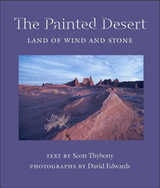
But this remote pocket of the Arizona desert, sandwiched between the Little Colorado River on one side and bold escarpments on the other, is much more than most tourists ever experience. An ethereal landscape of sculpted rock, wind-fluted cliffs, and elegantly drifting sand, the Painted Desert is a rich storehouse of natural beauty, colorful history, and scientific wonders. Here the strongest winds in Arizona blow across extensive dunefields, where less than ten inches of rain falls each year and only a few desert-savvy Navajo are able to live.
Now, for the first time award-winning writer Scott Thybony and freelance photographer David Edwards offer an intimate look at a place that remains inhospitable and inaccessible to so many. They share insights about the geology, paleontology, anthropology, and human history of the region as well as personal stories that dispel the misconceptions and mysteries that surround this delicate and difficult landscape.
With fifteen stunning photographs gracing the text, this book offers a vibrant portrait of one of the Southwest’s most barren, and most colorful landscapes.
The Stone and the Wireless
Mediating China, 1861–1906Shaoling Ma
Duke University Press, 2021
The Story of Stone
Intertextuality, Ancient Chinese Stone Lore, and the Stone Symbolism in <i>Dream of the Red Chamber</i>, <i>Water Margin</i>, and <i>The Journey to the West</i>Jing Wang
Duke University Press, 1992
Bringing together Chinese myth, religion, folklore, art, and literature, this book is the first in any language to amass the sources of stone myth and stone lore in Chinese culture. Uniting classical Chinese studies with contemporary Western theoretical concerns, Wang examines these stone narratives by analyzing intertextuality within Chinese traditions. She offers revelatory interpretations to long-standing critical issues, such as the paradoxical character of the monkey in The Journey to the West, the circularity of narrative logic in The Dream of the Red Chamber, and the structural necessity of the stone tablet in Water Margin.
By both challenging and incorporating traditional sinological scholarship, Wang’s The Story of Stone reveals the ideological ramifications of these three literary works on Chinese cultural history and makes the past relevant to contemporary intellectual discourse. Specialists in Chinese literature and culture, comparative literature, literary theory, and religious studies will find much of interest in this outstanding work, which is sure to become a standard reference on the subject.
Thinking with Stone
Deep Time in the San Rafael SwellBrian Rajski
University of Utah Press, 2026
An intellectual journey through 250 million years of stone
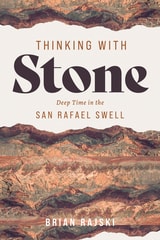
In the San Rafael Swell, geologic forces have tilted and exposed the strata so that over 250 million years of geologic history can be observed simply by traveling across the rocky landscape, with its dramatic variety of colors and forms. Largely neglected by visitors to the state’s national parks and monuments and overlooked by many nature writers of the Colorado Plateau, the exceptional “Swell” offers a unique opportunity to think about people’s connections to the layers of earth beneath our feet.
Thinking with Stone takes readers on an intellectual journey across the Swell, moving from the youngest rocks at its edges to the oldest near its center and guiding readers through the features and histories of each geological layer. Drawing on personal experience and scientific research, Brian Rajski explores how creatively engaging with geology by using rocks as the foundation for thinking can generate new ideas about art, ethics, and the environment. Ultimately, the book reimagines the relationships between history and deep time, humanity and geology, and the individual and the stories told by stone.
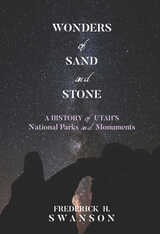
Wonders of Sand and Stone
A History of Utah's National Parks and MonumentsFrederick H. Swanson
University of Utah Press, 2020
Drawing on extensive historical research, Swanson presents little-known accounts of people who saw in these sculptured landscapes something worth protecting. Readers are introduced to the region’s early explorers, scientists, artists, and travelers as well as the local residents and tourism promoters who worked with the National Park Service to build the system of parks and monuments we know today, when Utah’s national parks and monuments face multiple challenges from increased human use and from development outside their borders. As scientists continue to uncover the astonishing diversity of life in these desert and mountain landscapes, and archaeologists and Native Americans document their rich cultural resources, the management of these federal lands remains critically important. Swanson provides us with a detailed and timely background to advance and inform discussions about what form that management should take.
Works in Stone
Contemporary Perspectives on Lithic AnalysisMichael J. Shott
University of Utah Press, 2014
Written in Stone
Public Monuments in Changing SocietiesSanford Levinson
Duke University Press, 1998
In Written in Stone, legal scholar Sanford Levinson considers the tangled responses of ever-changing societies to the monuments and commemorations created by past regimes or outmoded cultural and political systems. Drawing on examples from Albania to Zimbabwe, from Moscow to Managua, and paying particular attention to examples throughout the American South, Levinson looks at social and legal arguments regarding the display, construction, modification, and destruction of public monuments. He asks what kinds of claims the past has on the present, particularly if the present is defined in dramatic opposition to its past values. In addition, he addresses the possibilities for responding to the use and abuse of public spaces and explores how a culture might memorialize its historical figures and events in ways that are beneficial to all its members.
Written in Stone is a meditation on how national cultures have been or may yet be defined through the deployment of public monuments. It adds a thoughtful and crucial voice into debates surrounding historical accuracy and representation, and will be welcomed by the many readers concerned with such issues.
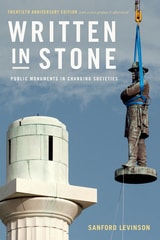
Written in Stone
Public Monuments in Changing SocietiesSanford Levinson
Duke University Press, 1998
From the removal of Confederate monuments in New Orleans in the spring of 2017 to the violent aftermath of the white nationalist march on the Robert E. Lee monument in Charlottesville later that summer, debates and conflicts over the memorialization of Confederate “heroes” have stormed to the forefront of popular American political and cultural discourse. In Written in Stone Sanford Levinson considers the tangled responses to controversial monuments and commemorations while examining how those with political power configure public spaces in ways that shape public memory and politics. Paying particular attention to the American South, though drawing examples as well from elsewhere in the United States and throughout the world, Levinson shows how the social and legal arguments regarding the display, construction, modification, and destruction of public monuments mark the seemingly endless confrontation over the symbolism attached to public space.
This twentieth anniversary edition of Written in Stone includes a new preface and an extensive afterword that takes account of recent events in cities, schools and universities, and public spaces throughout the United States and elsewhere. Twenty years on, Levinson's work is more timely and relevant than ever.
Written in Water, Written in Stone
Twenty Years of Poets on PoetryMartin Lammon, Editor
University of Michigan Press, 1996
Included are selections from, among others, Robert Bly, Hayden Carruth, Amy Clampitt, Robert Creeley, Tess Gallagher, Donald Hall, Robert Hayden, Galway Kinnell, Richard Kostelanetz, Maxine Kumin, Philip Levine, Marge Piercy, Anne Sexton, Charles Simic, Louis Simpson, William Stafford, Diane Wakoski, Charles Wright, and James Wright. This diverse collection of popular contemporary poets is sure to appeal to a wide range of readers.
Martin Lammon teaches creative writing at Fairmont State College. He is a poet and editor of the literary magazine Kestrel.