Results by title

5 books match the query 'Strathern, Marilyn'

cover of Before and After Gender: Sexual Mythologies of Everyday Life

Before and After Gender

Sexual Mythologies of Everyday Life

Marilyn Strathern

HAU, 2016

Written in the early 1970s amidst widespread debate over the causes of gender inequality, Marilyn Strathern’s Before and After Gender was intended as a widely accessible analysis of gender as a powerful cultural code and sex as a defining mythology. But when the series for which it was written unexpectedly folded, the manuscript went into storage, where it remained for more than four decades. This book finally brings it to light, giving the long-lost feminist work—accompanied here by an afterword from Judith Butler—an overdue spot in feminist history.
             
Strathern incisively engages some of the leading feminist thinkers of the time, including Shulamith Firestone, Simone de Beauvoir, Ann Oakley, and Kate Millett. Building with characteristic precision toward a bold conclusion in which she argues that we underestimate the materializing grammars of sex and gender at our own peril, she offers a powerful challenge to the intransigent mythologies of sex that still plague contemporary society. The result is a sweeping display of Strathern’s vivid critical thought and an important contribution to feminist studies that has gone unpublished for far too long.
 
[more]
cover of Difficult Attachments: Anxieties of Kinship and Care

Difficult Attachments

Anxieties of Kinship and Care

Kathryn E. Goldfarb

Rutgers University Press, 2025
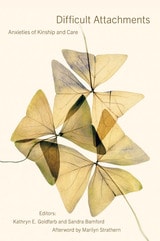
Anthropologists have long considered kinship as the basis for social solidarity. Indeed, the idea that kinship is grounded in positive sociality has found its way into most anthropological accounts and has served as an orienting framework directing decades of scholarly research. But what about when it is not? What about instances when kinship is anything but ‘warm and fuzzy’ but is characterized, instead, by neglect, violence, negative affect, or a lack of nurturance and care? In the three interlinked sections of this volume, the view that kinship is about “solidarity” and “care” is challenged by exploring how kin relations are not only about connection and inclusion but also about disconnection, exclusion, neglect, and violence. Kinship relationships that feel “positive” and “good” take a great deal of perseverance and work; there is nothing “natural” about kinship ties as being based on positive sociality. In these chapters, the contributors take seriously the contingency of kinship relations (the moments when kinship breaks down or is a source of suffering) and how this prompts scholars to develop new theoretical and methodological perspectives.
[more]
cover of Gifts and Commodities

Gifts and Commodities

C. A. Gregory

HAU, 2015

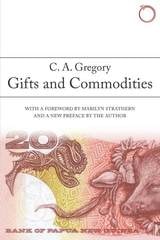
Christopher A. Gregory’s Gifts and Commodities is one of the undisputed classics of economic anthropology. On its publication in 1982, it spurred intense, ongoing debates about gifts and gifting, value, exchange, and the place of political economy in anthropology.

Gifts and Commodities is, at once, a critique of neoclassical economics and development theory, a critical history of colonial Papua New Guinea, and a comparative ethnography of exchange in Melanesian societies. This new edition includes a foreword by anthropologist Marilyn Strathern and a new preface by the author that discusses the ongoing response to the book and the debates it has engendered, debates that have become more salient in our evermore neoliberal and globalized era.
[more]
cover of Property, Substance, and Effect: Anthropological Essays on Persons and Things

Property, Substance, and Effect

Anthropological Essays on Persons and Things

Marilyn Strathern

HAU, 2022

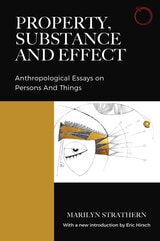
In engaging essays, celebrated anthropologist Marilyn Strathern reflects on the complexities of social life. 

Property, Substance, and Effect draws on Marilyn Strathern’s longstanding interest in the reification of social relations. If the world is shrinking in terms of resources and access to them, it is expanding in terms of new candidates for proprietorship. How new relations are brought into being is among the many questions about property, ownership, and knowledge that these essays bring together.

Twenty years have not diminished the interest in the book’s opening challenge: if one were inventing a method of enquiry by which to configure the complexity of social life, one might wish to invent something like the anthropologist’s ethnographic practice. A wide range of studies deliberately brings into conversation claims people make on one another through relations imagined in the form of body-substance along with the increasing visibility of conceptual or intellectual work as property. Whether one lives in Papua New Guinea or Great Britain, categories of knowledge are being dissolved and reformed at a tempo that calls for reflection—and for the kind of lateral reflection afforded through the “ethnographic effect.”
[more]
cover of Relations: An Anthropological Account

Relations

An Anthropological Account

Marilyn Strathern

Duke University Press, 2020

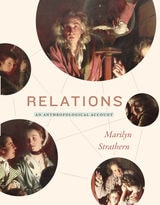
The concept of relation holds a privileged place in how anthropologists think and write about the social and cultural lives they study. In Relations, eminent anthropologist Marilyn Strathern provides a critical account of this key concept and its usage and significance in the English-speaking world. Exploring relation's changing articulations and meanings over the past three centuries, Strathern shows how the historical idiosyncrasy of using an epistemological term for kinspersons (“relatives”) was bound up with evolving ideas about knowledge-making and kin-making. She draws on philosophical debates about relation—such as Leibniz's reaction to Locke—and what became its definitive place in anthropological exposition, elucidating the underlying assumptions and conventions of its use. She also calls for scholars in anthropology and beyond to take up the limitations of Western relational thinking, especially against the background of present ecological crises and interest in multispecies relations. In weaving together analyses of kin-making and knowledge-making, Strathern opens up new ways of thinking about the contours of epistemic and relational possibilities while questioning the limits and potential of ethnographic methods.
[more]