Results by title
3 books match the query 'Students with social disabilities'

CANCELED - Notes from Home
Jonna McKone
Rutgers University Press, 2021
Through portraiture, oral history, writing, and family archives, the contributors explore childhood, geography, immigration, education, and family relationships, recovering misunderstood or overlooked moments. In the process of making this work, the group found old family photos, returned to sites of significance, and made new friendships, discovering the transformational potential of this kind of storytelling to reframe hardship, loss, and uncertainty. In the words of one contributor, “I felt like this process was a necessary step that allowed me to acknowledge and comprehend what I was experiencing at the time. It allowed me to create a more coherent understanding that I am who I am because of my past and because I was the one who had control of molding my own, better path.” Each chapter, encompassing one person’s story, is strikingly unique in its vision and approach.
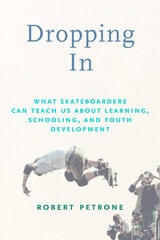
Dropping In
What Skateboarders Can Teach Us about Learning, Schooling, and Youth DevelopmentRobert Petrone
University of Massachusetts Press, 2023
The die-hard local skateboarders of Franklin Skatepark—a group of working-class, Latino and white young men in the rural Midwest—are typically classified by schools and society as “struggling,” “at-risk,” “failing,” and “in crisis.” But at the skatepark, they thrive and succeed, not only by landing tricks but also by finding meaning and purpose in their lives.
In Dropping In, Robert Petrone draws from multiple years of ethnographic research to bring readers into this rich environment, exploring how and why these young men engage more with skateboarding and its related cultural communities than with school. For them, it is in these alternative communities and spaces that they meet their intellectual, literate, and learning needs; cultivate meaningful and supportive relationships; and develop a larger understanding of their place in the world. By looking at what these skateboarders can teach us about what is right and working in their lives, Petrone asks educators and others committed to youth development to rethink schooling structures and practices to provide equitable education for all students.
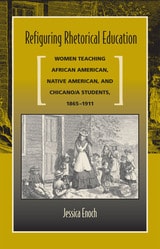
Refiguring Rhetorical Education
Women Teaching African American, Native American, and Chicano/a Students, 1865-1911Jessica Enoch
Southern Illinois University Press, 2008
Refiguring Rhetorical Education: Women Teaching African American, Native American, and Chicano/a Students, 1865-1911 examines the work of five female teachers who challenged gendered and cultural expectations to create teaching practices that met the civic and cultural needs of their students.
The volume analyzes Lydia Maria Child’s The Freedmen’s Book, a post–Civil War educational textbook for newly freed slaves; Zitkala Ša’s autobiographical essays published in the Atlantic Monthly in 1900 that questioned the work of off-reservation boarding schools for Native American students; and Jovita Idar, Marta Peña, and Leonor Villegas de Magnón’s contributions to the Spanish-language newspaper La Crónica in 1910 and 1911—contributions that offered language and cultural instruction their readers could not receive in Texas public schools.
Author Jessica Enoch explores the possibilities and limitations of rhetorical education by focusing on the challenges that Child, Zitkala Ša, Idar, Peña, and Villegas made to dominant educational practices. Each of these teachers transformed their seemingly apolitical occupation into a site of resistance, revising debilitating educational methods to advance culture-based and politicized teachings that empowered their students to rise above their subjugated positions.
Refiguring Rhetorical Education considers how race, culture, power, and language are both implicit and explicit in discussions of rhetorical education for marginalized students and includes six major tenets to guide present-day pedagogies for civic engagement.