Results by title
12 books match the query 'Sufi'
Al-Ghazali's "Moderation in Belief"
Al-Ghazali
University of Chicago Press, 2013
The first complete English-language edition of Moderation in Belief, this new annotated translation by Aladdin M. Yaqub draws on the most esteemed critical editions of the Arabic texts and offers detailed commentary that analyzes and reconstructs the arguments found in the work’s four treatises. Explanations of the historical and intellectual background of the texts also enable readers with a limited knowledge of classical Arabic to fully explore al-Ghazali and this foundational text for the first time.
With the recent resurgence of interest in Islamic philosophy and the conflict between philosophy and religion, this new translation will be a welcome addition to the scholarship.
Arguing Sainthood
Modernity, Psychoanalysis, and IslamKatherine Pratt Ewing
Duke University Press, 1997
Ewing critiques Eurocentric cultural theorists and Orientalist discourse while also taking issue with expatriate postcolonial thinkers Homi Bhabha and Gayatri Spivak. She challenges the notion of a monolithic Islamic modernity in order to explore the lived realities of individuals, particularly those of Pakistani saints and their followers. By examining the continuities between current Sufi practices and earlier popular practices in the Muslim world, Ewing identifies in the Sufi tradition a reflexive, critical consciousness that has usually been associated with the modern subject. Drawing on her training in clinical and theoretical psychoanalysis as well as her anthropological fieldwork in Lahore, Pakistan, Ewing argues for the value of Lacan in anthropology as she provides the basis for retheorizing postcolonial studies.
Expressions of Sufi Culture in Tajikistan
Benjamin Gatling
University of Wisconsin Press, 2018
Gatling demonstrates how Sufis transcend the oppressive religious politics of contemporary Tajikistan by using these forms to inhabit multiple times: the paradoxical present, the Persian sacred past, and the Soviet era. In a world consumed with the supposed political dangers of Islam, Gatling shows the intricate, ground-level ways that Muslim expressive culture intersects with authoritarian politics, not as artful forms of resistance but rather as a means to shape Sufi experiences of the present.

Fighting the Greater Jihad
Amadu Bamba and the Founding of the Muridiyya of Senegal, 1853–1913Cheikh Anta Babou
Ohio University Press, 2007
In Senegal, the Muridiyya, a large Islamic Sufi order, is the single most influential religious organization, including among its numbers the nation’s president. Yet little is known of this sect in the West. Drawn from a wide variety of archival, oral, and iconographic sources in Arabic, French, and Wolof, Fighting the Greater Jihad offers an astute analysis of the founding and development of the order and a biographical study of its founder, Cheikh Ahmadu Bamba Mbakke.
Cheikh Anta Babou explores the forging of Murid identity and pedagogy around the person and initiative of Amadu Bamba as well as the continuing reconstruction of this identity by more recent followers. He makes a compelling case for reexamining the history of Muslim institutions in Africa and elsewhere in order to appreciate believers’ motivation and initiatives, especially religious culture and education, beyond the narrow confines of political collaboration and resistance. Fighting the Greater Jihad also reveals how religious power is built at the intersection of genealogy, knowledge, and spiritual force, and how this power in turn affected colonial policy.
Fighting the Greater Jihad will dramatically alter the perspective from which anthropologists, historians, and political scientists study Muslim mystical orders.
Modern Muslims
A Sudan MemoirSteve Howard
Ohio University Press, 2016

Mystical Poems of Rumi
Jalal al-Din Rumi
University of Chicago Press, 2009
Devour it the moment it is fresh, before the dust settles upon it.
Its place is the warm climate of the heart; in this world it dies of cold.
Like a fish it quivered for an instant on dry land, another moment and you see it is cold.
Even if you eat it imagining it is fresh, it is necessary to conjure up many images.
What you drink is really your own imagination; it is no old tale, my good man.
“Rumi is one of the world’s greatest lyrical poets in any language—as well as probably the most accessible and approachable representative of Islamic civilization for Western students.”—James W. Morris, Oberlin College
Sufi Networks, Fulbe Itinerancy
A History of Islam in Senegambia, c. 1803–1996Assan Sarr
Michigan State University Press, 2026
This book traces the development and expansion of a network of itinerant Fulbe clerics in southern Senegambia who forged solidarity under the banner of Islam. Beginning with a marabout named Cherno Muhammadu Jallow (c. 1803–1883)—who expanded the Umarian branch of the Tijaniyya sect into remote parts of the region—Assan Sarr demonstrates that some Fulbe groups were not drawn into Islam until the late nineteenth and early twentieth centuries. He argues that by creating a series of villages that served as educational centers during a tumultuous period, the itinerant scholars who are at the heart of this book not only spread Islam throughout the land of the Firdu, Saloum, and parts of the Gambia region but also played a pivotal role in establishing a widely shared Muslim identity among the Fulbe people.
The Female Voice in Sufi Ritual
Devotional Practices of Pakistan and IndiaBy Shemeem Burney Abbas
University of Texas Press, 2002
The female voice plays a more central role in Sufi ritual, especially in the singing of devotional poetry, than in almost any other area of Muslim culture. Female singers perform sufiana-kalam, or mystical poetry, at Sufi shrines and in concerts, folk festivals, and domestic life, while male singers assume the female voice when singing the myths of heroines in qawwali and sufiana-kalam. Yet, despite the centrality of the female voice in Sufi practice throughout South Asia and the Middle East, it has received little scholarly attention and is largely unknown in the West.
This book presents the first in-depth study of the female voice in Sufi practice in the subcontinent of Pakistan and India. Shemeem Burney Abbas investigates the rituals at the Sufi shrines and looks at women's participation in them, as well as male performers' use of the female voice. The strengths of the book are her use of interviews with both prominent and grassroots female and male musicians and her transliteration of audio- and videotaped performances. Through them, she draws vital connections between oral culture and the written Sufi poetry that the musicians sing for their audiences. This research clarifies why the female voice is so important in Sufi practice and underscores the many contributions of women to Sufism and its rituals.
The Muridiyya on the Move
Islam, Migration, and Place MakingCheikh Anta Babou
Ohio University Press, 2021
Highlights the role of transnational space making in the construction of diasporic Muridiyya identity.
The construction of collective identity among the Muridiyya abroad is a communal but contested endeavor. Differing conceptions of what should be the mission of Muridiyya institutions in the diaspora reveal disciples’ conflicting politics and challenge the notion of the order’s homogeneity. While some insist on the universal dimension of Ahmadu Bamba Mbakke’s calling and emphasize dawa (proselytizing), others prioritize preserving Muridiyya identity abroad by consolidating the linkages with the leadership in Senegal. Diasporic reimaginings of the Muridiyya abroad, in turn, inspire cultural reconfigurations at home.
Drawing from a wide array of oral and archival sources in multiple languages collected in five countries, The Muridiyya on the Move reconstructs over half a century of the order’s history, focusing on mobility and cultural transformations in urban settings. In this groundbreaking work, Babou highlights the importance of the dahira (urban prayer circle) as he charts the continuities and ruptures between Muridiyya migrations. Throughout, he delineates the economic, socio-political, and other forces that powered these population movements, including colonial rule, the economic crises of the postcolonial era, and natural disasters.
The Mystical Poems of Rumi 1
Jalal al-Din Rumi
University of Chicago Press, 1974
"An excellent introduction to Rumi, the greatest mystical poet of Islam. . . . Rumi's scope, like that of all great poets, is universal—reaching from sensuous luxuriance to the driest irony."—Sherman Goldman, East-West Journal
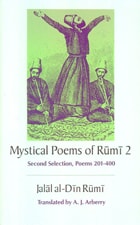
The Mystical Poems of Rumi 2
Second Selection, Poems 201-400Jalal al-Din Rumi
University of Chicago Press, 1991
Rumi, who wrote and preached in Persia during the thirteenth century, is one of history’s most celebrated mystics. His vast body of poetry includes a lengthy epic of religious mysticism, the Mathnavi, and more than three thousand lyrics and odes. A. J. Arberry, who selected four hundred of the lyrics for translation, calls Rumi "one of the world's greatest poets. In profundity of thought, inventiveness of image, and triumphant mastery of language, he stands out as the supreme genius of Islamic mysticism." Arberry’s authoritative translation is one of the few done directly from the original Persian.
A. J. Arberry (1905-69) was professor of Arabic at Cambridge University.
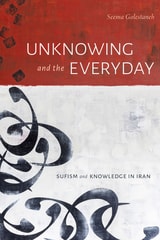
Unknowing and the Everyday
Sufism and Knowledge in IranSeema Golestaneh
Duke University Press, 2023