Results by title
21 books match the query 'Supernatural'
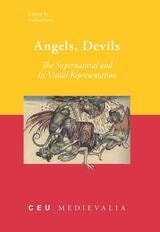
Angels, Devils
The Supernatural and Its Visual RepresentationGerhard Jaritz
Central European University Press, 2011
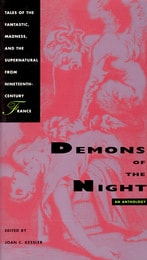
Demons of the Night
Tales of the Fantastic, Madness, and the Supernatural from Nineteenth-Century FranceEdited by Joan C. Kessler
University of Chicago Press, 1995
The anthology opens with "Smarra, or the Demons of the Night," Nodier's 1821 tale of nightmare, vampirism, and compulsion, acclaimed as the first work in French literature to explore in depth the realm of dream and the unconscious. Other stories include Balzac's "The Red Inn," in which a crime is committed by one person in thought and another in deed, and Mérimée's superbly crafted mystery, "The Venus of Ille," which dramatizes the demonic power of a vengeful goddess of love emerging out of the pagan past. Gautier's protagonist in "The Dead in Love" develops an obsessive passion for a woman who has returned from beyond the grave, while the narrator of Maupassant's "The Horla" imagines himself a victim of psychic vampirism.
Joan Kessler has prepared new translations of nine of the thirteen tales in the volume, including Gérard de Nerval's odyssey of madness, "Aurélia," as well as two tales that have never before appeared in English. Kessler's introduction sets the background of these tales—the impact of the French Revolution and the Terror, the Romantics' fascination with the subconscious, and the influence of contemporary psychological and spiritual currents. Her essay illuminates how each of the authors in this collection used the fantastic to articulate his own haunting obsessions as well as his broader vision of human experience.

Fan Phenomena
SupernaturalEdited by Lynn Zubernis and Katherine Larsen
Intellect Books, 2014
Fan Phenomena: Supernatural explores the ongoing fascination and passion for a show that developed a relationship with fans through eight seasons and continues to have an impact on fan culture to the present day. Essays here explore the rich dynamic that has developed between fans and producers, actors, writers, directors, the show creator, and showrunners through online interactions on Twitter and Facebook, face-to-face exchanges at conventions, and representations of fandom within the show's meta-episodes. Contributors also explore gender and sexuality in the show and in fan art; the visual dynamics, cinematography, and symbolism in the episodes as well as the fan videos they inspire; and the culture of influence, learning, and teaching in the series.
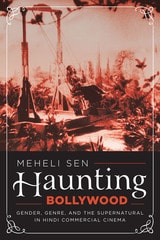
Haunting Bollywood
Gender, Genre, and the Supernatural in Hindi Commercial CinemaBy Meheli Sen
University of Texas Press, 2017
Haunting Bollywood is a pioneering, interdisciplinary inquiry into the supernatural in Hindi cinema that draws from literary criticism, postcolonial studies, queer theory, history, and cultural studies. Hindi commercial cinema has been invested in the supernatural since its earliest days, but only a small segment of these films have been adequately explored in scholarly work; this book addresses this gap by focusing on some of Hindi cinema’s least explored genres.
From Gothic ghost films of the 1950s to snake films of the 1970s and 1980s to today’s globally influenced zombie and vampire films, Meheli Sen delves into what the supernatural is and the varied modalities through which it raises questions of film form, history, modernity, and gender in South Asian public cultures. Arguing that the supernatural is dispersed among multiple genres and constantly in conversation with global cinematic forms, she demonstrates that it is an especially malleable impulse that routinely pushes Hindi film into new formal and stylistic territories. Sen also argues that gender is a particularly accommodating stage on which the supernatural rehearses its most basic compulsions; thus, the interface between gender and genre provides an exceptionally productive lens into Hindi cinema’s negotiation of the modern and the global. Haunting Bollywood reveals that the supernatural’s unruly energies continually resist containment, even as they partake of and sometimes subvert Hindi cinema’s most enduring pleasures, from songs and stars to myth and melodrama.
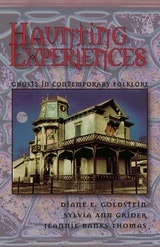
Haunting Experiences
Ghosts in Contemporary FolkloreDiane E. Goldstein, Sylvia Ann Grider, and Jeannie Banks Thomas
Utah State University Press, 2007
In Haunting Experiences, three well-known folklorists broaden the discussion of ghost lore by examining it from a variety of angles in various modern contexts. Diane E. Goldstein, Sylvia Ann Grider, and Jeannie Banks Thomas take ghosts seriously, as they draw on contemporary scholarship that emphasizes both the basis of belief in experience (rather than fantasy) and the usefulness of ghost stories. They look closely at the narrative role of such lore in matters such as socialization and gender, and unravel the complex mix of mass media, commodification, and popular culture that today puts old spirits into new contexts.
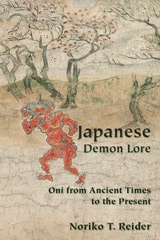
Japanese Demon Lore
Oni from Ancient Times to the PresentNoriko Reider
Utah State University Press, 2010
Oni, ubiquitous supernatural figures in Japanese literature, lore, art, and religion, usually appear as demons or ogres. Characteristically threatening, monstrous creatures with ugly features and fearful habits, including cannibalism, they also can be harbingers of prosperity, beautiful and sexual, and especially in modern contexts, even cute and lovable. There has been much ambiguity in their character and identity over their long history. Usually male, their female manifestations convey distinctivly gendered social and cultural meanings.
Oni appear frequently in various arts and media, from Noh theater and picture scrolls to modern fiction and political propaganda, They remain common figures in popular Japanese anime, manga, and film and are becoming embedded in American and international popular culture through such media. Noriko Reiderýs book is the first in English devoted to oni. Reider fully examines their cultural history, multifaceted roles, and complex significance as "others" to the Japanese.
Legend Tripping
A Contemporary Legend CasebookLynne S. McNeill
Utah State University Press, 2018
The volume presents both insightful research and useful pedagogy, making this an invaluable resource in the classroom. Selected major articles on legend tripping, with introductory sections written by the editors, are followed by discussion questions and projects designed to inspire readers to engage critically with legend traditions and customs of legend tripping and to explore possible meanings and symbolics at work. Suggested projects incorporate digital technology as it appears both in legends and in modes of legend tripping.
Legend Tripping is appropriate for students, general readers, and folklorists alike. It is the first volume in the International Society for Contemporary Legend Research series, a set of casebooks providing thorough and up-to-date studies that showcase a variety of scholarly approaches to contemporary legends, along with variants of legend texts, discussion questions, and projects for students.
Contributors: S. Elizabeth Bird, Bill Ellis, Carl Lindahl, Patricia M. Meley, Tim Prizer
Magic Flutes and Enchanted Forests
The Supernatural in Eighteenth-Century Musical TheaterDavid J. Buch
University of Chicago Press, 2008
David J. Buch reveals that despite—and perhaps even because of—their fundamental irrationality, fantastic and exotic themes acquired extraordinary force and popularity during the period, pervading theatrical works with music in the French, German, and Italian mainstream. Considering prominent compositions by Gluck, Rameau, and Haydn, as well as many seminal contributions by lesser-known artists, Buch locates the origins of these magical elements in such historical sources as ancient mythology, European fairy tales, the Arabian Nights, and the occult. He concludes with a brilliant excavation of the supernatural roots of Mozart’s The Magic Flute and Don Giovanni, building a new foundation for our understanding of the magical themes that proliferated in Mozart’s wake.
Out Of The Ordinary
Folklore and the SupernaturalBarbara Walker
Utah State University Press, 1995
Out of the Ordinary explores the functions of belief and supernatural experience within an array of cultures, as well as the stance of academe toward the study of belief and the supernatural. The essays in this volume call into question the idea that supernatural experience is extraordinary.
Among the contributors are Shelley Adler, David Hufford, Barre Toelken, and Gillian Bennett.
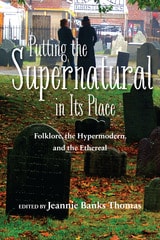
Putting the Supernatural in Its Place
Folklore, the Hypermodern, and the EtherealJeannie B. Thomas
University of Utah Press, 2015
Putting the Supernatural in Its Place explores zombies, vampires, witches, demented nuns, mediums, and ghosts in their natural (and unnatural) habitats while making sense of the current ubiquity of the supernatural on the Internet, in the movies, in tourism, and in places like New Orleans. This unique study of how we locate the supernatural sheds light on why certain sites and their stories captivate us and shows how pondering the supernatural can bring a better understanding of the places we create and inhabit. Each chapter is authored by a noted folklorist who examines the supernatural as it appears “in place.” Among the locales are Salem, Massachusetts; Lily Dale, New York; and Internet fan sites for the Twilight movies and the TV series Buffy the Vampire Slayer. Supernatural places have the potential to alter perceptions of reality—sometimes enchanting, sometimes terrifying, and sometimes even schooling those who experience them. Ultimately, the authors demonstrate that, culturally speaking, the supernatural’s place is important and not trivial.
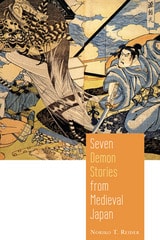
Seven Demon Stories from Medieval Japan
Noriko T. Reider
Utah State University Press, 2016
Reider, concordant with many scholars of Japanese cultural studies, argues that to study oni is to study humanity. These tales are from an era in which many new oni stories appeared for the purpose of both entertainment and moral/religious edification and for which oni were particularly important, as they were perceived to be living entities. They reflect not only the worldview of medieval Japan but also themes that inform twenty-first-century Japanese pop and vernacular culture, including literature, manga, film, and anime. With each translation, Reider includes an introductory essay exploring the historical and cultural importance of the characters and oni manifestations within this period.
Offering new insights into and interpretations of not only the stories therein but also the entire genre of Japanese ghost stories, Seven Demon Stories is a valuable companion to Reider’s 2010 volume Japanese Demon Lore. It will be of significant value to folklore scholars as well as students of Japanese culture.
Shakespeare the Illusionist
Magic, Dreams, and the Supernatural on FilmNeil Forsyth
Ohio University Press, 2019
In Shakespeare the Illusionist, Neil Forsyth reviews the history of Shakespeare’s plays on film, using the basic distinction in film tradition between what is owed to Méliès and what to the Lumière brothers. He then tightens his focus on those plays that include some explicit magical or supernatural elements—Puck and the fairies, ghosts and witches, or Prospero’s island, for example—and sets out methodically, but with an easy touch, to review all the films that have adapted those comedies and dramas, into the present day.
Forsyth’s aim is not to offer yet another answer as to whether Shakespeare would have written for the screen if he were alive today, but rather to assess what various filmmakers and TV directors have in fact made of the spells, haunts, and apparitions in his plays. From analyzing early camera tricks to assessing contemporary handling of the supernatural, Forsyth reads Shakespeare films for how they use the techniques of moviemaking to address questions of illusion and dramatic influence. In doing so, he presents a bold step forward in Shakespeare and film studies, and his fresh take is presented in lively, accessible language that makes the book ideal for classroom use.
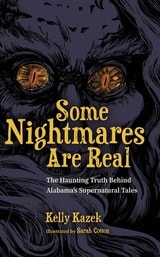
Some Nightmares Are Real
The Haunting Truth Behind Alabama’s Supernatural Talesby Kelly Kazek, illustrated by Sarah Cotton
University of Alabama Press, 2024
Southern writer and folklorist Kelly Kazek’s collection of eerie and enigmatic Alabama ghost stories
Dark secrets lurk beneath the sleepy surface of Alabama. Ghosts and grisly creatures haunt the towns and forests. In the great Southern ghost-story tradition, famed Alabama storyteller Kelly Kazek weaves a gothic tapestry of ten stories drawn from real people and legendary creatures, cursed places, and harrowing events.
Each story or legend takes readers to a different place in Alabama. Read about the bestial Wolf Woman who terrified Mobilians in the haunted old port city. In the northern city of Huntsville, visit the Dead Children’s Playground in gloomy Maple Hill Cemetery. In Jacksonville, feel the cold grip of the Old Mill Witch, rumored to protect the workers at the rickety cotton yarn mill. Hear about the mysterious green light that drifts along the Alabama River in the Black Belt hamlet of Gee’s Bend and learn about the role the Gee’s Bend Ferry played in the Civil Rights Movement.
Unlike most ghost-story collections, Some Nightmares Are Real includes an appendix of facts, historical resources, and information about how to visit the locations. These contemporary stories embrace a beloved Southern folkloric tradition for a new generation of young readers. The tales will terrify and ensnare ghost-story lovers of all ages. So settle in, pull the covers up tight, and maybe turn on the light, because the truth is: Some Nightmares Are Real.
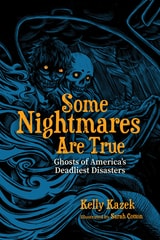
Some Nightmares Are True
Ghosts of America's Deadliest Disastersby Kelly Kazek, illustrated by Sarah Cotton
University of Alabama Press, 2025
Digging up the eerie aftermath of America’s deadliest disasters—where ghost stories take root, history lingers in the shadows, and the past refuses to stay buried.
In this haunting follow-up to Some Nightmares Are Real: The Haunting Truth Behind Alabama’s Supernatural Tales, journalist and storyteller Kelly Kazek investigates supernatural folklore grounded in historical catastrophe. This time, she ventures far beyond Alabama, unearthing the eerie legends born from their aftermath of nine of America’s most infamous disasters. From the strangling suffocation of the Boston Molasses Flood and the terror of Galveston’s notorious Great Storm, to flames blasting from the Triangle Shirtwaist Factory disaster, Some Nightmares Are True examines ghost stories that have haunted communities long after the news headlines stopped.
Each spooky story blends vivid storytelling with meticulous research, connecting real events to the ghostly lore they inspired. Kazek explores not just the moment of disaster, but how grief, resilience, and remembrance shape the way stories live on—through newspaper archives, folklore, and generations of retelling.
With both wry Southern sensibility and journalistic rigor, Kazek explores how moments of tragedy like the Dixie Tornado Outbreak in Alabama, the capsizing of the SS Eastland in Chicago, and the haunting aftermath of the Schoolchildren’s Blizzard in Nebraska leave lasting imprints on generational memory. These sites of devastation become more than historical footnotes; they transform into hallowed grounds where grief lingers, legends remain, and the line between fact and folklore dissolves.
For ghost hunters, or simply those brave enough to follow their curiosity into learning more about the stories’ historical facts, Kazek has compiled a robust appendix that provides context, source materials, and location details, making this a perfect pick to toss in the car for that late-night road trip adventure. But remember, Some Nightmares Are True.
The Ambuiguity of Being
Lonergan and the Problems of the SupernaturalJonathan R. Heaps
Catholic University of America Press, 2024
The Essential Supernatural
A Dialogical Study in Kierkegaard and BlondelMaurice Ashley Agbaw-Ebai
St. Augustine's Press, 2022
Like these philosophers who have preceded him, Agbaw-Ebai exhorts us to never allow the sense of our relation to the supernatural as a settled matter. The philosophy of religion we have inherited does not protect us from having to confront our own subjectivity with autonomy: to be God without God and against God, or to be God with and through God.
The Hatak Witches
Devon A. Mihesuah
University of Arizona Press, 2021
Monique discovers that a portion of an ancient and deformed skeleton had also been stolen from the neglected museum archives. Her uncle, the spiritual leader Leroy Bear Red Ears, concludes that the stolen remains are those of Hatak haksi, a witch and the matriarch of the Crow family, a group of shape-shifting Choctaws who plan to reestablish themselves as the powerful creatures they were when the tribe lived in Mississippi. Monique, Leroy, and Chris must stop the Crows, but to their dread, the entities have retreated to the dark and treacherous hollow in the center of Chalakwa Ranch. The murderous shape-shifters believe the enormous wild hogs, poisonous snakes, and other creatures of the hollow might form an adequate defense for Hatak haksi.
But what no one counts on is the unexpected appearance and power of the Old Ones who guard the lands of the Choctaw afterlife. Blending tribal beliefs and myths into a modern context, The Hatak Witches continues the storyline of Choctaw cosmology and cultural survival that are prominent in Devon A. Mihesuah’s award-winning novel, The Roads of My Relations.
The Last Journey of Ago Ymeri
Bashkim Shehu
Northwestern University Press, 2007
The New Prometheans
Faith, Science, and the Supernatural Mind in the Victorian Fin de SiècleCourtenay Raia
University of Chicago Press, 2019
The New Prometheans traces the evolution of psychical research through the intertwining biographies of four men: chemist Sir William Crookes, depth psychologist Frederic Myers, ether physicist Sir Oliver Lodge, and anthropologist Andrew Lang. All past presidents of the society, these men brought psychical research beyond academic circles and into the public square, making it part of a shared, far-reaching examination of science and society. By layering their papers, textbooks, and lectures with more intimate texts like diaries, letters, and literary compositions, Courtenay Raia returns us to a critical juncture in the history of secularization, the last great gesture of reconciliation between science and sacred truths.
The Supernatural in Society, Culture, and History
Dennis Waskul and Marc Eaton
Temple University Press, 2018
In the twenty-first century, as in centuries past, stories of the supernatural thrill and terrify us. But despite their popularity, scholars often dismiss such beliefs in the uncanny as inconsequential, or even embarrassing. The editors and contributors to The Supernatural in Society, Culture, and History have made a concerted effort to understand encounters with ghosts and the supernatural that have remain present and flourished. Featuring folkloric researchers examining the cultural value of such beliefs and practices, sociologists who acknowledge the social and historical value of the supernatural, and enthusiasts of the mystical and uncanny, this volume includes a variety of experts and interested observers using first-hand ethnographic experiences and historical records.
The Supernatural in Society, Culture, and History seeks to understand the socio-cultural and socio-historical contexts of the supernatural. This volume takes the supernatural as real because belief in it has fundamentally shaped human history. It continues to inform people’s interpretations, actions, and identities on a daily basis. The supernatural is an indelible part of our social world that deserves sincere scholarly attention.
Contributors include: Janet Baldwin, I'Nasah Crockett, William Ryan Force, Rachael Ironside, Tea Krulos, Joseph Laycock, Stephen L. Muzzatti, Scott Scribner, Emma Smith, Jeannie Banks Thomas, and the editors
Victorian Ghosts in the Noontide
Women Writers and the SupernaturalVanessa D. Dickerson
University of Missouri Press, 1996
During the nineteenth century, British society was making rapid advancements in science and technology. While the men became materially productive, women were expected to be the fulcrums of society's changes. As one means of adjusting to these changes, many women focused on supernaturalism and spirituality.
In Victorian Ghosts in the Noontide, Vanessa D. Dickerson analyzes women's spirituality in a materialistic age by examining the supernatural fiction of Charlotte and Emily Brontë, Elizabeth Gaskell, and George Eliot and provides interpretive readings of familiar texts like Jane Eyre and Wuthering Heights. Other works by lesser-known authors are also examined.
Technological advances eliminated many of the jobs women were accustomed to doing. This left women looking for their place in society. A sense of "in-betweenness" developed in these women who were now expected to attend not only to the physical but also to the moral and spiritual needs of the family. As an answer to this "in-betweenness" some channeled their power toward the art of writing. Because people in the mid-1800s were so thoroughly engaged in scientific thought and advancements, supernatural folklore and spirituality were disreputable ideas for anyone, especially women, to explore. Ghosts and spirits were tied to old-wives' tales, superstitions, and legends. However, by focusing on these concepts and using fiction as an outlet, women were able to make great strides in being seen and heard. The art of writing functioned as an exploration of their spiritualism in which women discovered expression, freedom, and power.
This perceptive, well-written book will add a new dimension to our understanding of women's supernatural writings of the Victorian era. Scholars of Victorian literature, women's studies, and popular culture will benefit from its insights.