Results by title
3 books match the query 'Surfaces (Philosophy)'

Hiding
Mark C. Taylor
University of Chicago Press, 1997
Nothing defines postmodernism so well as its refusal of depth, its emphasis on appearance and spectacle, its tendency to collapse a three-dimensional world in which image and reality are distinct into a two-dimensional world in which they merge. The postmodern world, Taylor argues, is a world of surfaces, and the postmodern condition is one of profound superficiality.
For many cultural commentators, postmodernism's inescapable play of surfaces is cause for despair. Taylor, on the other hand, shows that the disappearance of depth in postmodern culture is actually a liberation repleat with creative possibilities. Taylor introduces readers to a popular culture in which detectives—the postmodern heroes of Paul Auster and Dennis Potter—lift surfaces only to find more surfaces, and in which fashion advertising plays transparency against hiding. Taylor looks at the contemporary preoccupation with body piercing and tattooing, and asks whether these practices actually reveal or conceal. Phrenology and skin diseases, the "religious" architecture of Las Vegas, the limitless spread of computer networks—all are brought within the scope of Taylor's brilliant analysis. Postmodernism, he shows, has given us a new sense of the superficial, one in which the issue is not the absence of meaning but its uncontrollable, ecstatic proliferation.
Embodying the very tendencies it analyzes, Hiding is unique. Conceived and developed with well-known designers Michael Rock and Susan Sellars, this work transgresses the boundary that customarily separates graphic design from the story within a text. The product of nearly three decades of reflection and writing, Hiding opens a window on contemporary culture. To follow the remarkable course Taylor charts is to see both our present and past differently and to encounter a future as disorienting as it is alluring.

Surface Encounters
Thinking with Animals and ArtRon Broglio
University of Minnesota Press, 2011
What it is like to be an animal? Ron Broglio wants to know from the inside, from underneath the fur and feathers. In examining this question, he bypasses the perspectives of biology or natural history to explore how one can construct an animal phenomenology, to think and feel as an animal other—or any other.
Until now phenomenology has grappled with how humans are embedded in their world. According to philosophical tradition, animals do not practice the self-reflexive thought that provides humans with depth of being. Without human interiority, philosophers have believed, animals live on the surface of things. But, Broglio argues, the surface can be a site of productive engagement with the world of animals, and as such he turns to humans who work with surfaces: contemporary artists.
Taking on the negative claim of animals living only on the surface and turning the premise into a positive set of possibilities for human–animal engagement, Broglio considers artists—including Damien Hirst, Carolee Schneemann, Olly and Suzi, and Marcus Coates—who take seriously the world of the animal on its own terms. In doing so, these artists develop languages of interspecies expression that both challenge philosophy and fashion new concepts for animal studies.
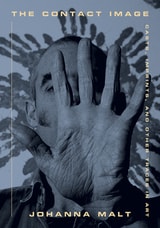
The Contact Image
Casts, Imprints, and Other Traces in ArtJohanna Malt
University of Minnesota Press, 2026
A new conceptual tool for understanding the history of art
From ancient cave paintings to contemporary sculpture, forms of indexical trace are vital to the human practice of artmaking. Through this wide-ranging exploration, Johanna Malt shows how casts, molds, and imprints (“contact images”) offer a paradigm for thinking about our relationship to objects and their surfaces as sites of meaning. Engaging and complicating philosophical dualities of absence and presence, art and non-art, original and copy, Malt introduces the contact image as an important new concept for the study of Western art.
Close reading examples from 30,000 years of art history, Malt cuts across eras and media to unite diverse forms of artistic production created through instances of contact with “the objects of the world.” From holy relics to Napoleon’s death mask to life casts of the human body by artists such as Duane Hanson and Janine Antoni, as well as conceptual and performance work by Jasper Johns and Yves Klein, The Contact Image traces themes of selfhood, time, negation, and vestige in these tactile encounters.
Revisiting fundamental questions about representation, perception, and aesthetics, The Contact Image is a sophisticated provocation for a theory of art built on the tension and oscillations that emerge when we explore how artworks embody opposites.
Retail e-book files for this title are screen-reader friendly with images accompanied by short alt text and/or extended descriptions.