Results by title
15 books match the query 'Swales, John M.'
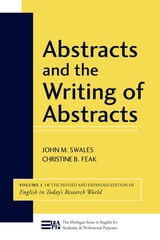
Abstracts and the Writing of Abstracts
John M. Swales and Christine B. Feak
University of Michigan Press, 2009
Today's research world demands a variety of different abstracts to serve different purposes. As a result, writing abstracts can be a difficult task for graduate and international students, researchers, and even practiced authors. Abstracts and the Writing of Abstracts is designed to demystify the construction of this essential writing form and to equip scholars with the skills to summarize their work in clear and compelling ways.
This volume represents a revision and expansion of the material on writing abstracts that appeared in English in Today's Research World.
The Abstracts volume focuses on abstracts for research articles before addressing abstracts for short communications, conferences, and PhD dissertations. It also covers keywords, titles, and author names. Wherever appropriate within the text, Language Focus sections discuss options and provide tips for meeting specific linguistic challenges posed by the writing of different types of abstracts.
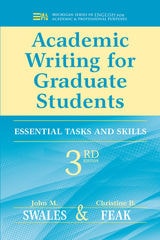
Academic Writing for Graduate Students, 3rd Edition
Essential Tasks and SkillsJohn M. Swales & Christine B. Feak
University of Michigan Press, 2012
Among the many changes in the third edition:
*newer, longer, and more authentic texts and examples
*greater discipline variety in texts (added texts from hard sciences and engineering)
*more in-depth treatment of research articles
*greater emphasis on vocabulary issues
*revised flow-of-ideas section
*additional tasks that require students to do their own research
*more corpus-informed content
*binding that allows the book to lay flat when open.
The Commentary (teacher's notes and key) (978-0-472-03506-9) has been revised expanded.
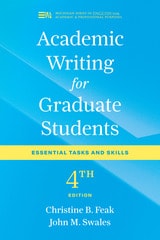
Academic Writing for Graduate Students
Essential Tasks and SkillsChristine B. Feak and John M. Swales
University of Michigan Press, 2027
For decades, Academic Writing for Graduate Students has introduced writers to the skills they need for successful academic writing. Now covering academic writing across an even broader range of disciplines, the new edition focuses on recurring rhetorical patterns found in academic texts and on the ways writers consider their audience, purpose, and disciplinary expectations as they make choices.
The book brings together short readings from published, student, and pedagogically-constructed texts with guided tasks to analyze how texts are organized and how claims are presented and supported. The first four units prepare students for academic writing while the following four units dive into genre-specific activities, such as the writing of summaries, critiques, and different research article sections. Throughout the book, readers will develop their rhetorical consciousness to see how strategic writing choices contribute to author positioning.
In Academic Writing for Graduate Students, 4th Edition, students will:
- Analyze real student writing for information flow, citation patterns, and authorial stance
- Learn to recognize different rhetorical patterns, such as cause and effect
- Engage with different types of writing, such as summaries, critiques, data commentary, book reviews, and research articles
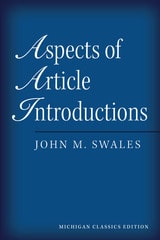
Aspects of Article Introductions, Michigan Classics Ed.
John M. Swales
University of Michigan Press, 2011
Aspects of Article Introductions has bee reissued to make it more easily available than it has ever been, particularly for the use of university libraries and for younger and newer practitioners and researchers in the rapidly expanding and increasingly global field of EAP.
The original Aspects of Article Introductions appeared in fall 1981 as a ring-bound 90-page monograph. The “publisher” was the Language Studies Unit at the University of Aston in Birmingham. Although essentially an “underground” work, it has remained a relevant part of the short intellectual history of English for Academic Purposes, particularly as genre-based or genre-driven approaches to EAP research and pedagogical practice have become more popular. Its longevity is also a testament to the genre analysis work of John Swales, but in addition, the research article has become the most influential genre in most areas of scholarship, and introductions are at least supposed to be read first and to be designed in such a way as to attract as large readership as possible.
“If I were asked to list the most influential texts in applied linguistics over the last 30 years, John Swales' Aspects of Article Introductions would be in the top three or four. This was a seminal work which not only presented a novel way of analysing texts and a commentary on academic discourse, but one which helped to establish a foundation for the massive interest we see today in describing the structure and features of academic articles. This is not just a text which offers us a glimpse of an intellectual history, but it remains full of fascinating insights and observations about texts and the workings of academic discourse. While the ideas may have evolved and the genre it describes moved on, both the style of writing and the methodology it describes are as fresh and as revealing as anything written on the topic since.” ---Ken Hyland, Hong Kong University
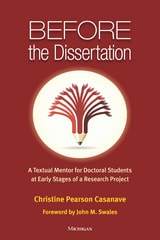
Before the Dissertation
A Textual Mentor for Doctoral Students at Early Stages of a Research ProjectChristine Pearson Casanave
University of Michigan Press, 2014
“This very readable book is what every graduate student needs as they start a program. I wish my own MA and PhD students, during my 40 years of supervising, could have been demystified by having Casanave's ‘textual mentor' as a companion."
--Merrill Swain, Professor Emerita, OISE, University of Toronto
“Before the Dissertation is an insightful, relevant, and accessible resource for doctoral students at any stage. Full of reflections and advice not found in other books, it serves as an indispensable guide for students and their supervisors. And the dispelling of myths is a superb idea!”
--Robert Kohls, PhD candidate, University of Toronto
Before the Dissertation speaks to an audience in the social sciences, but in particular to doctoral students who have experience with and interest in international, multilingual, as well as native English speaking students and settings and who wish to investigate topics in (second) language and multicultural-transcultural education. Athough appropriate for use in English-dominant doctoral programs throughout the world, the book will relate more closely to students in the North American educational system than to ones, for example, in the British system. The main audience for this book is thus doctoral students who are first or second/additional users of English, who are interested in pursuing topics in one of the social sciences, including education and multilingual inquiry, and who may just be finishing course work in an English-dominant university and are wondering what might happen next.
Commentary for Academic Writing for Graduate Students, 2d ed.
Essential Tasks and SkillsJohn M. Swales and Christine B. Feak
University of Michigan Press, 2004
Like its predecessor, this edition of Academic Writing for Graduate Students
"explains understanding the intended audience, the purpose of the paper, and academic genres.
"includes the use of task-based methodology, analytic group discussion, and genre consciousness-raising.
"shows how to write summaries and critiques.
"features "language focus" sections that address linguistic elements as they affect the wider rhetorical objectives.
"helps students position themselves as junior scholars in their academic communities.
Commentary for Academic Writing for Graduate Students, 3rd Ed.
Essential Tasks and SkillsJohn M. Swales & Christine B. Feak
University of Michigan Press, 2012
The Commentary for the third edition of this successful guide to writing has been revised and expanded in many ways to provide more support for instructors; this includes additional tasks for Units Two and Four to supplement the main text. However, the collegial tone established in previous Commentaries between Swales & Feak and instructors has been retained.
This volume contains commentaries on each of the eight units plus the two appendixes. The format for each unit includes
- a summary of the main points of the unit along with a list of topics covered.
- a synopsis of activities, divided into Language Focus sections and description of tasks.
- some general notes designed to capture the character of the unit, to indicate alternative activities, or to anticipate problems that may arise.
- detailed commentary and discussion of individual tasks, including model or sample answers where possible.
Commentary for Academic Writing for Graduate Students
Essential Tasks and SkillsChristine B. Feak and John M. Swales
University of Michigan Press, 2027
Now in its 4th edition, the Commentary for Academic Writing for Graduate Students remains an important companion text. Useful for instructors as well as students and scholars using Academic Writing for Graduate Students for self-study, the Commentary includes a synopsis of what each unit attempts to achieve, further discussion of certain points, and sample responses to the more controlled tasks. Many of the responses or model texts come directly from class discussion or from submitted homework, which students generously offered for inclusion. In response to numerous requests, the authors have expanded the number of teaching suggestions included at the end of each unit for this edition.
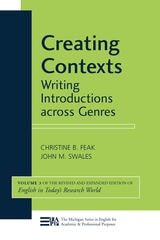
Creating Contexts
Writing Introductions across GenresChristine B. Feak & John M. Swales
University of Michigan Press, 2011
Research article introductions are central to Creating Contexts: Writing across Genres with the CaRS (creating a research space) model used as a starting point. This volume focuses on introductions for other kinds of texts that are also part of the graduate student writing experience such as course papers and critiques, proposals, and dissertations.
This volume represents a revision and expansion of the material on introductions that appeared in English in Today's Research World.
The material presented in this volume is appropriate for graduate students and others already working in their chosen academic fields. The material has, in fact, been used with each of these groups in both writing courses and writing workshops. We believe that the material would also be suitable for those wishing to pursue a course of self-study. To target these different possible uses, we have included a variety of topics and tasks that we hope will deepen users’ understanding of how to create a writing context for their work. Tasks range from evaluating text commentaries to open-ended questions and have been designed to generate lively classroom or workshop discussion as well as thoughtful consideration by an individual user.
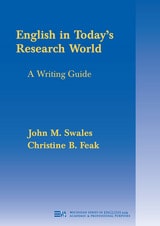
English in Today's Research World
A Writing GuideJohn M. Swales and Christine B. Feak
University of Michigan Press, 2000
In addition to instruction on writing for publication, English in Today's Research World provides needed advice on applications, recommendations, and requests--types of communications that are particularly vulnerable to influences from national cultural expectations and conventions and that, therefore, place the NNS writer at increased disadvantage.
The text is both a reference manual and a course book, so that researchers can continue to use the book after they have completed their formal education. New ESL/EFL teachers can use English in Today's Research World as a reference book for themselves or as a teaching aid in the classroom.
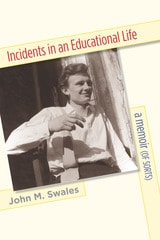
Incidents in an Educational Life
A Memoir (of Sorts)John M. Swales
University of Michigan Press, 2009
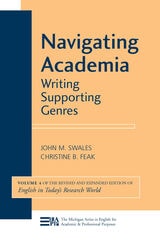
Navigating Academia
Writing Supporting GenresJohn M. Swales & Christine B. Feak
University of Michigan Press, 2011
Navigating Academia is a bit different from the other volumes in the series because it focuses on the supporting genres that facilitate the more public genres that form the building blocks of an academic and/or research career. Included are statements of purpose for graduate school applications, letters of recommendation, and responses to journal reviewers.
One feature that these genres have in common is that they are largely hidden from public view; it is difficult to find examples of them in university libraries. Although guidance about these genres can increasingly be found on the Internet, this guidance is often too general to be helpful in an individual particular situation. This is unfortunate because in almost all cases, the individual needs to be seen as both a serious scholar, researcher, or instructor (whether beginning or getting established) and as a collegial but objective person. As a result, many of these academic communications need to be carefully considered, particularly with regard to the likely effect this communication will have on its intended recipients, who, more often than not, are established figures in the field (as with a job application letter). Because of the roles of these genres, this volume also differs somewhat from the others in that it is as much concerned with social academic practice as it is with more formal academic texts.
This volume represents a revision and expansion of the material on academic correspondence that appeared in English in Today's Research World.
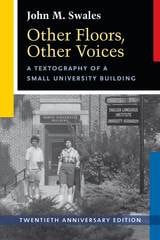
Other Floors, Other Voices, Twentieth Anniversary Edition
A Textography of a Small University BuildingJohn M. Swales
University of Michigan Press, 2018
Originally published in 1998, Other Floors, Other Voices uses texts to capture the lives of three communities operating within a single building (the North University Building, or NUBS) on the University of Michigan campus. Swales' thoughtful exploration of the three units—the Computer Resource Site, the University Herbarium (botany), and the English Language Institute—centers around the individuals who work on each floor and the discourse-related activities they engage in.
The Twentieth Anniversary Edition of Other Floors, Other Voices includes: a new preface, an introductory essay on the value of rereading this volume many years after publication, and an epilogue that reflects on and reveals what has happened to the three units in the past 20 years.
Telling a Research Story
Writing a Literature ReviewChristine B. Feak and John M. Swales
University of Michigan Press, 2009
Telling a Research Story: Writing a Literature Review is concerned with the writing of a literature review and is not designed to address any of the preliminary processes leading up to the actual writing of the literature review.
This volume represents a revision and expansion of the material on writing literature reviews that appeared in English in Today's Research World.
This volume progresses from general to specific issues in the writing of literature reviews. It opens with some orientations that raise awareness of the issues that surround the telling of a research story. Issues of structure and matters of language, style, and rhetoric are then discussed. Sections on metadiscourse, citation, and paraphrasing and summarizing are included.
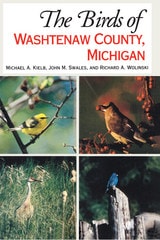
The Birds of Washtenaw County, Michigan
Michael A. Kielb, John M. Swales, and Richard A. Wolinski
University of Michigan Press, 1993
The Birds of Washtenaw County, Michigan provides a comprehensive account of the birdlife in Washtenaw County. Situated to the west of Detroit in southeast Michigan, the county has an exceptionally rich history of ornithological study, fueled by the activists of numerous amateur birdwatchers and by the interests of two major universities.
Frequency accounts of the 267 species recorded in the county during the last 15 years are framed by a discussion of the topographical history of the county. In addition, the authors present notes on another 30 species not seen in the county since 1976. A comprehensive site guide offers suggestions of the optimal locals and times to try to find the birds.
Michael A. Kielb has studied birds in Michigan for over 15 years and teaches classes on birds at the Matthaei Botanical Gardens in Ann Arbor and the College of Du Page in Illinois. He also leads bird-watching tours throughout the Americas and is currently a Research Associate in the Reproductive Sciences Program at the University of Michigan.
John M. Swales first became interested in birds while teaching in the Sudan and has been exploring the birdlife of Washtenaw County since arriving at the University of Michigan in 1985. He is Professor of Linguistics and Director of the English Language Institute, University of Michigan.
Richard A. Wolinski has been studying birds of Washtenaw County for nearly two decades. He is a staff biologist with an engineering firm in southeast Michigan.