Results by title
5 books match the query 'Symbolism (Art movement)'
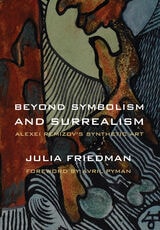
Beyond Symbolism and Surrealism
Alexei Remizov's Synthetic ArtJulia Friedman, Foreword by Avril Pyman
Northwestern University Press, 2011
The great modernist eccentric Alexei Remizov was a “writers’ writer” whose innovative poetic prose has long since entered the Russian literary canon. Gradually expanding his working methods to make drawing an integral part of the writing process, during the 1930s and 1940s, Remizov created hundreds of albums that combined texts with collages and india ink and watercolor illustrations. In Beyond Symbolism and Surrealism, Julia Friedman provides the first extensive examination of the dynamic interplay between text and image in Remizov’s albums, revealing their coequal roles in his oneiric and synaesthetic brand of storytelling. A participant in the Russian symbolist movement, an intellectual ally of many futurists, and during his émigré years, a collaborator of the surrealists, Remizov had unique insight into artistic cultures of the European avant-garde. His reinterpretation of the medieval illuminated manuscripts carries forward the traditions of symbolist mysticism and
This long-overdue examination of Remizov’s visual art addresses modernism’s key theoretical questions surrounding the relationships between image and text. Beyond Symbolism and Surrealism introduces a generous sampling of Remizov’s graphic work, much of which is currently held in private collections.

Decadent Style
John Robert Reed
Ohio University Press, 1985
In Decadent Style, John Reed defines “decadent art” broadly enough to encompass literature, music, and the visual arts and precisely enough to examine individual works in detail. Reed focuses on the essential characteristics of this style and distinguishes it from non–esthetic categories of “decadent artists” and “decadent themes.”
Like the natural sciences and psychology, the arts in the late nineteenth century reflect an interest in the process of atomization. Literature and the other arts mirror this interest by developing, or rather elaborating, existing forms to the point of what appears to be dissolution. Instead of these forms dissolving, however, they require their audience’s participation and thus involve a new order. Reed argues that this process of reordering characterizes decadent style, which depends upon sensory provocation resolvable only through negation and is therefore bounded by philosophical and emotional assumptions of inevitable frustration.
Drawing upon the literature, music, and visual arts of England and Europe at the end of the nineteenth century, Reed provides a widely ranging and authoritative overview of decadent style, which relates such artists as Huysmans, Wilde, D’Annunzio, Moreau, Bresdin, Klimt, Klinger, Wagner, and Strauss. He related decadent style to Pre–Raphaelite and Naturalist preoccupation with detail and to aesthetic and Symbolist fascination with sensibility and idealism. Ultimately, Reed argues, decadent style is a late stage of Romanticism, overshadowed by Symbolism but anticipating, in its attempt to yoke incompatibilities and to engender a new cerebral form, some of the main traits of Modernism.
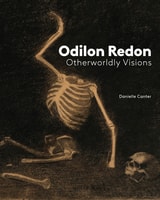
Odilon Redon
Otherworldly VisionsDanielle Canter
J. Paul Getty Trust, The, 2026
Enigmatic and haunting, the work of the French Symbolist Odilon Redon (1840–1916) intrigues and entrances all who encounter it. During the first half of his career, Redon created dramatically monochromatic charcoal drawings and lithographs, dreamily dark images that plumbed the depths of his wild imagination. Eventually, however, he also turned to pastels, adopting a bold colorful palette in fantastical explorations of the natural world.
Featuring more than seventy illustrations, this publication offers an overview of Redon's career. The informative, accessible essays examine his disparate influences from the worlds of religion, mythology, literature, and music, and demonstrate why Redon’s mysterious work is an important precursor to Surrealism.
This volume is published to accompany an exhibition on view at the J. Paul Getty Museum at the Getty Center from July 14 to October 18, 2026.

Passionate Discontent
Creativity, Gender, and French Symbolist ArtPatricia Mathews
University of Chicago Press, 2000
Art historian Patricia Mathews traverses the artistic, social, and scientific discourses of fin-de-siècle France in order to illuminate the Symbolist construction of a feminized aesthetic that nonetheless excluded female artists from its realm. Along the way, Mathews proffers important new readings of the art of such Symbolists as Gauguin, van Gogh and Moreau, as well as that of their female contemporaries Camille Claudel and Suzanne Valadon. Passionate Discontent is an important contribution to art historical and women's studies.
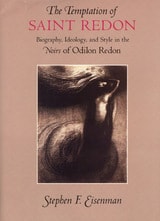
The Temptation of Saint Redon
Biography, Ideology, and Style in the Noirs of Odilon RedonStephen F. Eisenman
University of Chicago Press, 1992
Indeed, local tales and legends of witches, ghosts, one-eyed monsters, evil eyes, and wood fairies figure prominently in Redon's graphic works, which he called his noirs, or "blacks." After formal training at Bordeaux and Paris in the 1850s and 1860s, Redon began to chart his independent artistic course. Eisenman shows how, rejecting both naturalism and classicism, Redon, a prototypical Symbolist, found in grotesque and epic genres the expression of organic communities and precapitalist societies. He places Redon's desire for this imagined world of superstitious simplicity a desire manifest in his entire mature artistic practice in the context of contemporary avant-garde movements.
Redon's great noirs of the 1870s and 1880s, dreamlike configurations of seemingly irreconcilable elements from portraits, still lifes, and landscapes, show an increasingly subtle control of connotation and a complex indebtedness to caricature, allegory, and puns. Many of the noirs also visually interpret works by like-minded authors, including Baudelaire, Flaubert, Poe, and Mallarmé, one of Redon's close friends. Eisenman's analysis of the noirs underscores Redon's interest in creating an imaginative, even fantastic art, that could act directly on the human spirit. In addition to deepening our understanding of Redon and his art, The Temptation of Saint Redon exposes a link between place, politics, personal history, and the artistic imagination.