Results by title
7 books match the query 'T︠S︡vetaeva, Marina'
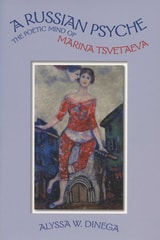
A Russian Psyche
The Poetic Mind of Marina TsvetaevaAlyssa W. Dinega
University of Wisconsin Press, 2001
Russian poet Marina Tsvetaeva’s powerful poetic voice and her tragic life have often prompted literary commentators to treat her as either a martyr or a monster. Born in Russia in 1892, she emigrated to Europe in 1922, returned to the Soviet Union at the height of the Stalinist Terror, and committed suicide in 1941. Alyssa Dinega focuses on the poetry, rediscovering Tsvetaeva as a serious thinker with a coherent artistic and philosophical vision.

Marina Tsvetaeva
The Double Beat of Heaven and HellLily Feiler
Duke University Press, 1994
Born to a family of Russian intelligentsia in 1892 and coming of age in the crucible of revolution and war, Tsvetaeva has been seen as a victim of her politicized time, her life and her work marked by exile, neglect, and persecution. This book is the first to show us the poet as she discovered her life through art, shaped as much by inner demons as by the political forces and harsh realities of her day. With remarkable psychological and literary subtlety, Lily Feiler traces these demons through the tragic drama of Tsvetaeva’s life and poetry. Hers is a story full of contradictions, resisting social and literary conventions but enmeshed in the politics and poetry of her time. Feiler depicts the poet in her complex relation to her contemporaries—Pasternak, Rilke, Mayakovsky, Mandelstam, and Akhmatova. She shows us a woman embodying the values of nineteenth-century romanticism, yet radical in her poetry, supremely independent in her art, but desperate for appreciation and love, simultaneously mother and child in her complicated sexual relationships with men and women.
From prerevolutionary Russia to Red Moscow, from pre-World War II Berlin, Prague, and Paris to the Soviet Union under Stalin, Feiler follows the tortuous drama of Tsvetaeva’s life and work to its last tragic act, exposing at each turn the passions that molded some of this century’s most powerful poetry.
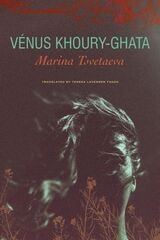
Marina Tsvetaeva
To Die in YelabugaVénus Khoury-Ghata
Seagull Books, 2022
The life of Marina Tsvetaeva (1892–1941) coincided with turbulent years in Russian history. She was an eminent Russian poet and a passionate lover involved with several men at the same time, including Rilke, who chose Lou Andreas-Salomé over her, and Pasternak, who married someone else, but protected her until her death. Her life included many trials such as her poverty during the grueling Russian civil war, her young daughter’s death from hunger in an orphanage, and the death of her husband, who fought against the Communist regime and was executed by the Soviet state. Rejected by official poets, then by the wealthy Russian diaspora in France, she finally returned to her country to end her wandering life. She hanged herself from a rope in an attic from which she could see the field where she had dug with bare hands for potatoes abandoned by local farmers. A poet-martyr of the Stalinist era—buried in an unmarked plot in the cemetery of Yelabuga—Tsvetaeva is brought to life in this poetic biographical novel by celebrated Lebanese author Vénus Khoury-Ghata.
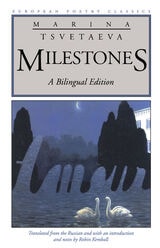
Milestones
A Bilingual EditionMarina Tsvetaeva, translated from the Russian by Robin Kemball
Northwestern University Press, 2003
Milestones lays out a sensual feast of moods, themes, styles, and rhythms—all the ingredients that would in time reveal Tsvetaeva as one of the most daring and original poets of her time.
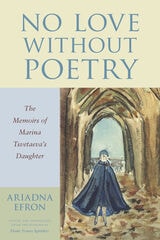
No Love Without Poetry
The Memoirs of Marina Tsvetaeva's DaughterAriadna Efron
Northwestern University Press, 2009
The memoirs of Ariadna Efron provide an intimate and indispensable perspective on the poet Marina Tsvetaeva’s life and work, told from the point of view of her daughter. This wrenching story about the difficulty of living with genius charts Efron’s relationship with her parents as they navigate art and exile.
Efron’s rapport with her mother, already intense, became strained under the hardships imposed by early twentieth century Russian political upheaval. Efron recounts the family’s travels from Moscow to Germany, to Czechoslovakia, and finally to France, where, against her mother’s advice, Efron decided to return to Russia. Diane Nemec Ignashev draws on Efron’s short stories and her mother’s notebooks to supplement the original memoirs. Haunting and poignant, No Love without Poetry completes extant historical records on Tsvetaeva—and showcases Efron as a literary force in her own right.
The Silk, the Shears and Marina; or, About Biography
Irena Vrkljan
Northwestern University Press, 1999
These are the first two volumes of the Croatian poet and novelist Irena Vrkljan's lyrical autobiography. Although each novel illuminates the other, they also stand alone as original and independent works of art. In The Silk, the Shears, Vrkljan traces the symbolic and moral significance of her life, and her vision of the fate of women in her mother's time and in her own. Marina continues the intense analysis of the poetic self, using the life of Marina Tsvetaeva to meditate on the processes behind biography.
Tsvetaeva's Orphic Journeys in the Worlds of the Word
Olga Peters Hasty
Northwestern University Press, 1996
Tsvetaeva’s Orphic Journeys in the Worlds of the Word explores the rich theme of the myth of Orpheus as master narrative for poetic inspiration and creative survival in the life and work of Marina Tsvetaeva. Olga Peters Hasty establishes the basic themes of the Orphic Complex—the poet’s longing to mediate between the embodied physical world and an “elsewhere,” the poet’s inability to do so, the primacy of the voice over the visual world, the insistence on concrete imagery, the costs of the poet’s gift—and orders her arguments in the tragic shape of the Orpheus myth as it worked itself out organically in Tsvetaeva’s own life. Hasty delineates the connections between the Orpheus myth and other key mythological and literary figures in the poet’s life—including Alexander Blok, Anna Akhmatova, Alexander Pushkin, and Rainer Maria Rilke—to make an important and original critical contribution.