Results by title
2 books match the query 'Taxicab drivers'

Hack
Stories from a Chicago CabDmitry Samarov
University of Chicago Press, 2011
Cabdrivers and their yellow taxis are as much a part of the cityscape as the high-rise buildings and the subway. We hail them without thought after a wearying day at the office or an exuberant night on the town. And, undoubtedly, taxi drivers have stories to tell—of farcical local politics, of colorful passengers, of changing neighborhoods and clandestine shortcuts. No one knows a city’s streets—and thus its heart—better than its cabdrivers. And from behind the wheel of his taxi, Dmitry Samarov has seen more of Chicago than most Chicagoans will hope to experience in a lifetime.
An artist and painter trained at the School of the Art Institute of Chicago, Samarov began driving a cab in 1993 to make ends meet, and he’s been working as a taxi driver ever since. In Hack: Stories from a Chicago Cab, he recounts tales that will delight, surprise, and sometimes shock the most seasoned urbanite. We follow Samarov through the rhythms of a typical week, as he waits hours at the garage to pick up a shift, ferries comically drunken passengers between bars, delivers prostitutes to their johns, and inadvertently observes drug deals. There are long waits with other cabbies at O’Hare, vivid portraits of street corners and their regular denizens, amorous Cubs fans celebrating after a game at Wrigley Field, and customers who are pleasantly surprised that Samarov is white—and tell him so. Throughout, Samarov’s own drawings—of his fares, of the taxi garage, and of a variety of Chicago street scenes—accompany his stories. In the grand tradition of Nelson Algren, Saul Bellow, Mike Royko, and Studs Terkel, Dmitry Samarov has rendered an entertaining, poignant, and unforgettable vision of Chicago and its people.
An artist and painter trained at the School of the Art Institute of Chicago, Samarov began driving a cab in 1993 to make ends meet, and he’s been working as a taxi driver ever since. In Hack: Stories from a Chicago Cab, he recounts tales that will delight, surprise, and sometimes shock the most seasoned urbanite. We follow Samarov through the rhythms of a typical week, as he waits hours at the garage to pick up a shift, ferries comically drunken passengers between bars, delivers prostitutes to their johns, and inadvertently observes drug deals. There are long waits with other cabbies at O’Hare, vivid portraits of street corners and their regular denizens, amorous Cubs fans celebrating after a game at Wrigley Field, and customers who are pleasantly surprised that Samarov is white—and tell him so. Throughout, Samarov’s own drawings—of his fares, of the taxi garage, and of a variety of Chicago street scenes—accompany his stories. In the grand tradition of Nelson Algren, Saul Bellow, Mike Royko, and Studs Terkel, Dmitry Samarov has rendered an entertaining, poignant, and unforgettable vision of Chicago and its people.
[more]
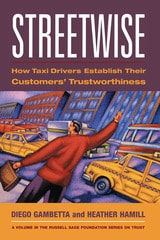
Streetwise
How Taxi Drivers Establish Customer's TrustworthinessDiego Gambetta
Russell Sage Foundation, 2005
A taxi driver's life is dangerous work. Picking up a bad customer can leave the driver in a vulnerable position, and erring even once can prove fatal. To protect themselves, taxi drivers must quickly and accurately assess the trustworthiness of complete strangers. In Streetwise, Diego Gambetta and Heather Hamill take this predicament as a prototypical example of many trust decisions, where people must act on limited information and judge another person's trustworthiness based on signs that may or may not be honest indicators of that person's character or intent. Gambetta and Hamill analyze the behavior of cabbies in two cities where driving a taxi is especially perilous: New York City, where drivers have been the targets of frequent and violent robberies, and Belfast, Northern Ireland, a divided metropolis where drivers have been swept up in the region's sectarian violence. Based on in-depth ethnographic research, Streetwise lets drivers describe in their own words how they seek to determine the threat posed by each potential passenger. The drivers' decisions about whom to trust are treated in conjunction with the "sign-management" strategies of their prospective passengers—both genuine passengers who try to persuade drivers of their trustworthiness and the villains who mimic them. As the theory that guides this research suggests, drivers look for signs that correlate closely with trustworthiness but are difficult for an impostor to mimic. A smile, a business suit, or a skullcap alone do not reassure drivers, as any criminal could easily wear them. Only if attached to other signs—a middle-aged woman, a business address, or a synagogue—are they persuasive. Drivers are adept at deciphering deceitful signals, but trickery is occasionally undetectable, so they must adopt defensive strategies to minimize their exposure to harm. In Belfast, where drivers are locals and often have histories of paramilitary involvement, "macho" posturing often serves to deter would-be criminals, while New York cabbies, mostly immigrants who view themselves as outsiders, try simply to minimize the damage from attacks by appeasing robbers and carrying only small amounts of cash. For most people, erring in a trust decision leads to a broken heart or a few dollars lost. For cab drivers, such an error could mean losing their lives. The way drivers negotiate these high stakes offers us vivid insight into how to determine another person's trustworthiness. Written with clarity and color, Streetwise invites the reader to ride shotgun with cabbies as they grapple with a question of relevance to us all: which signs of trustworthiness can we really trust? A Volume in the Russell Sage Foundation Series on Trust
[more]