Results by title
11 books match the query 'Teaching Writing'
First Semester
Graduate Students, Teaching Writing, and the Challenge of Middle GroundJessica Restaino
Southern Illinois University Press, 2012
Jessica Restaino offers a snapshot of the first semester experiences of graduate student writing teachers as they navigate predetermined course syllabi and materials, the pressures of grading, the influences of foundational scholarship, and their own classroom authority. With rich qualitative data gathered from course observations, interviews, and correspondence, Restaino traces four graduate students’ first experiences as teachers at a large, public university. Yet the circumstances and situations she relates will ring familiar at widely varying institutions.
First Semester: Graduate Students, Teaching Writing, and the Challenge of Middle Ground presents a fresh and challenging theoretical approach to understanding and improving the preparation of graduate students for the writing classroom. Restaino uses a three-part theoretical construct—labor, action, and work, as defined in Hannah Arendt’s work of political philosophy, The Human Condition—as a lens for reading graduate students’ struggles to balance their new responsibilities as teachers with their concurrent roles as students. Arendt’s concepts serve as access points for analysis, raising important questions about graduate student writing teachers’ first classrooms and uncovering opportunities for improved support and preparation by university writing programs.
Lazy Virtues
Teaching Writing in the Age of WikipediaRobert E. Cummings
Vanderbilt University Press, 2008
Focusing largely on the controversial website Wikipedia, the author explores the challenges confronting teachers of college writing in the increasingly electronic and networked writing environments their students use every day. Rather than praising or condemning that site for its role as an encyclopedia, Cummings instead sees it as a site for online collaboration between writers and a way to garner audience for student writing.
Applying an understanding of Commons-Based Peer Production theory, as developed by Yochai Benkler, this text is arranged around the following propositions:
-- Commons-Based Peer Production is a novel economic phenomenon which informs our current teaching model and describes a method for making sense of future electronic developments.
-- College writers are motivated to do their best work when they write for an authentic audience, external to the class.
-- Writing for a networked knowledge community invites students to participate in making knowledge, rather than only consuming it.
-- A plan for integrating networked writing for an external audience helps students understand the transition from high school to college writing.
-- Allowing students to review and self-select points of entry into electronic discourse fosters "laziness," or a new work dynamic where writers seek to better understand their own creativity in terms of a project's demands.
Lazy Virtues offers networked writing assignments to foster development of student writers by exposing them to the demands of professional audiences, asking them to identify and assess their own creative impulses in terms of a project's needs, and removing the writing teacher from the role of sole audience.
Nowhere Near the Line
Pain and Possibility in Teaching and WritingElizabeth H. Boquet
Utah State University Press, 2016
In this short work, Elizabeth Boquet explores the line Lawrence Schall describes above, tracing the overlaps and intersections of a lifelong education around guns and violence, as a student, a teacher, a feminist, a daughter, a wife, a citizen and across the dislocations and relocations that are part of a life lived in and around school. Weaving narratives of family, the university classroom and administration, her husband’s work as a police officer, and her work with students and the Poetry for Peace effort that her writing center sponsors in the local schools, she recounts her efforts to respond to moments of violence with a pedagogy of peace. “Can we not acknowledge that our experiences with pain anywhere should render us more, not less, capable of responding to it everywhere?” she asks. “Compassion, it seems to me, is an infinitely renewable resource.”
Originality, Imitation, and Plagiarism
Teaching Writing in the Digital AgeCaroline Eisner and Martha Vicinus, Editors
University of Michigan Press, 2008
"At long last, a discussion of plagiarism that doesn't stop at 'Don't do it or else,' but does full justice to the intellectual interest of the topic!"
---Gerald Graff, author of Clueless in Academe and 2008 President, Modern Language Association
This collection is a timely intervention in national debates about what constitutes original or plagiarized writing in the digital age. Somewhat ironically, the Internet makes it both easier to copy and easier to detect copying. The essays in this volume explore the complex issues of originality, imitation, and plagiarism, particularly as they concern students, scholars, professional writers, and readers, while also addressing a range of related issues, including copyright conventions and the ownership of original work, the appropriate dissemination of innovative ideas, and the authority and role of the writer/author. Throughout these essays, the contributors grapple with their desire to encourage and maintain free access to copyrighted material for noncommercial purposes while also respecting the reasonable desires of authors to maintain control over their own work.
Both novice and experienced teachers of writing will learn from the contributors' practical suggestions about how to fashion unique assignments, teach about proper attribution, and increase students' involvement in their own writing. This is an anthology for anyone interested in how scholars and students can navigate the sea of intellectual information that characterizes the digital/information age.
"Eisner and Vicinus have put together an impressive cast of contributors who cut through the war on plagiarism to examine key specificities that often get blurred by the rhetoric of slogans. It will be required reading not only for those concerned with plagiarism, but for the many more who think about what it means to be an author, a student, a scientist, or anyone who negotiates and renegotiates the meaning of originality and imitation in collaborative and information-intensive settings."
---Mario Biagioli, Professor of the History of Science, Harvard University, and coeditor of Scientific Authorship: Credit and Intellectual Property in Science
"This is an important collection that addresses issues of great significance to teachers, to students, and to scholars across several disciplines. . . . These essays tackle their topics head-on in ways that are both accessible and provocative."
---Andrea Lunsford, Louise Hewlett Nixon Professor of English, Claude and Louise Rosenberg Jr. Fellow, and Director of the Program in Writing and Rhetoric at Stanford University and coauthor of Singular Texts/Plural Authors: Perspectives on Collaborative Writing
digitalculturebooks is an imprint of the University of Michigan Press and the Scholarly Publishing Office of the University of Michigan Library dedicated to publishing innovative and accessible work exploring new media and their impact on society, culture, and scholarly communication. Visit the website at www.digitalculture.org.
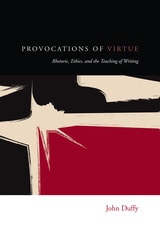
Provocations of Virtue
Rhetoric, Ethics, and the Teaching of WritingJohn Duffy
Utah State University Press, 2018
Drawing upon Aristotle’s Nicomachean Ethics and the branch of philosophical inquiry known as “virtue ethics,” Provocations of Virtue calls for the reclamation of “rhetorical virtues” as a core function in the writing classroom. Duffy considers what these virtues actually are, how they might be taught, and whether they can prepare students to begin repairing the broken state of public argument. In the discourse of the virtues, teachers and scholars of writing are offered a common language and a shared narrative—a story that speaks to the inherent purpose of the writing class and to what is at stake in teaching writing in the twenty-first century.
This book is a timely and historically significant contribution to the field and will be of major interest to scholars and administrators in writing studies, rhetoric, composition, and linguistics as well as philosophers and those exploring ethics.
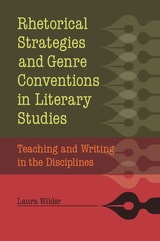
Rhetorical Strategies and Genre Conventions in Literary Studies
Teaching and Writing in the DisciplinesLaura Wilder
Southern Illinois University Press, 2012
Laura Wilder fills a gap in the scholarship on writing in the disciplines and writing across the curriculum with this thorough study of the intersections between scholarly literary criticism and undergraduate writing in introductory literature courses. Rhetorical Strategies and Genre Conventions in Literary Studies is the first examination of rhetorical practice in the research and teaching of literary study and a detailed assessment of the ethics and efficacy of explicit instruction in the rhetorical strategies and genre conventions of the discipline.
Using rhetorical analysis, ethnographic observation, and individual interviews, Wilder demonstrates how rhetorical conventions play a central, although largely tacit, role in the teaching of literature and the evaluation of student writing. Wilder follows a group of literature majors and details their experiences. Some students received experimental, explicit instruction in the special topoi, while others received more traditional, implicit instruction.
Arguing explicit instruction in disciplinary conventions has the potential to help underprepared students, Wilder explores how this kind of instruction may be incorporated into literature courses without being overly reductive. Taking into consideration student perspectives, Wilder makes a bold case for expanding the focus of research in writing in the disciplines and writing across the curriculum in order to grasp the full complexity of disciplinary discourse.
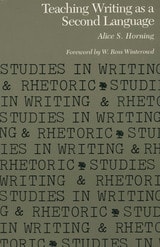
Teaching Writing as a Second Language
Alice S. Horning. Foreword by W. Ross Winterowd
Southern Illinois University Press, 1986
Classrooms filled with glassy-eyed students provide an experiential base for Alice S. Horning’s new comprehensive theory about basic writers.
Horning explores the theory of writing acquisition in detail. Her examination of spoken and written language and redundancy give a theoretical base to her argument that academic discourse is a separate linguistic system characterized by particular psycholinguistic features. She proposes that basic writers learn to write as other learners master a second language because for them, academic written English is a whole new language.
She explores the many connections to be found in second language acquisition research to the teaching and learning of writing and gives special attention to the interlanguage hypothesis, pidginization theory, and the Monitor theory. She also addresses the role of affective factors (feelings, attitudes, emotions, and motivation) in the success or failure of writing students.
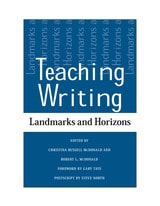
Teaching Writing
Landmarks and HorizonsEdited by Christina Russell McDonald and Robert L. McDonald. Foreword by Gary Tate. Postscript by Steve North
Southern Illinois University Press, 2002
Teaching Writing: Landmarks and Horizons, edited by Christina Russell McDonald and Robert L. McDonald, is designed to present an overview of some of the major developments in the establishment of composition studies as a field during the past thirty-five years. The essays are theoretically grounded but are focused on pedagogy as well. Divided into two parts, the first presents nine landmark essays, selected and introduced by distinguished composition scholars, and the second brings together eight new essays by emerging scholars.
Teaching/Writing in Thirdspaces
The Studio ApproachRhonda C. Grego and Nancy S. Thompson
Southern Illinois University Press, 2007
Teaching/Writing in Thirdspaces: The Studio Approach examines a dynamic approach to teaching composition that reimagines not only the physical space in which writing and learning occurs but also the place occupied by composition in the power structure of universities and colleges.
In response to financial and programmatic cutbacks at the University of South Carolina in the 1990s, authors Rhonda C. Grego and Nancy S. Thompson used their academic backgrounds in composition and English education, along with their personal histories in working-class families, to look at compositional spaces and places with an eye to challenging the embedded issues of race, class, and gender within the university hierarchies. The result was a supplemental writing program that they called the writing studio.
The studio model emphasizes individual participation in a small group that allows students to present work they are preparing for outside classes, discuss their challenges, and refine their ideas with other students and staff facilitators. This “interactional inquiry” is replicated and reinforced by the facilitators, who meet in their own small groups to analyze larger patterns, possibilities, and needs as they arise in their studios.
Grego and Thompson argue that because the studio is physically and institutionally “outside but alongside” both students’ other coursework and the hierarchy of the institution, it represents a “thirdspace,” a unique position in which to effect institutional change. The focus on interactional inquiry challenges traditional power hierarchies within classrooms and shifts the nature of discourse. As a bottom-up approach to the development of educational programs within institutions that have different needs, demographies, and histories, the studio model can address a multitude of different institutional needs with little disruption to the curriculum.
The studio model allows university administrators, teachers, student aides, and students to continually adapt to changing institutional environments with new teaching and learning strategies. Teaching/Writing in Thirdspaces provides an alternative approach to traditional basic writing courses that can be adopted in educational institutions of all types and at all levels.
Translingual Dispositions
The Affordances of Globalized Approaches to the Teaching of WritingAllana Frost
University Press of Colorado, 2020
Work of Teaching Writing
Learning from Fiction, Film, and DramaJoseph Harris
Utah State University Press, 2020
Each chapter examines a fictional representation of writing classes—as portrayed in Dead Poets Society, Up the Down Staircase, Educating Rita, Push, and more—and shifts the conversation from how these works portray teachers to how they dramatize the actual work of teaching. Harris considers scenes of instruction from different stages of the writing process and depictions of students and teachers at work together to highlight the everyday aspects of teaching writing.
In the writing classroom the ideas of teachers come to life in the work of their students. The Work of Teaching Writing shows what fiction, film, and drama can convey about the moment of exchange between teacher and student as they work together to create new insights into writing. It will interest both high school and undergraduate English teachers, as well as graduate students and scholars in composition and rhetoric, literary studies, and film studies.