Results by title
7 books match the query 'Teachings'
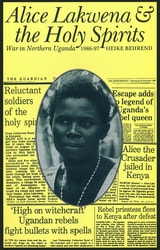
Alice Lakwena and the Holy Spirits
War in Northern Uganda, 1985–97Heike Behrend
Ohio University Press, 1999
In August 1986, Alice Auma, a young Acholi woman in northern Uganda, proclaiming herself under the orders of a Christian spirit named Lakwena, raised an army called the “Holy Spirit Mobile Forces.” With it she waged a war against perceived evil, not only an external enemy represented by the National Resistance Army of the government, but internal enemies in the form of “impure” soldiers, witches, and sorcerers. She came very close to her goal of overthrowing the government but was defeated and fled to Kenya.
This book provides a unique view of Alice’s movement, based on interviews with its members and including their own writings, examining their perceptions of the threat of external and internal evil. It concludes with an account of the successor movements into which Alice’s forces fragmented and which still are active in the civil wars of the Sudan and Uganda.
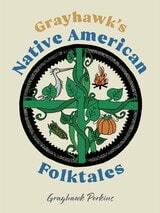
Grayhawk's Native American Folktales
Grayhawk Perkins
University of Alabama Press, 2025
Beloved Houma/Choctaw storyteller Grayhawk Perkins shares age-old wisdom in an unforgettable collection of folktales.
Grayhawk’s Native American Folktales is the eagerly awaited collection of stories by Grayhawk Perkins, a noted Houma storyteller from Louisiana. Drawing on traditional Indigenous tales, Grayhawk transforms these narratives into stories that captivate contemporary readers and audiences.
The collection features universal animal characters such as Deer, Rabbit, Bobcat, Turtle, and Snake that embody a variety of traits. Their adventures and challenges in the natural world reveal human behavior and lessons about how to treat others. Creation stories explain how the world and its inhabitants came to be, including the diligent Crawfish, the origin of skunk stripes, and why opossums are white. Although written for children ages 7 to 12 and their families, all will be charmed by Grayhawk’s contributions to Indigenous literature.
Held in Memory, Shared in Story
Teachings of the Middle KuskokwimAnn Fienup-Riordan
University of Alaska Press, 2026
Along the winding banks of the Middle Kuskokwim River, stories live in the languages of the land. Shared from our Elders, around kitchen tables on long winter nights and beside summer campfires, these teachings carry the wisdom of the people who have called this place home for generations. Held in Memory, Shared in Story gathers these voices into a collection, a record of resilience and the deep relationship we share with world around us. This book captures the knowledge, shared in writing and orally, of our region and celebrates the storytellers, the listeners, and all who keep these traditions alive. To read these stories is to walk beside the people of the Middle Kuskokwim, to see through their eyes, to hear their laughter, and to understand that the heart of a culture lives in the stories shared across generations.
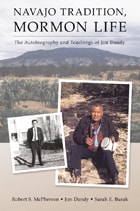
Navajo Tradition, Mormon Life
The Autobiography and Teachings of Jim DandyRobert S. McPherson
University of Utah Press, 2012
Born in the early 1940s in northern Arizona’s high country desert, Jim Dandy began life imbued with the traditions of the Navajo people. Raised by his father and grandfather—both medicine men—and a grandmother steeped in Navajo practices, he embraced their teachings and followed in their footsteps. But attending the LDS Placement program in northern Utah changed his life’s course when he became a member of the Mormon Church. Following graduation from high school, Jim served an LDS mission among his people, obtained a bachelor’s degree, and entered the work force in southeastern Utah as a career counselor, teacher, and community advocate who improved educational opportunities on the Navajo Reservation.
Jim has led a life of service and teaching. He maintains the traditional philosophy with which he was raised and the Mormon beliefs that he learned and continues to follow; his life reflects the values inherent in these two different worlds. Readers interested in Navajo philosophy will find his blend of these two distinct views fascinating, while others will better understand the effects of the controversial placement program on the life of one individual. However, this is primarily the warm story of a man’s life among his people and his love for them and their culture.
The Experiment of Faith
Pope Benedict XVI on Living the Theological Virtues in a Secular AgeCatholic University of America Press, 2020
The Philosophy of Jesus
Peter Kreeft
St. Augustine's Press, 2007
Amazingly, no one ever seems to have looked at Jesus as a philosopher, or his teaching as philosophy. Yet no one in history has ever had a more radically new philosophy, or made more of a difference to philosophy, than Jesus. He divided all human history into two, into "B.C." and "A.D."; and the history of philosophy is crucial to human history, since philosophy is crucial to man; so how could He not also divide philosophy?
This book (1) looks at Jesus as a complete human being (as well as divine), therefore also as a philosopher; (2) looks at philosophy as Jesus' pre-modern contemporaries did, as a wisdom, a world-view, and a way of life rather than as a super-science (Descartes, Hegel) or as a servant-science (Hobbes, Hume); and (3) looks at philosophy in light of Jesus rather than at Jesus in light of philosophy. It explores the consequences of Etienne Gilson's point that when St. John brought Christianity and Greek philosophy into contact and identified the Messiah the Jews had most deeply sought with the logos that the Greeks had most deeply sought, nothing happened to Christ but something happened to the logos.
This book explores the most radical revolution in the history of philosophy, the differences Jesus made to metaphysics (the philosophy of being), to epistemology (the philosophy of knowing), to anthropology (the philosophy of man), and to philosophical ethics and politics.
And, besides, it has the greatest ending of any philosophy book in a century.
Unity in Christ
Bishops, Synodality, and CommunionArchbishop Anthony Fisher, OP
Catholic University of America Press, 2023