Results by title

11 books match the query 'Telecommunication systems'
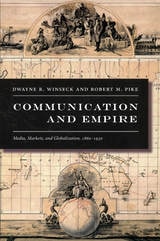
cover of Communication and Empire: Media, Markets, and Globalization, 1860-1930

Communication and Empire

Media, Markets, and Globalization, 1860-1930

Dwayne R. Winseck and Robert M. Pike

Duke University Press, 2007

Filling in a key chapter in communications history, Dwayne R. Winseck and Robert M. Pike offer an in-depth examination of the rise of the “global media” between 1860 and 1930. They analyze the connections between the development of a global communication infrastructure, the creation of national telegraph and wireless systems, and news agencies and the content they provided. Conventional histories suggest that the growth of global communications correlated with imperial expansion: an increasing number of cables were laid as colonial powers competed for control of resources. Winseck and Pike argue that the role of the imperial contest, while significant, has been exaggerated. They emphasize how much of the global media system was in place before the high tide of imperialism in the early twentieth century, and they point to other factors that drove the proliferation of global media links, including economic booms and busts, initial steps toward multilateralism and international law, and the formation of corporate cartels.

Drawing on extensive research in corporate and government archives, Winseck and Pike illuminate the actions of companies and cartels during the late nineteenth century and early twentieth, in many different parts of the globe, including Africa, Asia, and Central and South America as well as Europe and North America. The complex history they relate shows how cable companies exploited or transcended national policies in the creation of the global cable network, how private corporations and government agencies interacted, and how individual reformers fought to eliminate cartels and harmonize the regulation of world communications. In Communication and Empire, the multinational conglomerates, regulations, and the politics of imperialism and anti-imperialism as well as the cries for reform of the late nineteenth century and early twentieth emerge as the obvious forerunners of today’s global media.

[more]
cover of Intelligent Networks: Principles and applications

Intelligent Networks

Principles and applications

John Anderson

The Institution of Engineering and Technology, 2002

This book explains how intelligence can be introduced into digital telephone networks. Beginning by outlining the basic principles of Intelligent Networks (IN), it tracks the application of the IN principle of separation of the service logic for advanced telephony services from the underlying call control infrastructures. The book explains how large public networks are updated to incorporate IN principles for advanced telephony services. This is illustrated using many practical examples which are set against a background of following the ETSI standards within the overall ITU-T framework of recommendations. This book is targeted at postgraduate telecommunications students, or engineers requiring a concise and practical introduction to IN.
[more]
cover of Key Enablers for User-Centric Advertising Across Next Generation Networks

Key Enablers for User-Centric Advertising Across Next Generation Networks

Jose Simoes

The Institution of Engineering and Technology, 2012

Telecommunication and internet services are constantly subject to change, seeking the customer's full satisfaction. Enriching these services with innovative approaches such as contextaware, social, mobile, adaptable and interactive mechanisms, enables users to experience a variety of personalized services seamlessly across different platforms and technologies. In this sense, advertising is no exception, especially if we consider that it will become the business enabler for next generation services. Nevertheless, currently there is no cross-domain solution capable of delivering real-time advertising across heterogeneous environments or domains, and at the same time, address user needs, desires and intentions. This is because most of the products available today are only used within isolated environments / silos. Therefore, managing advertising campaigns across different verticals is still very complex. However, leveraging on the advances provided by Next Generation Networks, together with the design principles inherent to Service Oriented Architectures and capabilities offered by Service Delivery Platforms, this scenario is about to change. Based on key conceptual entities called enablers, this work aims to change the current scenario. More concretely, this book introduces three distinct but complementary enablers. The Human Enabler provides a real-time context brokerage system capable of securely managing different types of user-related data in a standardized way. The Reasoning Enabler is the result of a welldefined methodology that enables new knowledge to be reasoned, based on previously stored data, by aggregating, correlating and inferring new information about people and their contexts. Lastly, the Session Management Enabler is responsible for abstracting the communication layers. It provides a context-aware multimedia delivery system capable of personalizing and adapting multimedia content according to a set of user and system pre-defined context data or rules, respectively. Altogether, they form the Converged User-Centric Advertising System and introduce new features that address the needs of both users and advertisers.
[more]
cover of Lightning-Induced Effects in Electrical and Telecommunication Systems

Lightning-Induced Effects in Electrical and Telecommunication Systems

Yoshihiro Baba

The Institution of Engineering and Technology, 2021

Power and telecommunications systems are growing increasingly complex. This increases their vulnerability to lightning-related effects.
[more]
cover of Loving Little Egypt: A Novel

Loving Little Egypt

A Novel

Thomas McMahon

University of Chicago Press, 1986

In the early 1920s, nearly blind physics prodigy Mourly Vold finds out how to tap into the nation's long distance telephone lines. With the help of Alexander Graham Bell, Vold tries to warn the phone companies that would-be saboteurs could do the same thing, but they ignore him. Unfortunately, his taps do catch the notice of William Randolph Hearst, who hires Thomas Edison to get to the bottom of them—and the chase is on!
[more]
cover of Principles of Performance Engineering for Telecommunication and Information Systems

Principles of Performance Engineering for Telecommunication and Information Systems

M. Ghanbari

The Institution of Engineering and Technology, 1997
The term 'teletraffic engineering' has been used since the early days of the century to describe the design of switched telecommunications networks in terms of probabilities. More recent advances in queuing theory, and the growing realisation that the basic techniques can be applied to many other aspects of system design, has led to an extension of the subject and to the term 'performance engineering'.
[more]
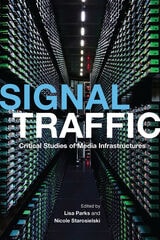
cover of Signal Traffic: Critical Studies of Media Infrastructures

Signal Traffic

Critical Studies of Media Infrastructures

Edited by Lisa Parks and Nicole Starosielski

University of Illinois Press, 2015

The contributors to Signal Traffic investigate how the material artifacts of media infrastructure--transoceanic cables, mobile telephone towers, Internet data centers, and the like--intersect with everyday life. Essayists confront the multiple and hybrid forms networks take, the different ways networks are imagined and engaged with by publics around the world, their local effects, and what human beings experience when a network fails.

Some contributors explore the physical objects and industrial relations that make up an infrastructure. Others venture into the marginalized communities orphaned from the knowledge economies, technological literacies, and epistemological questions linked to infrastructural formation and use. The wide-ranging insights delineate the oft-ignored contrasts between industrialized and developing regions, rich and poor areas, and urban and rural settings, bringing technological differences into focus.

Contributors include Charles R. Acland, Paul Dourish, Sarah Harris, Jennifer Holt and Patrick Vonderau, Shannon Mattern, Toby Miller, Lisa Parks, Christian Sandvig, Nicole Starosielski, Jonathan Sterne, and Helga Tawil-Souri.

[more]
cover of Telecommunication Networks

Telecommunication Networks

J.E. Flood

The Institution of Engineering and Technology, 1997
Telecommunications is vital to modern life, and the global telecommunication network that has developed is an essential part of the infrastructure of society. Although there is an extensive literature on many aspects of telecommunication technology, comparatively little has been published on the functioning and planning of complete telecommunication networks. The first edition of this book was intended to help fill that gap and this new edition has been thoroughly revised and includes much new material.
[more]
cover of Telecommunications Network Modelling, Planning and Design

Telecommunications Network Modelling, Planning and Design

Sharon Evans

The Institution of Engineering and Technology, 2003
Telecommunications Network Modelling, Planning and Design addresses sophisticated modelling techniques from the perspective of the communications industry and covers some of the major issues facing telecommunications network engineers and managers today. Topics covered include network planning for transmission systems, modelling of SDH transport network structures and telecommunications network design and performance modelling, as well as network costs, ROI modelling and QoS in 3G networks. This practical book will prove a valuable resource to network engineers and managers working in today's competitive telecommunications environment.
[more]
cover of Understanding Telecommunications Networks

Understanding Telecommunications Networks

Andy Valdar

The Institution of Engineering and Technology, 2006

This book explains how telecommunications networks work. It uses straightforward language supported by copious block-schematic diagrams so that non-engineers and engineers alike can learn about the principles of fixed and mobile telecommunications networks carrying voice and data. The book covers all aspects of today's networks, including how they are planned, formed and operated, plus next generation networks and how they will be implemented.
[more]
cover of Understanding Telecommunications Networks

Understanding Telecommunications Networks

Andy Valdar

The Institution of Engineering and Technology, 2017

A telecommunications network is an electronic system of links, nodes and the controls that govern their operations to allow voice and data transfer among users and devices. Examples of telecommunications networks are the telephone networks, computer networks and the Internet. Understanding Telecommunications Networks provides a comprehensive explanation of how various systems and technologies link together to construct fixed and mobile telecommunications networks and provide services. It uses straightforward language supported by block-schematic diagrams so that non-engineers and engineers alike can learn about the principles.
[more]