Results by title
51 books match the query 'Television programs' and 2 start with a

A Thousand Screenplays
The French Imagination in a Time of CrisisSabine Chalvon-Demersay
University of Chicago Press, 1999
In 1991, French public television held an amateur screenwriting contest. When Sabine Chalvon-Demersay, a French sociologist, examined the roughly 1,000 entries, she had hoped to analyze their differences. What she found, however, surprised her. Although the entrants covered nearly every social demographic, their screenplays presented similar characters in similar situations confronting similar problems.
The time of crisis presented by the amateur writers was not one of war, famine, or disease—it was the millennial dilemma of representation. In a world plagued by alienation, individualization, and a lack of mobility, how can members of a society combat their declining senses of self?
Although the contestants wrote about life in France, their concerns and struggles have a distinctly universal ring. A lucid, witty writer, Chalvon-Demersay offers a clear, if still developing, photograph of the contemporary imagination.
[more]
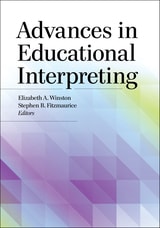
Advances in Educational Interpreting
Elizabeth A. Winston
Gallaudet University Press, 2021
In this follow up to Educational Interpreting: How It Can Succeed, published in 2004, Elizabeth A. Winston and Stephen B. Fitzmaurice present research about the current state of educational interpreting in both K-12 and post-secondary settings. This volume brings together experts in the field, including Deaf and hearing educational interpreters, interpreter researchers, interpreter educators, and Deaf consumers of educational interpreting services. The contributors explore impacts and potential outcomes for students placed in interpreted education settings, and address such topics as interpreter skills, cultural needs, and emergent signers.
Winston and Fitzmaurice argue massive systemic paradigm shifts in interpreted educations are as needed now as they were when the first volume was published, and that these changes require the collaborative efforts of everyone on the educational team, including: administrators, general education teachers, teachers of the deaf, interpreters, and counselors. The contributors to this volume address research-based challenges and make recommendations for how interpreting practitioners, and all members of the educational team, can enact meaningful changes in their work towards becoming part of a more comprehensive solution to deaf education.
Winston and Fitzmaurice argue massive systemic paradigm shifts in interpreted educations are as needed now as they were when the first volume was published, and that these changes require the collaborative efforts of everyone on the educational team, including: administrators, general education teachers, teachers of the deaf, interpreters, and counselors. The contributors to this volume address research-based challenges and make recommendations for how interpreting practitioners, and all members of the educational team, can enact meaningful changes in their work towards becoming part of a more comprehensive solution to deaf education.
[more]